In October, Premier Jacinta Allan visited the Baw Baw Shire to announce Noojee’s participation in the Healthy Forest Plans Pilot project.
Following an end of native timber harvesting in Victoria, the state’s forests will be reimagined to meet community expectations. Support for regional economies, better forest management and community access to forests, are all a priority for the state government. The aim from the state government is to keep forests open, healthy and ready to explore.
Premier Allan said that “our forests remain open to every single Victorian and visitor alike – to enjoy hunting, fishing, camping, bushwalking and all the benefits of the bush.
“My focus is to bring more families to the bush and more jobs to the regions – and that’s exactly what our plan for Victoria’s great outdoors will do,” she said.
The $4 million investment into Noojee will also support the transition away from native timber harvesting, and also for the implementation of new strategies to support the area.
“By ending large-scale native timber harvesting, we’ve given our forests a future. Now we’re making sure every Victorian can share in it,” said Minister for Environment Steve Dimopoulos.
Ten other towns in Victoria are seeing similar investments. The funding boost for Noojee is part of the government’s plan for Victoria’s great outdoors and will see them invest $30 million to unlock 1.8 million hectares of state forests in Gippsland and North East Victoria, with better tracks and trails, and amenities to boost regional tourism.
The Great Outdoors Taskforce has been consulting with communities and determining the best future use of Victoria’s forests. From here, three local working groups will be established to inform the direction of Noojee: the Eco Tourism Working Group, the Specialised Agricultural Industry Development Working Group, and the Power and Connectivity Reliability Working Group.
Cr Danny Goss acknowledged that the future of Noojee’s forests has been discussed since 2022 and that during this time, the state government and council have “worked closely with the community to support local businesses to establish, expand and create local jobs.”
Member for Eastern Victoria Tom McIntosh encouraged locals to “appreciate our [state’s] brilliant bush [and] get out amongst it” and ensured that projects like this support that.
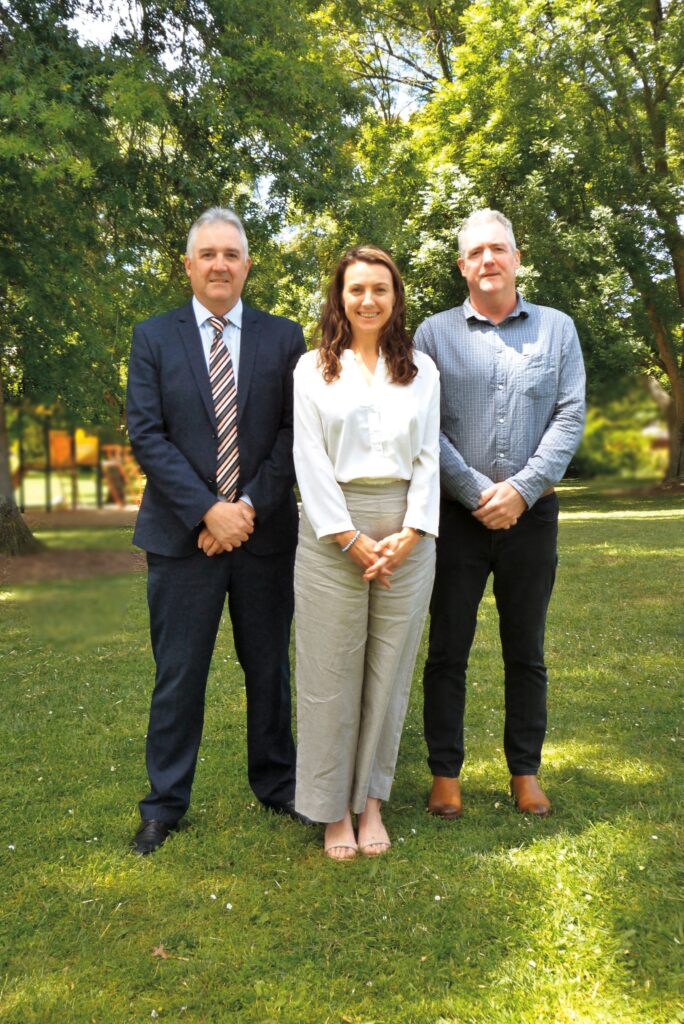
(From left) Minister for the Environment Steve Dimopoulos MP, Baw Baw Shire Councillor Danny Goss, Premier Jacinta Allan, Member for Eastern Victoria Tom McIntosh.
On November 5, Bendigo Bank Trafalgar hosted a presentation evening at the Trafalgar RSL, celebrating the community investments that they had made into local sporting clubs, events, schools and community organisations.
Across the successful recipients, over $37,000 was awarded, bringing the total Bendigo Bank has reinvested into the local community to $2.1 million.
Community engagement advisor Moriah Taylor described the evening as “a special occasion.”
“It is a moment to reflect on the difference local support can make when it is backed by a bank that genuinely cares,” she says.
Recipients Tom Mackenzie and Maddie Kennedy from Thorpdale Netball Club, feel grateful for the funding received. They plan to use the funding to upgrade the netball dresses and general equipment at the club.
“We are excited for hopefully what this money can do for our netball club,” says Mackenzie.
Highlighting the pride taken in seeing students thrive in their pursuit of further education, Bendigo Bank sponsored eight scholarships for students in University and TAFE.
Trafalgar High School graduates Poppy Susa and Keeley Lewis-Ryen were present to accept their scholarships.
Poppy, now pursuing a career in medicine, says that she feels “very privileged” to have received the scholarship.
“To attend university and move to Melbourne is very expensive, but I guess it [scholarship] allows me to spend a bit more time studying and getting involved in extracurriculars,” she says.
Throughout the year, Bendigo Bank has worked to support “over 40 local clubs and organisations and funded projects such as youth development, mental health, sport, arts and environmental sustainability,” says branch manager Torina Johnston.
“It is really rewarding as a staff member to know that the work that we are doing is able to support local community groups and to see local community groups thrive off the back of our efforts is so satisfying.”“I would like to thank our local customers for their support in helping us be successful which then lets us return profits back into the community,” she says.
All successful recipientsTom Mackenzie (left) and Maddie Kennedy (second from right) from Thorpdale Netball Club with Bank Director Edwin Vandenberg (second from left) & Branch staff member, Mel Kemp (right).(From left) Community Engagement Advisor, Moriah Taylor, with Trafalgar High School gradu- ates Poppy Susa and Keeley Lewis-Ryen, and the Community Bank Board Chair Debbie Di Sisto.
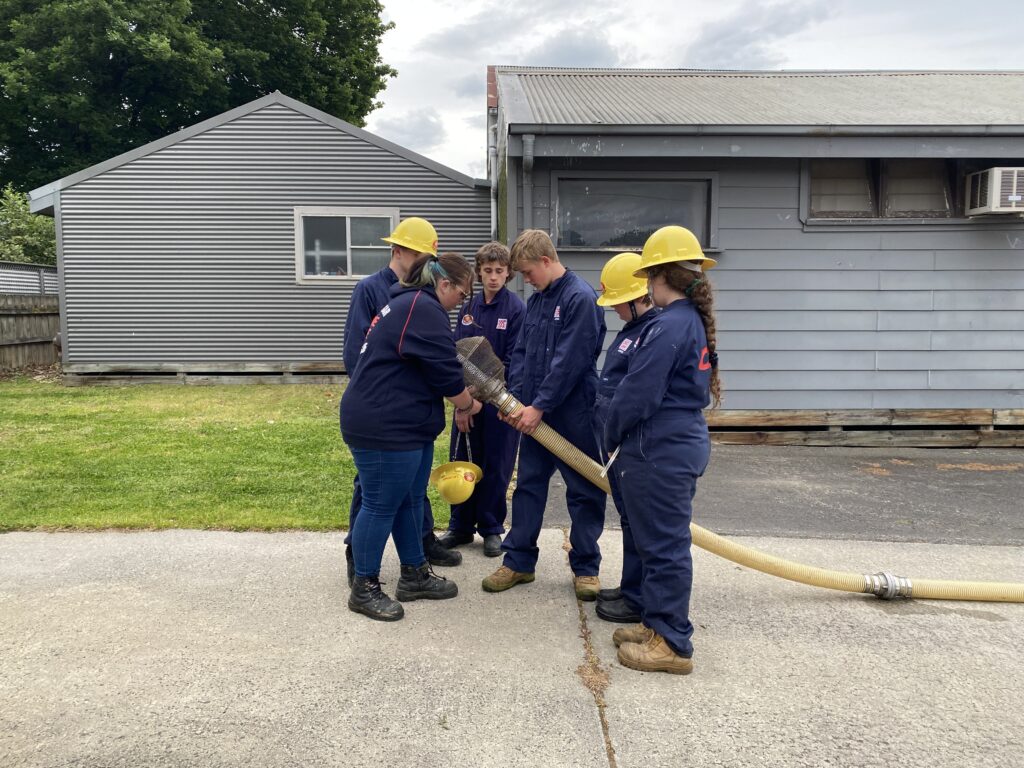
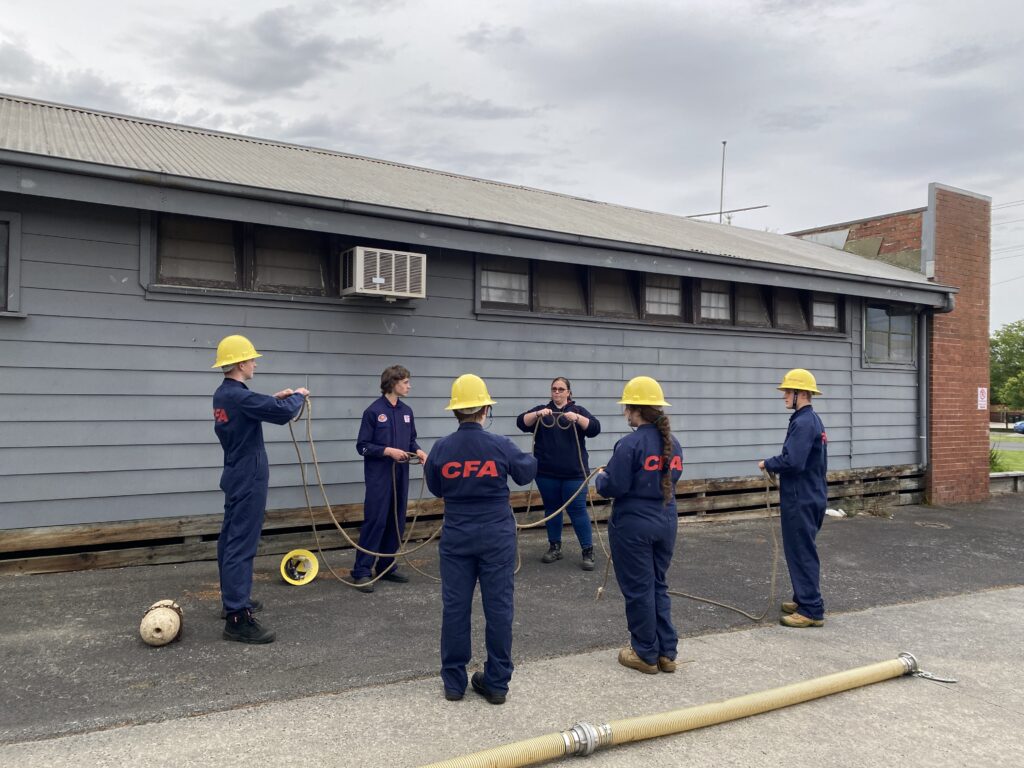
On the first and third Thursday of every month excluding school holidays, the junior fire brigade under the junior volunteer development program, meet at Trafalgar fire station to learn about fire safety and develop their skills as junior firefighters.
The junior volunteer development program is run across 160 brigades in Victoria and is open for young people aged 11-15.
In Trafalgar, the junior fire brigade sessions are led by volunteer firefighter Naomi Goodin, who has been a firefighter for the past seven years.
Goodin is assisted by Phil Barnes, who joined the CFA in 1987.
Both Barnes and Goodin use their experiences as firefighters to guide the juniors.
On November 6, five junior firefighters came to a training session and learnt about drafting. When fire hydrants are not accessible, drafting works to draw water from an external source like a river, a dam or even a swimming pool into the fire truck.
With teamwork being an essential aspect of being a firefighter, the juniors work well together to assemble equipment and ask questions when needed.
Goodin explained that the training sessions are led by the juniors themselves, giving them the opportunity to take ownership and learn through hands-on experience.
“They get to choose their training; we are just here mainly to supervise.
“Other than going near live fire, they get to do all the same training that we [qualified firefighters] do,” she says.
As well as developing firefighting skills, the program gives the juniors the opportunity to be social, learn valuable life skills and understand the importance of community.
“I think it is a really good program. The confidence boost that it gives quite a lot of kids is phenomenal,” Goodin says.
Junior firefighter Trin Jarvis and her family are new to the area. She says that joining the junior brigade is her way of getting “involved in more activities” within the community.
Logan Goodin and Reid Barnes say that their favourite part about being junior firefighters is “hanging out with mates.”
They would both like to see more young people join the program.
“We need more firefighters. You never know when someone is going to retire or just feel like quitting,” Barnes says.
Due to many reasons including availability, life commitments and health concerns, the number of operational volunteer firefighters has fluctuated over the years.
Through the junior brigade, Goodin hopes to see more young people join and work their way up to becoming senior firefighters.
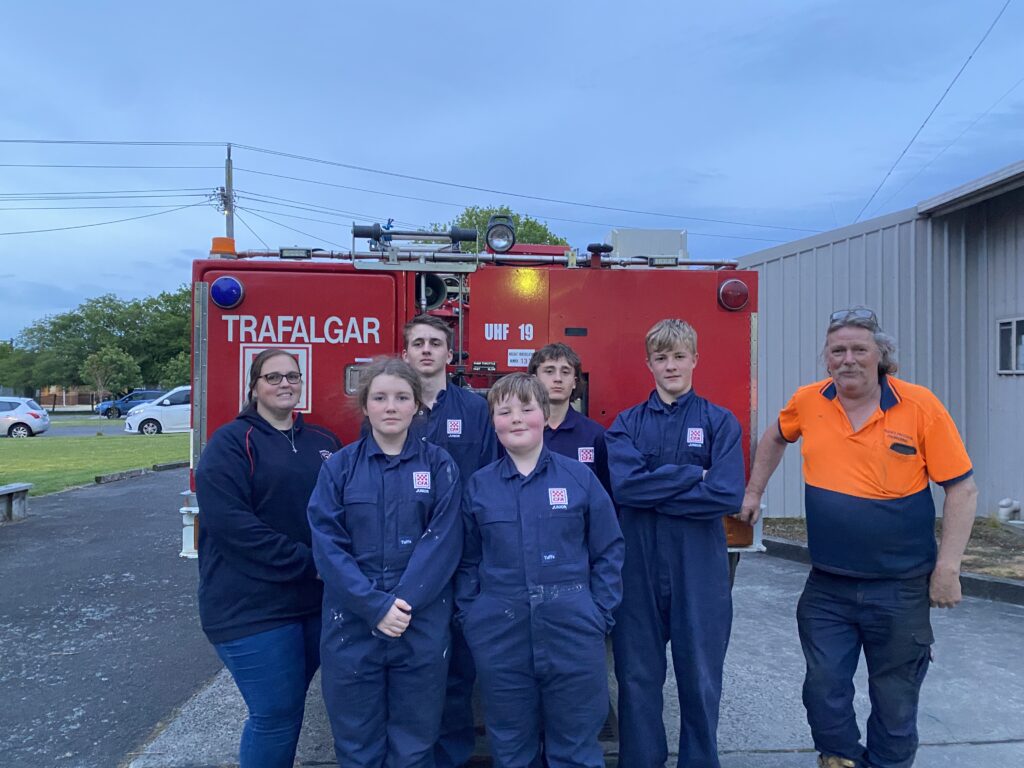
Working together to assemble the hose.Learning how to tie rope.Trafalgar junior brigade members (Back) Naomi Goodin, Logan Goodin, Onyx Word, Reid Barnes, Phil Barnes. (Front) Trin Jarvis, Quinn Jarvis.
The Baw Baw Shire Council team rolled into Trafalgar on November 18, bringing the community together to look to the future. Around 50 community members attended.
The night began with presentations from councillors Adam Kingwill, Adam Sheehan and Mayor Kate Wilson. Council officers covered different topics in more detail as well. Cr Danny Goss and Deputy Mayor Cr Suzanne Allen were also in attendance.
Following this, councillors and council officers were available to answer community questions, and take feedback on concerns regarding local issues and projects.
Cr Kingwill, who has been critical of past consultation efforts, said that council is trialing something new which could be recreated in Trafalgar and other towns in the future.
Cr Sheehan said that “it’s an exciting time to be in collaboration with the community.”
Local issues such as the need for more kindergarten infrastructure, the future of the No. 2 Oval, the Lois Court playground, and the sale of the Trafalgar Business Centre – which continues to be an unpopular move – were all discussed. Council revealed that they currently have an offer for the building and reaffirmed that tender from the sale will be directed to fund the second oval at the Traf Recreation Reserve.
There was definite concern around the concept of selling public assets in order to fund new projects.
Kindergarten was also a hot topic of discussion. Due to changes in state legislation, under the Best Start, Best Life program, the number of kindergarten hours that families are entitled to will increase. Combined with increased population, the shire is in urgent need of more kindergarten infrastructure.
Modelling presented by the council showed that there will soon be less available places than expected children entering kindergarten. By 2041, the number of children aged 4 and under will have doubled in the Trafalgar area.
The most convenient option to increase the number of kinder spaces is to restore the former site on Contingent Street. However, that site is currently proposed to be a library.
There was concern among attendees that if the library goes ahead before a decision is made, that there will not be a convenient location for a new kindergarten.
A council spokesperson confirmed that there are other options in the broader area, including in Yarragon and Thorpdale. Council is currently looking into the suitability of other options, which will be made public upon further investigation.
Newly elected Mayor Cr Kate Wilson, said that planning for the future will require the community “to be creative”, given the “harsh reality” of the current financial constraints.
She thanked those who attended and said that the “world is shaped by the people who show up.”
Having the community together was also a good way to remind locals that bushfire season is fast approaching. A representative of the CFA was present to remind locals to stay informed, be prepared and have a plan. They also encouraged everyone to download the VicEmergency app on our phones to ensure we receive alerts.
Council is keen to seek your feedback on this event as well as for proposed, planned, and underway local projects. See https://www.bawbawconnect.com.au/ to have your say.
A gentleman who transformed communities through connection, compassion, and unwavering dedication.
Trevor Colvin, who passed away on November 8, 2025, leaves behind a legacy that spans continents and touches countless lives. Described by many as “a gentleman and a gentle man,” Trevor’s life was defined by his remarkable ability to bring people together and build thriving communities wherever he went.
Trevor Colvin brought the Trafalgar District News back to life in December 2023 after it had folded, using a lifetime of experience in the newspaper world. Trevor always joked that it was perhaps a “foolish adventure” but recognised the importance of the newspaper to the local community. Importantly, he ensured the paper was financially sustainable, having four paid workers, something of which he was proud.
Early Years and Professional Success
Trevor’s professional journey began with a Diploma in Advertising and Communications from RMIT, launching a six-year career in advertising before joining The Age newspaper. His talents soon took him international when he was sent to Hong Kong to manage The Age’s Asian publishing business. It was there that Trevor’s entrepreneurial spirit flourished—he established six new publications and spent time in the People’s Republic of China starting the first English-language daily newspaper, The China Daily, demonstrating his vision and determination in challenging markets.
After six years abroad, Trevor returned to Melbourne as Deputy Display Advertising Manager with The Age. Following his retirement, he and his wife Susie embarked on a new venture, starting a newspaper publishing software business together—a partnership that reflected both his innovative spirit and the strong bond they shared.
Wonyip and Yarram
Trevor and Susie left Melbourne to live the country life of their dreams, and managed for some time to run their business from Wonyip in South Gippsland where they had settled. But as the business and international travel demands grew, Trevor found himself commuting weekly between Wonyip and Melbourne, until his retirement.
Born in Trentham, Trevor was deeply connected to rural Victoria. When living on their farm in Wonyip, he started the Wonyip Landcare group, demonstrating early on his commitment to environmental stewardship and community action. His main goal for this initiative was to build ‘Highways for Quolls’ from Wonyip to Wilsons Promontory, after it was discovered via hair-tube sampling, that the endangered Spot-tailed Tiger Quoll was still active in the area. He raised tens of thousands of dollars beginning in 2007 for this project, primarily from the World Wildlife Fund. He also enrolled Hancock Victorian Plantations to donate tracts of land that the Wonyip group planted out with native trees, following harvesting of plantation timber along the route. This project is ongoing.
He also spent many years heavily involved, voluntarily, with Landcare Victoria.
Trevor was an active member of the Yarram Golf Club, and instigated very successful marketing campaigns on its behalf. He was also very involved with Tarra Territory Tourism, promoting the beautiful Tarra Valley and Corner Inlet.
After the catastrophic central Gippsland bushfires in 2009, which had a devastating effect on the Yarram farming and surrounding communities, Trevor formed Blokes and Banter, after he became acutely aware of how difficult such traumatic events are for many men to process. The group was formed specifically to provide a secure, non-challenging space for men to come together to support each other – and share their experiences, if and when they felt able. Or just to have a sausage and a beer, no questions asked. The group is still going strong.
Trevor also spent time in the early stages of developing a feature movie about the extraordinary life of Sir John Monash. A project of many, many years duration and commenced prior to his move to Trafalgar, it is far from complete…but it is back in the hands of the original scriptwriter who will, hopefully, finally bring it to life.
The Trafalgar Chapter
Six years ago, at the start of the COVID-19 pandemic, Trevor and Susie moved to Trafalgar—a decision that would profoundly impact the town. Trevor didn’t just move to Trafalgar, he fell in love with it, embracing the community and its people with characteristic enthusiasm and dedication. He loved to play a round at the Trafalgar Golf Club and he looked forward to relaxing at the end of the week playing bowls with mates at the Traf Bowls Club. Out of respect for his great friendship, the president Ian Myles lowered the flag to half mast to honour his dedication and commitment to the club.
As one of the founding members of the Silk Road Community, Trevor became a driving force for positive change. His initiatives transformed Trafalgar’s social fabric:
Community gardens: Creating spaces where neighbors could grow food, share knowledge, and build friendships.
Men’s support group: Providing a vital space for men to connect, share, and support one another.
Trafalgar Farmers’ Market: Bringing local producers and community together, strengthening the local economy.
A Legacy of Courage
When Trevor was diagnosed with an aggressive form of lung cancer three years ago, he faced his illness with the same grace and determination that characterized his life. Working until his last day, he continued encouraging others—especially his beloved wife Susie, his children, grandchildren and others —demonstrating that true strength lies not in avoiding hardship, but in how we face it.
Remembering Trevor
Trevor Colvin was a powerhouse who understood that community isn’t built by grand gestures alone, but through consistent, compassionate action. From Hong Kong boardrooms to Trafalgar community gardens, from international publishing to local community newspapers, Trevor’s life was a testament to the power of showing up, caring deeply, and working tirelessly for the common good.
He leaves behind his wife Susie, his children and grandchildren, and communities in Wonyip, Yarram and Trafalgar that are richer, stronger, and more connected because of his presence. Trevor Colvin was indeed a gentleman—and a gentle man—whose legacy will continue to inspire and unite the communities he loved so dearly.
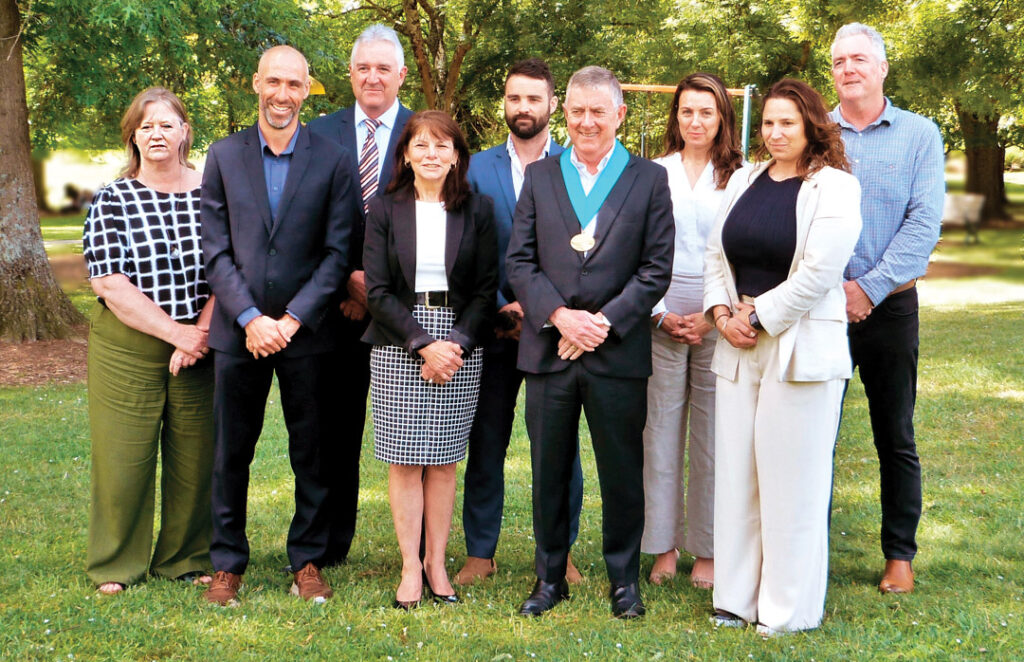
Baw Baw Shire councillors have unanimously elected East Ward Cr Kate Wilson as Mayor after an election was held on November 12. She said she felt “really honoured” to be nominated but jokingly added she was a “little terrified.”
Cr Suzanne Allen was elected Deputy Mayor. Both will serve a 12 month term with another election to be held in November next year.
Mayor Cr Wilson was excited by the opportunity to represent her local community.
“It’s a great honour to be elected Mayor of Baw Baw Shire, a place where I am proud to live, work and represent. I look forward to working closely with my fellow councillors, staff and our community to deliver the priorities in our council plan and work towards our shared vision for a stronger, thriving and connected community,” said Cr Wilson.
“Looking ahead, I want to make sure every voice is heard, to cast my votes with fairness and integrity, and always with the whole community in mind. I’m committed to continuing the great work already started for the betterment of our region and am excited to see what can be achieved.”
Prior to her time on council, Cr Wilson had worked in local government and told Traf District News last year that this experience showed her “the realities of what local government can and can’t do.”
Outgoing Mayor Cr Danny Goss nominated Cr Wilson who has “impressed” him greatly during her first year on the council.
“I just could not be happier to see new blood in the role,” said Cr Goss who had announced he was not seeking a second consecutive term as mayor.
Reflecting on the past year, Cr Goss said that council had “achieved a lot” and had accomplished an important goal, to “restore the standards and protocols that [had] been lost [during the previous council term].”
These words follow a tumultuous period for the council which saw allegations of sexism and bullying, a short suspension for Cr Goss, and a shocking last election result which saw only two out of the nine councillors returned to their position in 2024.
“This council is now widely seen, I think, as very cohesive, functional, hardworking, and long-term focused,” he said.
Also on the meetings agenda, appointments to council committees and the election of the Deputy Mayor.
Cr Allen spoke of her gratitude for the opportunity to serve as Deputy Mayor, saying “I’m thankful for the trust my fellow councillors have placed in me. I look forward to supporting Mayor Wilson in representing our community and doing the best we can for this beautiful place we call home.”
The next council meeting will be held at 5:30pm on Wednesday December 10 in the Fountain Room of the West Gippsland Arts Centre. Members of the public are welcome to attend.
Newly elected Deputy Mayor Cr Suzanne Allen and Mayor Cr Kate Wilson. Image supplied.Mayor Kate Wilson (centre) with fellow East Ward Councillors Brendan Kingwill (left) and Adam Sheehan (right). Photographed by Trevor Colvin.
Council is running an open community consultation on Tuesday November 18 from 4pm to 6pm at the Trafalgar Community Centre.
Councillors and council officers will join the community to talk about the future of Trafalgar.
“We decided to go straight to the community… so we have a clear path forward,” said Cr Brendan Kingwill.
The sale of the Trafalgar Business Centre, the adoption of the Trafalgar Structure Plan, and the development of the second oval will be key discussion points, however, Councillor Brendan Kingwill was keen to ensure that the session will be “driven by the community.”
“This is all about giving people in the community a direct chance to give input rather than hearing about the current plans.”
Cr Kingwill said it would be important to hear from community groups and clubs as well as the wider public.
“We [need to] make sure that the major stakeholders in Trafalgar are personally invited to make sure we get all the right people in the room at the right time and bounce ideas off people and get a plan going forward,” he said.
Cr Adam Sheenan is also “very excited” to meet with the community and “hear what’s on their minds face-to-face.”
Council will also seek community feedback at the event on the proposed upgrade of the kindergarten in Contingent Street, options to maximise use of the community centre, and playground equipment renewals.
“I’m hopeful to get a clear and strategic plan for Trafalgar and am looking forward to some good outcomes,” said Cr Kate Wilson.
Council is excited to engage the community and encourages locals to attend the event to help inform council decision-making moving into the future. Registration details will be available on council’s website closer to the date – www.bawbawshire.vic.gov.au
East Ward Councillors Adam Kingwill, Kate Wilson, and Adam Sheehan. Photographed by Trevor Colvin.
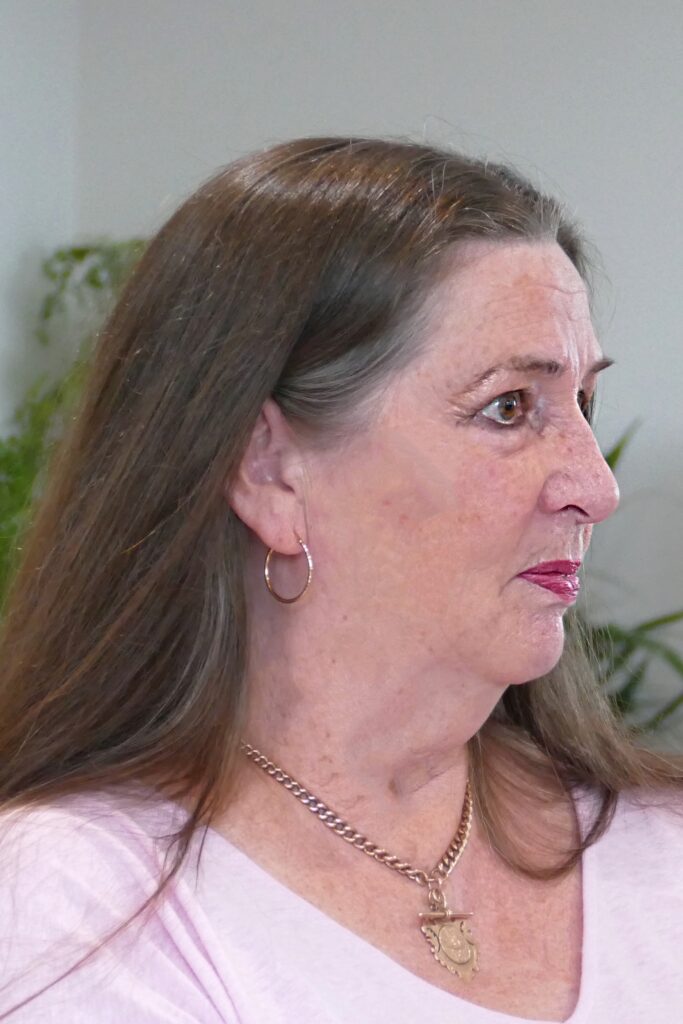
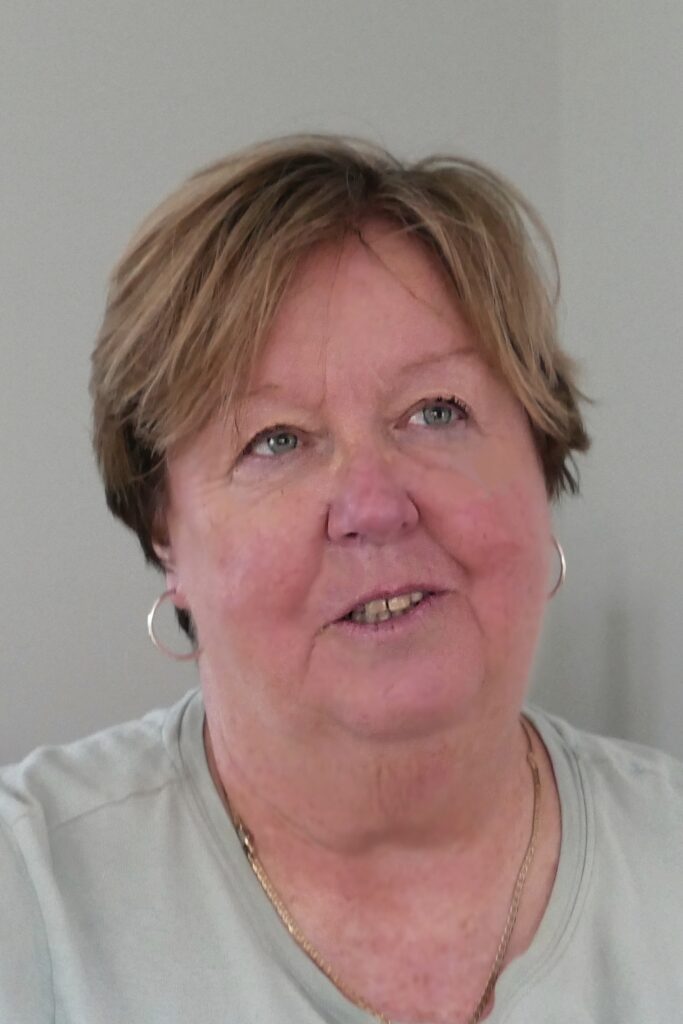
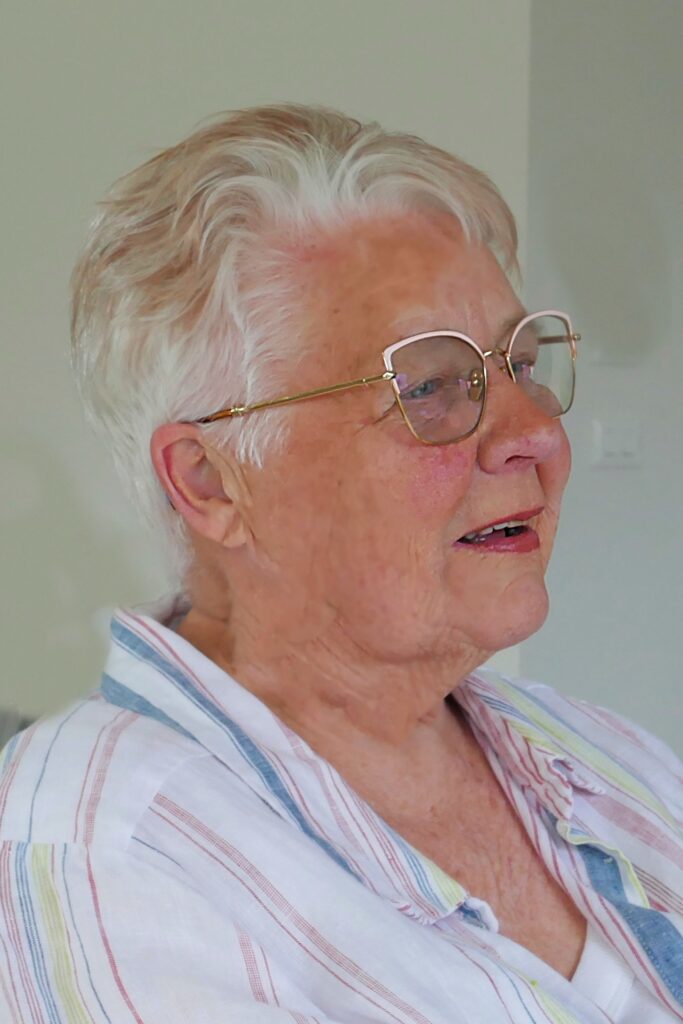
Last Month Traf District News interviewed three men who live in the Encore Retirement Living to find out what it is that they like about living in a retirement village.
This month we asked the same question of three women residents.
Gwen
Gwen
“I think the people who are here are all lovely. The staff look after us well. I think everybody should, in their older age, feel protected and looked after, and that’s what we have here.
“I think a lot of people leave it too late. They need to come here while they’re still healthy, while they’re still mobile, and get into the swing of it. We visited other retirement villages before we chose to move here, a number of folks said to me they left it too late.
“We like the fact that it’s a happy community, we feel safe, and everybody looks after everybody else without living in each other’s pockets.
“This village is good for people who are on their own. They‘ve got increased security. They’ve got people around them.
“Another great thing is that people can go away for months at a time and their house is still looked after.
“How comfortable and cozy are these places? We’re just so lucky.”
Ann
Editor: Before moving to Encore, Ann and her husband lived in a large retirement village not far away and she says they didn’t like it for a number of reasons, but she is delighted to live at Encore. She is especially thrilled that since her husband passed away after they arrived, how other residents have been so supportive and caring of her.
“I love the idea of a community centre, because you can do many different things. There are some things that I’m not interested in, but there are other things that I am. And I think it covers a wide range.
“The book library is fantastic. I love the library. There’s always plenty to read.
“The new gym is fantastic. I’m not a swimmer, so I can’t comment on the pool. But the swimmers seem to love it.
“I love the idea of the gates locking at night. I really appreciate the security that brings.
“This villa was ideal for my husband because there are no steps. Everything is flat, which is great. I think we all can get clumsy and a single level villa with wide doors is a great feature.
“And I generally get on with everyone. I can honestly say there’s no one here that I don’t like. You know, I think we’ve all got something, we’ve all got something to offer each other.
“And the friendship, the security, like I said, I keep saying that.
“I like having a little garden, because I can go out into that and when I just don’t want anyone, I can just close the door and that’s it.
“Just me and the dog. And I think it’s fantastic that we can have dogs, because dogs are amazing, especially when you’re on your own, the company and the love they give. And it’s always, when you’re walking here, and I walk every day, usually early and there’re not many people around, you’re always meeting someone and you’re talking. So you’ve got that social interaction.
“And there are so many different activities. I went to the Morning Melodies in the community centre and I thought, oh, I won’t know any of these songs, but I was singing away to all of them. I knew them all!
“I also love that this place is quiet. You know, you haven’t got noisy neighbours. There’s nothing… Like I said, I can’t see anything negative about living here.”
Cathy
“My mum and dad went to a retirement village after years and years of resisting and they absolutely loved it. They were so wrong thinking that…and I remember the first day I helped move them into their unit, I thought, oh my God, I could live here.
“You know, nice, generous sized unit. And so that was in the back of my mind and they both became quite ill and I had teaching commitments. So I was sort of stuck in the southeastern suburbs.
“But in my heart, I always wanted to be in the country because I had horses and, you know, I had them on agistment so I’d get out into the country and get fresh air and relaxation.
“And I also used to spend a lot of time on my aunt and uncle’s farm from when I was a kid. And that was like my paradise.
“So I started looking online and over at least two years, I must have looked at every retirement village in Victoria. And in my mind, I wanted coastal or country, but for what I wanted, which is a villa like this, going coastal and wanting to go to the Peninsula, well, that was beyond my price range. So I thought, okay, so it’s country and I actually looked around Ballarat because I have family history in Ballarat and I have a cousin there.
“There were some nice ones there, but it was a bit far away from the rest of my family. I just started looking at properties further and further from the southeastern suburbs.
“And I remember I found a another place near here which I really liked but they didn’t have a vacancy for months and months and months.
“So one day, I just Googled retirement villages near Warrigal and found Encore. I looked at it online and it started off with a drone going down Flagship Drive andI saw all the colours are Australian landscape colours. Then the drone did a big sweep and I got a view of the Strzelecki Ranges. And I just thought, that’s it for me.
“As soon as I drove in the gates, I just knew. So…and it had everything.
“The units were just perfect. The two bedrooms, the flexi room, and built in brick. I’ve got a double garage, which I need for my junk!
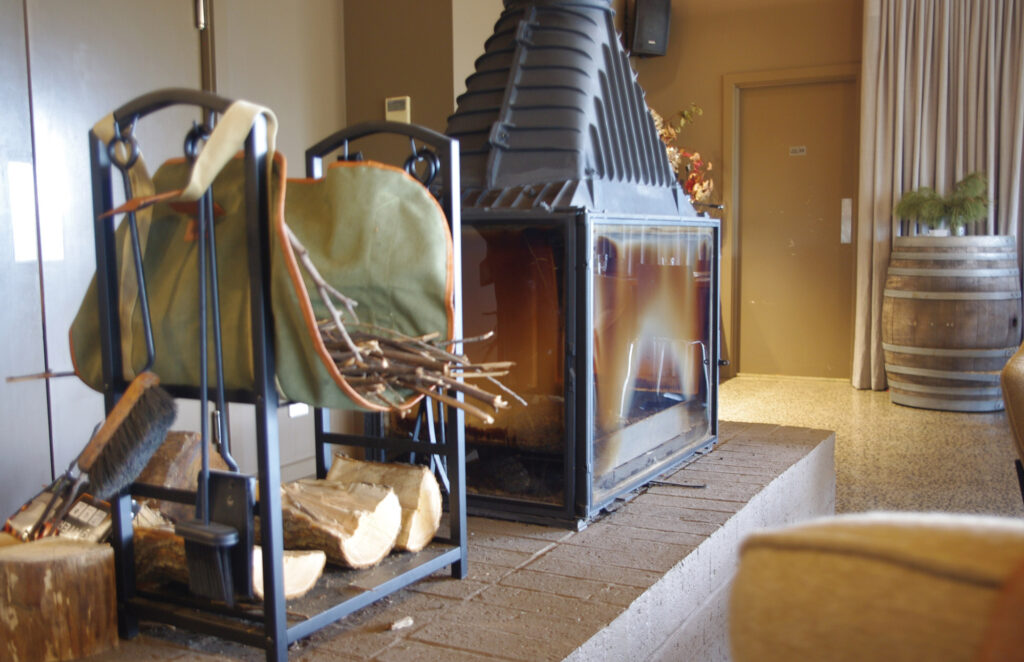
“Oddly enough, the community centre at that stage wasn’t that important to me. I just wanted it to look nice. But that’s such a bonus now. The fireplace and all that sort of thing.
“And being gated is important to me. Security; especially now with what’s going on with home invasions and so forth. It just makes me feel that much safer.
“The management is fantastic. Rosa, the manager, and Anne-Marie and Shaz in the office, their care for everybody is above and beyond what you’d expect. I really appreciate that. They’ve really helped me settle in.
“When you move into a place like this, you don’t know what the community’s going to be like. But I’ve just been welcomed so warmly. People aren’t in your face but they are there when you need them.
“Everyone is friendly. You can go for a walk around the village and have chats everywhere. One day I set out at 11 o’clock and got home at 1:30 and that was just walking around the block!
“I just think how privileged we are to live here. It is so beautiful. You know, from my lounge room, I can see the Baw Baw ranges that way and I can see the Strzelecki ranges in the other direction.
“And you go for a drive toward Mirboo North, and the first time I went there, my head was like on a swivel, because it’s just breathtaking. And I’ll sit here sometimes in the lounge room, and a crimson rosella will land on the fence… or the black cockatoos, which I love.
“And I’ve seen little wrens and pardalopes, and all sorts of things. So it’s just beautiful. And I hear a kookaburra sometimes.
“Another good thing about living here is there’s no pressure on you here to join in. It was only when I typed in retirement villages near Warragul that it came up. And I thought, why isn’t anyone talking about this? I just love it here. I love it!
“This is a step-free village, which is very important as we get older.
“The owner has put quality into this village. He’s put a lot of thought into it.
“The villas are one level, ambos can come in and out, double glazing everywhere, 10-foot ceilings. It’s wonderful!”
Given the current housing crisis – in which more than 122,000 people were estimated to be experiencing homelessness at the last census in 2021, and with house prices having risen 6.2% in the past year – Australians are vulnerable when it comes to housing security. This makes the question posed in the headline particularly relevant and it’s a question recently answered by the Australian Capital Territory, which enshrined housing as a part of their Human Rights Act.
The law was passed through the ACT Legislative Assembly with support from Labor and The Greens. The territory’s Human Rights Commissioner, Dr Penelope Mathew, said that it brings “the ACT closer toward fully realising the right to adequate housing and a more comprehensive human rights framework for all Canberrans.”
This is also a question being discussed in Victoria.
While Victoria does not have a Human Rights Act, it does have the Charter of Human Rights and Responsibilities Act 2006. It protects 21 fundamental rights, some of which include:
“Right to recognition and equality before the law”.
“Right to freedom of thought, conscience, religion and belief”.
“Right to freedom from forced work”.
So if housing was considered a human right in Victoria, what would that look like?
Human rights are rights inherent to all human beings, regardless of their background. In the ACT, this legislation means that the territory’s government will need to consider the right to housing when making decisions and developing policies. It will particularly advocate for the rights of people in social or public housing, renters, and those experiencing homelessness. It also provides constituents with the ability to challenge decisions and laws made by the government to ensure the right is being upheld.
“Adequate housing is about more than just shelter. It is the right to live somewhere in security, peace, and dignity. If people don’t have safe and stable housing, many other fundamental rights are at risk,” Dr Penelope Mathew said, while ACT Greens leader Shane Rattenbury – who introduced the bill – said that it will “reshape the way we think about housing… treat[ing] housing not as a private asset… but as a foundational social good.”
This last statement feels increasingly true. Houses are treated as a commodity rather than a necessity. Even when the housing crisis is discussed, it feels as if much of the framing is surrounding the idea that if young people are not able to buy homes, they won’t have that asset to support themselves and their families in retirement – and not through the lens that this crisis really means that many people are without a secure and stable place to live.
The Victorian Greens first introduced a bill (Human Rights and Responsibilities Amendment (Right to Housing) Bill 2025) to the Victorian Legislative Council in June, with debate taking place in August. The primary sentiment is that it is right for every person to have adequate housing.
“We are offering something all MPs across the political spectrum can agree on – that everyone has a right to a safe and affordable home,” said Greens housing spokesperson Gabrielle de Vietri.
In August, the Council to Homeless People called for bipartisan support for the bill, urging Premier Jacinta Allan and Opposition Leader Brad Battin to vote in favour of enshrining housing as a human right. They argued that every Victorian needs a “guarantee of safe and dignified housing” because without it, there are “dire consequences for quality of life.”
However, neither Labor or the Liberals supported the legislation. Labor MLC Ryan Batchelor said “that [it] will not build a single home” and that their focus is on improving house affordability and tackling homelessness.
If that’s what the focus is currently, then let’s look at the situation at hand. A study released by The Guardian last year found that people experiencing homelessness are dying at an average age of 44, more than 30 years less than the national life expectancy, with exposure to violence and a lack of access to healthcare being some of the main causes. Research from the Australian Institute of Health and Wellbeing found that secure housing leads to decreased rates of hospitalisation, reduced transmission of infectious diseases, and improved mental health.
In Victoria, the homelessness crisis is growing. 102,000 Victorians sought help from homelessness services in the 2023-2024 financial year. Reporting from earlier this year found that in Gippsland, over 7,500 households were on the Victorian Housing Register for social housing, and 572 households reported sleeping rough in the past year.
So perhaps a new approach is needed. A new framework to view housing as something that is essential and not a commodity or asset.
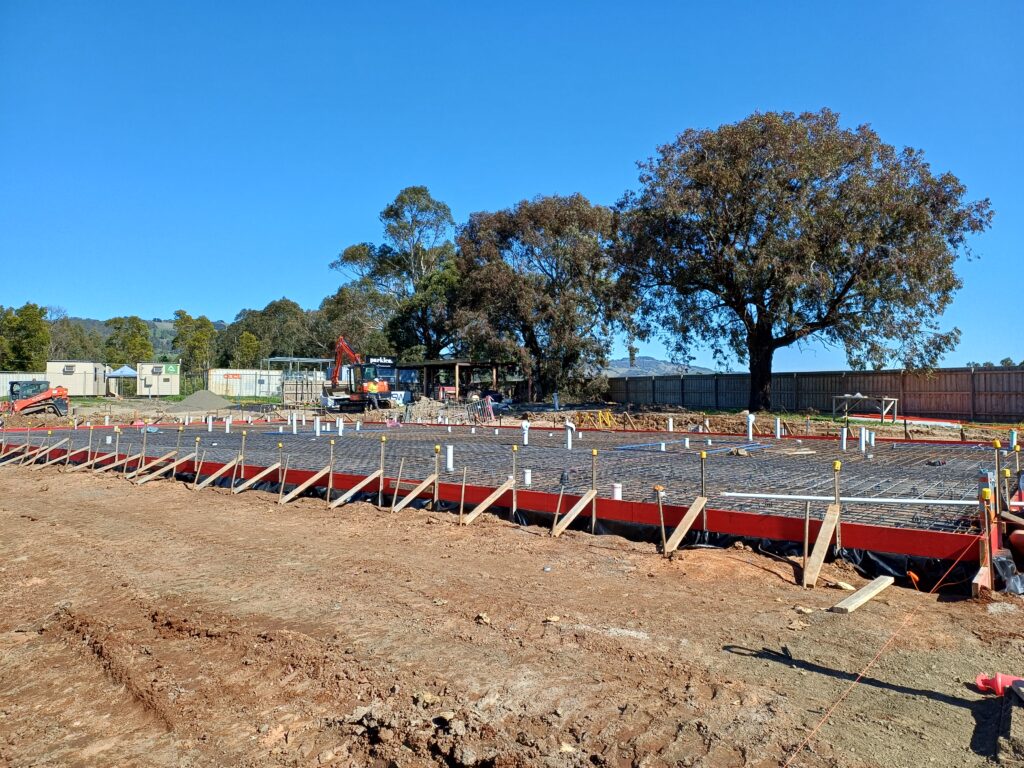
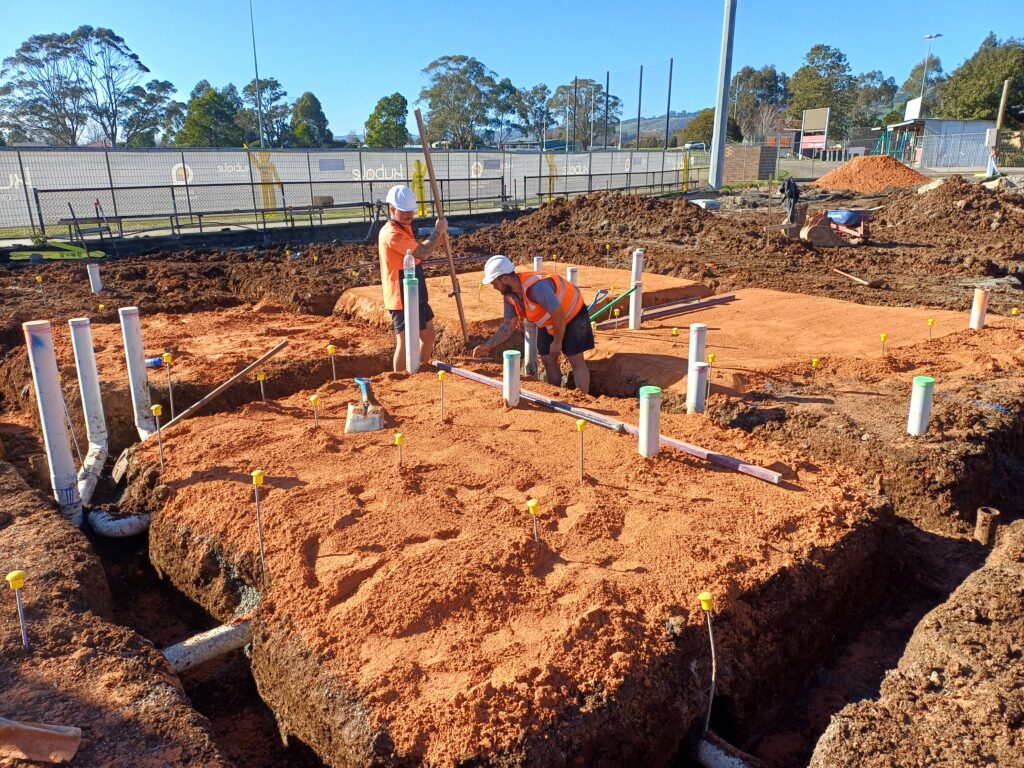
Construction is well underway for the new sporting pavilion at Yarragon’s Dowton Park. Following demolition of the existing outdated facility, a concrete slab has been poured, and both the structural steel and lightweight framing are now in place. Preparations are also underway for roof truss installation.
The $3.9 million project is a part of the Baw Baw Shire Council’s capital works program, totalling over $46 million infrastructure investment in 2024/25. The Rollo Street park project in Yarragon is also currently underway.
East Ward Councillor Adam Sheehan said the new pavilion would help to put Yarragon on the map for junior and senior footy, netball and cricket.
“We recently had a site walkthrough which gave us a great opportunity to see the emerging structure and visualise the layout of each room. The quality of the work is exceptional,” said Cr Sheehan.
“Once completed, this new facility will provide a welcome boost to grassroots sport for the Yarragon community and surrounds,” he continued.
Of the $3.9 million project fund, $250,000 has been invested by the state government and a further $1.8 million contributed by the federal government.
Mayor Danny Goss said that this collaboration “is a great example of all three levels of government working together to deliver the infrastructure that local communities want, need and deserve.”
The new pavilion will improve the site’s accessibility with additions such as handrails and an improved women’s changerooms.
Electrical mains have been connected to the upgraded power pillar, water connection works are scheduled for completion soon, and construction of the separate timekeeper’s room and coaches’ box is nearly complete.
Over the coming months, next steps will see installation of plaster walls, concrete pavements and connecting paths, internal fit outs and other essential service connections.
Local contractor, Kubale Constructions Pty Ltd, is overseeing the works.
The pavilion should be completed in March 2026 and ready for use soon after.
The new pavilion will include more accessible infrastructure, meaning everyone can participate at Dowton Park.
Construction is underway at Dowton Park. All images supplied.
The concrete slab for the pavilion has been poured.
Structural steel and lightweight framing are now in place for the pavilion.
Through September and October, a series of community barbecues were held, with the intention of bringing local farmers together.
The Look Over the Farm Gate – Help a Mate! initiative had events in Neerim South, Ellinbank, Buln Buln, Longwarry, and Trafalgar. The events were an amazing opportunity for farmers to support each other with the stresses of farming in dry season conditions, as well as provide access to important support resources.
Mayor of Baw Baw Shire Cr Danny Goss said the sense of community amongst local farmers is obvious.
“There is no denying farming is a tough job, even more so in the harsh and dry conditions we are experiencing now. It’s great to see farmers taking a few hours off their land to relax, connect, and access important support services,” said Cr Goss.
He also thanked the Lions Clubs and Country Women’s Associations for providing catering, adding that “the opportunity to share a meal and talk to each other was appreciated by all attending.”
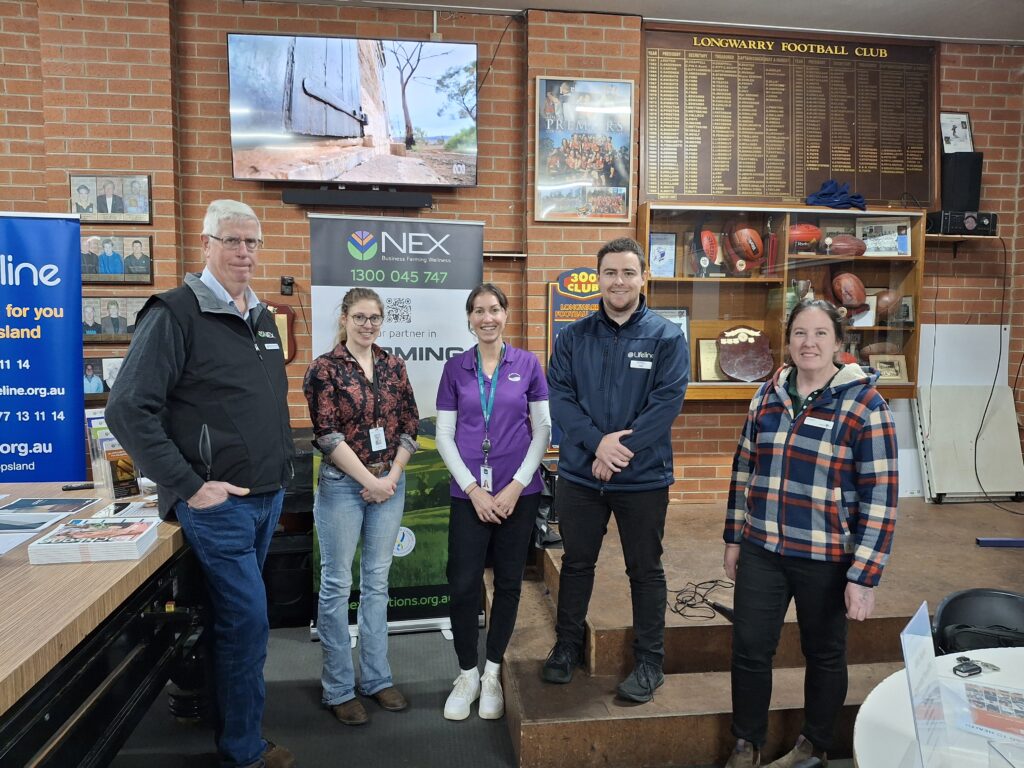
All local primary producers were invited to attend. Information and support services from the Baw Baw Shire Council, Head2Health, Agriculture Victoria, GippsDairy and Lifeline also attended the events.
This is a particularly important time to provide support for Victorian farmers. Much of the state has been experiencing rainfall deficiencies since 2023 which has continued through winter and spring this year.
Many primary producers are being stretched financially as they must source and pay for limited supplies of water, as well as hay and grain from as far away as Western Australia.
This series of events was delivered by council with funding from the state government through Agriculture Victoria and the National Centre for Farmer Health. These community events are part of the $67.2 million drought relief package provided by the state government earlier this year.
Support agency representatives from the Longwarry community barbecue. All images supplied.
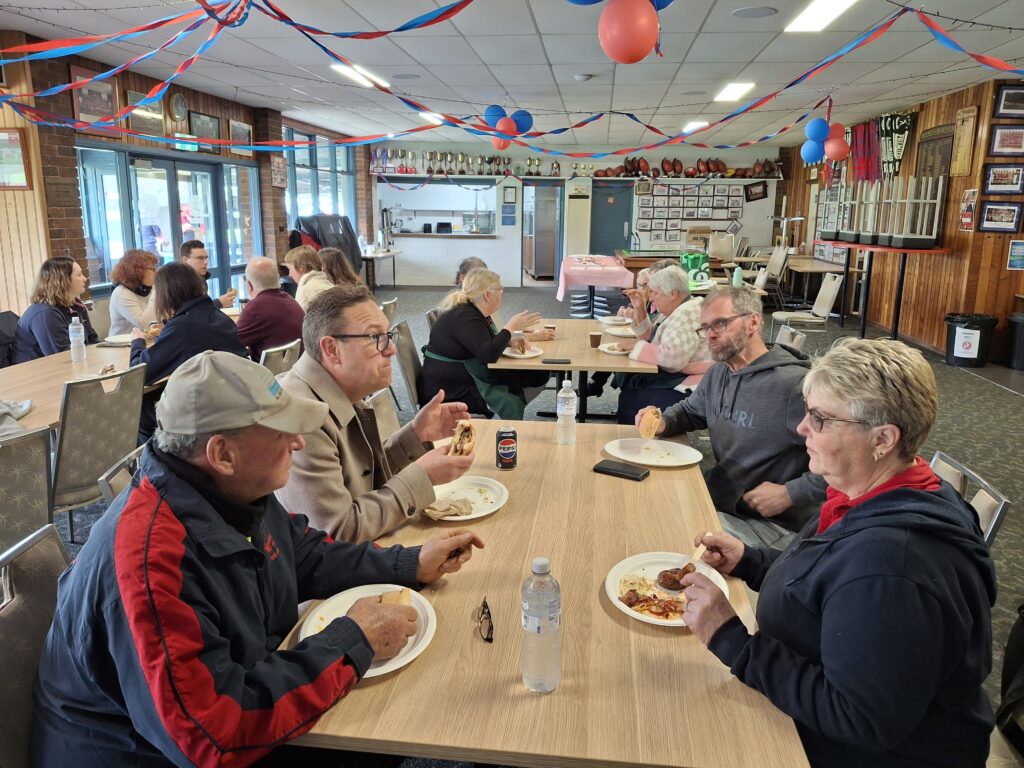
Lunch and conversation at the Buln Buln community barbecue.
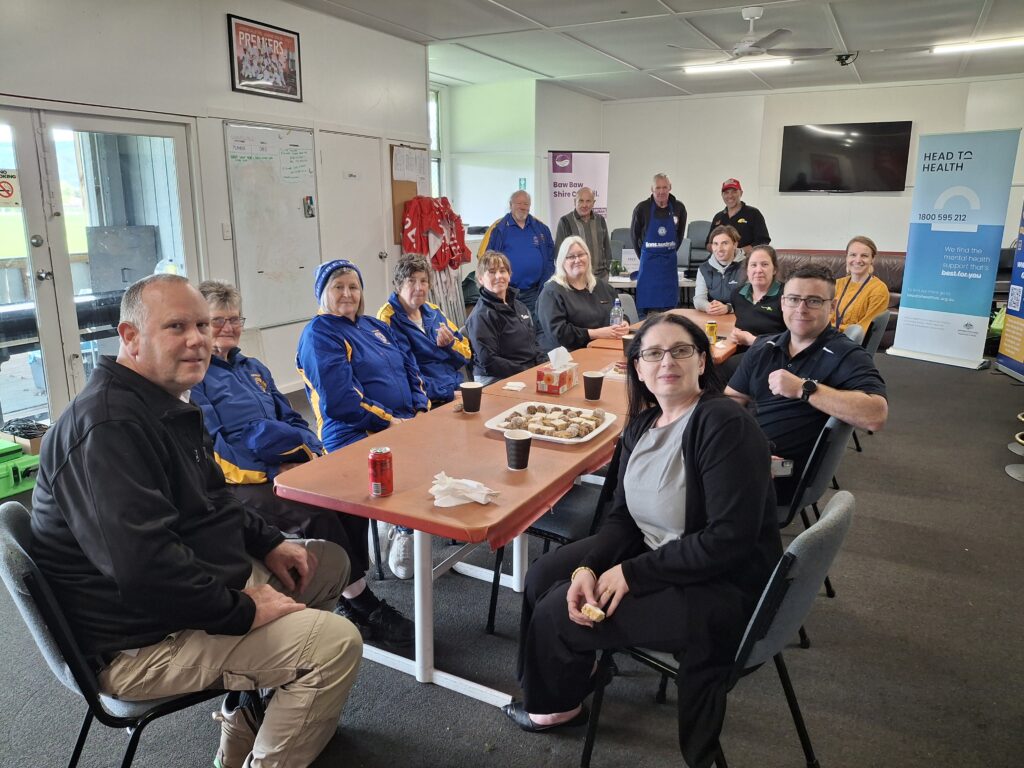
Local farmers and support services gathered at Trafalgar Cricket Club for a community barbecue.
A number of Trafalgar Cricket Club players achieved personal milestones last month.
Rhys Holdsworth, Zack Brown and Liam Durkin each made further marks in the club’s more than 130 history, after chalking up further accolades.
Holdsworth brought up 8000 senior runs for the club, as well as 250 wickets at First XI level.
In a statistically prolific career, the left-hand bat is among the top performers the club has ever seen, while he has used his cricket smarts to manufacture the bulk of more than 200 poles bowling right arm variety.
Brown didn’t have to wait long to take his 100th First XI wicket, after snaring the first scalp of the season.
Still only in his mid-20s, the opening quick has a knack for taking wickets, and is already in the top 10 on the club’s senior aggregate.
Durkin became the latest member of the 200 club when he played his milestone match in Round 2.
His 200 was made up of 127 games in the First XI, 55 in the seconds and 18 twenty20s.
The club has been fortunate in its recent history to have a number of loyal players.
Of the 13 who have played 200 games, seven are still actively involved with the club: John Asmussen, Christian Burgess, Brendan Dawson, Rhys Holdsworth, Daniel Heathcote, Jackson Noonan and Liam Durkin.
Holdsworth, Noonan, Heathcote and Durkin have also played the best part of 100 days of First XI cricket together – a likely club record.
Rhys Holdsworth went past 8000 runs for Trafalgar Cricket Club in Round 2.
Zack Brown has now taken more than100 First XI wickets.
Liam Durkin became the 13th Trafalgar cricketer to play 200 games last month.
Pet owners may face the difficult decision to rehome their beloved pet. Changes in personal circumstances may force the pet owner to consider new home alternatives.
So this prompts an important question, do animals have rights?
Definitely. Animals’ rights matter and should be properly legislated in every state to recognise them not as objects, or property, but as sentient beings. The ACT passed legislation to reflect the same in 2019. I know we can do better calling out to every state ensuring all animals are treated in good welfare and working towards simplifying legislation.
Mandating clear legislation across the country supports our judiciary system to confidently and accurately serve justice against perpetrators, whilst defending animal welfare. Many countries have recognised animals as sentient beings in law.
Recently, an abhorrent situation involving a rescue farm sanctuary located in Warragul came to light, where animals were received and left in cages as the organisation was overwhelmed. The organisation was unable to cope with the influx and improperly provided care. When officers entered the property, animals were found in cages.
These vulnerable animals relied on humans to be kind and to be cared for. Through no fault of their own, they were surrendered by their owners believing they would find them a new home.
Fortunately, the person responsible was brought before the magistrate receiving a fine and good behaviour bond. This situation raises serious questions.
Did the organisation call out for help from other rescue groups? Most are well connected offering guidance and support avoiding these types of situations. What are the core values of the organisation? Were pet owners falsely promised humane conditions upon surrender? Was the organisation a registered rescue group within the shire?
Pet owners cannot assume all rescue groups conduct their business virtuously, offering genuine care. Registered animal welfare charities should be scrutinised.
The other perspective is not to vilify the good work of foster carers, dedicated volunteers protecting animals for an organisation because of a few people not doing the right thing by the animals. The public’s perception can sour hesitating to donate money or goods. Raising funds, daily tasks feeding and cleaning, is an enormous task for these groups and any negative publicity negates what they are trying to achieve. Most groups are voluntarily administered.
Pet owner responsibility
Animals adopted from shelters, pound and rescue groups are desexed, vaccinated and microchipped, eliminating unwanted litters and promoting good pet health. This is where problems begin. If you take on a pet, please ensure the above procedures.
Where do I start the rehoming process?
Ask family and friends.
Discuss with your vet intentions to rehome, open and honest conversations are crucial. They may or may not provide recommended rescue groups.
Reach out to your pet trainer.
Search pet rescue websites (details noted below). The sites provide great information in many areas of the industry.
Seek out negative comments if the group or individual has acted inappropriately towards animals.
Ask the local council pound for suggestions, remembering most groups communicate among the rescue network. Baw Baw Shire Council offers an adoption and rehoming service through its Municipal Animal Pound. Residents can contact them to discuss their individual circumstances.
Be honest with dog assessors at shelters and rescue groups. They may refuse if dogs are deemed aggressive or display unacceptable behaviour.
Rescue groups may be charity registered, not-for-profit, relying on private and government donations (website details noted below).
Ensure the rescue group is registered, legitimate and foster carers vetted. Would you surrender your children to anyone? Is the group ethical? Do they promote unacceptable ideology counteracting genuine animal welfare?
Animal shelters either private or council may be an option. Unfortunately, animals for various reasons are put to sleep. This can be confronting but is a reality. Some rescue groups dedicate their efforts accepting animals listed on the kill list, offering the animal a greater chance of life. They are placed in foster care preparing the animal for adoption.
Research the rehoming process, view the group’s website, and carefully read the fine print. An online application will be required to be completed, signed, and submitted. Be familiar with the process. Some resources to check out are:
RSPCA (https://rspcavic.org/)
Facebook page Aussies Against Animal Abuse
Rescue Directory (www.petrescue.com.au)
Australian Charities and not-for-profit commission (www.acnc.gov.au/for-charities)
Foster carers
Foster carers provide an important service. Animals are cared for in their home observing and learning the pet’s personality and temperament in preparation for adoption. They are an asset to any welfare organization.
Cat and dog carers residing in Baw Baw Shire can become a registered foster carer through the Voluntarily Enrolled Foster Carer (VEFC) scheme. Registering is not mandatory. When more than five animals are fostered, the carer must register their premises as a domestic animal business because they are classed as a shelter.
Animal Welfare Victoria are informed of all registered animal foster carers within the municipality.
Legislation
Animal welfare legislation is complicated (Alliance for Animals link below). Navigating our way to understand Baw Baw Shire’s authority, animal rescues and shelters must comply with the following acts and regulations: Domestic Animals Act 1994; Baw Baw Shire Community Local Law 2024; Baw Baw Planning Scheme; Local Government Act 1989 & Local Government Act 2020; and a proposed Bill in the Victorian Parliament, which would be the Domestic Animals Amendment Bill 2025.
To all pet owners, if you are facing economic challenges and unable to properly care for your pet, please seek help from friends, family, and neighbours. Most people are good human beings willing to help. Please do not dump animals in rural areas, instead, reach out to your local vet and genuine animal welfare groups for guidance.
Lastly, an acknowledgement to our exceptional professional vets providing animal care. Without your love and passion animals would be denied healthcare they deserve. Thank you Trafalgar and Newborough Vet Centres, Moe Veterinary Centre and beyond.
A furry friend at the Baw Baw Pet Expo. Image supplied.
Seven years ago Moe South resident Nina Burke took a good look at Hazelwood and instead of seeing a huge tract of land where a power station had been and a massive hole in the ground, Nina imagined it differently.
Nina allowed herself to dream of what it could become and saw the possibility to turn this massive asset into a thriving economic hub, creating much needed jobs and income for the Valley.
Nina shared her dream with others and founded a community group titled Great Latrobe Park, and for the past seven years they have been working to enrol local and state government and the mine owners in the vision.
When Hazelwood shut down it cost a lot of jobs. Yallourn is also scheduled to close soon with another massive cost to the community in lost jobs. Add in the cost of the closure of the native timber logging industry last year and The Valley economy is taking a serious nose dive, which will get worse. It is expected that Gross Regional Product in our region will drop from $7 billion to $5 billion per annum. Indications are one in ten jobs will disappear at a cost of $350 million annually. When jobs go, business closures follow closely, homelessness, poverty and social issues rise.
But all is not lost, and it is not all gloom and doom, if the vision of GLP is enacted upon and these massive mines – starting with Hazelwood – are developed into vibrant economic projects, creating businesses and jobs and bringing wealth and stability to Latrobe Valley.
Fortunately, Hazelwood mine owner, Engie Australia is supportive of such rehabilitation and development. Writing recently in The Latrobe Valley Express, Jamie Lowe, head of regulation and compliance, welcomed Great Latrobe Park’s interest and agreed Hazelwood could be developed to include tourism and industry.
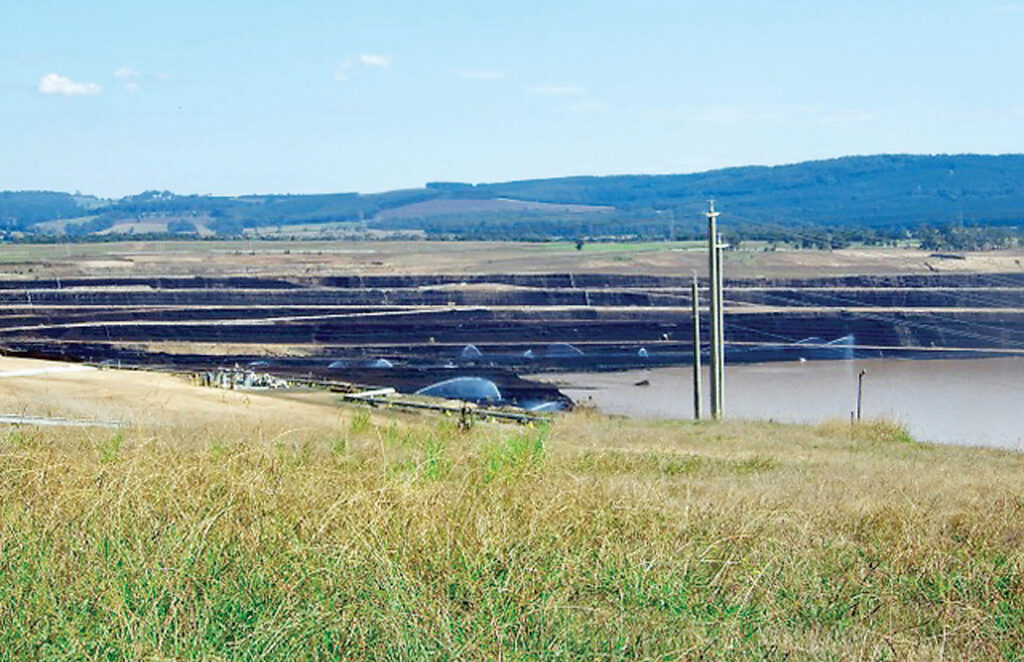
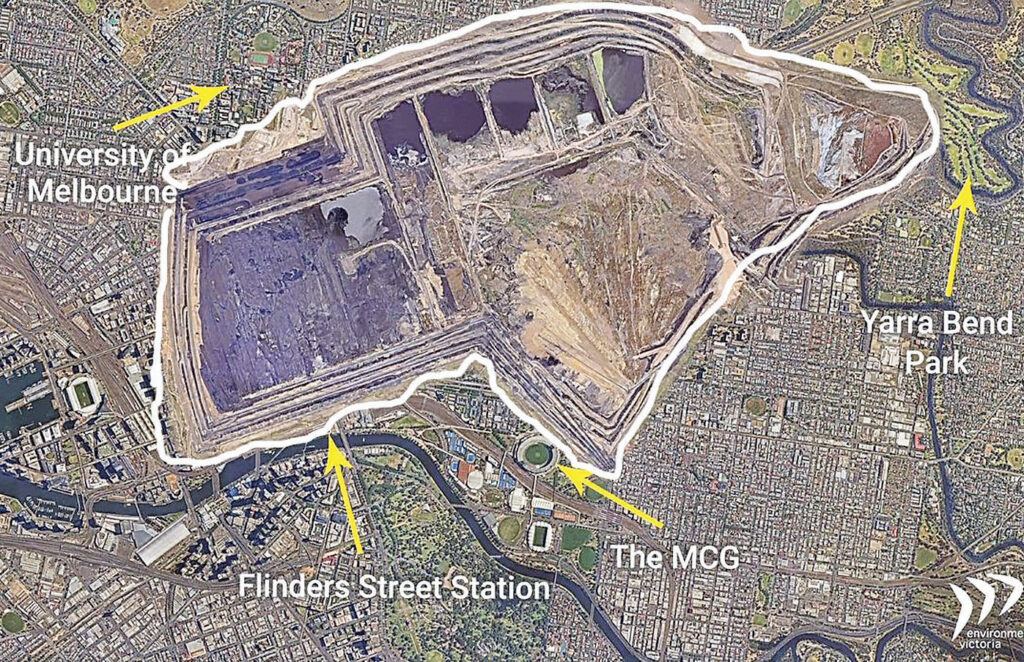
Hazelwood occupies four thousand hectares, which is bigger than the city of Melbourne, and the lake could hold more water than Sydney Harbour. Yallourn is even bigger and the two are geologically connected. Nina and her group see both being developed to provide much needed economic and social stimulus.
So, what could it look like?
Tourism, the lake:
Imagine international quality hotels cut into the wall, overlooking this massive lake. Golden beaches with safe swimming areas for families. Yachting, kayaking, diving, fishing, sailboarding and more. Cafes and restaurants catering to all tastes and budgets.
A zipline running to a floating island nature reserve in the lake.
Along the shores of the lake, an international golf course, a large nature reserve for bushwalkers and birders, a tourist railway ferrying visitors around the area – eventually this train would also serve the rehabilitated Yallourn mine.
Sporting facilities, picnic areas, perhaps an underwater viewing platform.
Imagine a large Indigenous centre to help us all better understand our first peoples, and acres and acres of parklands.
Industry: Hazelwood produces billions of litres of hot water; free energy which could bring whole new green industries to Latrobe City. Agriculture, and aquaculture could and would make good use of this readily available energy source.
Among the agricultural hot houses would be spas and baths for locals and international visitors to enjoy.
None of this is impossible. In fact it is all very possible and fortunately there is time to develop it and it doesn’t have to be developed all at once. Repurposing would be gradual and that would ease the cost pressures.
In his letter in the Latrobe Valley Express, Jamie Lowe signalled that perhaps some smaller parcels of land could be made available as and when needed.
Traf District News will continue to report on this topic which could once again turn The Valley into a thriving and vibrant economy. Disclosure: The writer is also a member of the Great Latrobe Park Committee.
Hazelwood produces billions of litres of hot water – free energy which could be used to develop aquaculture and agriculture industries and a healthy spa tourism industry.
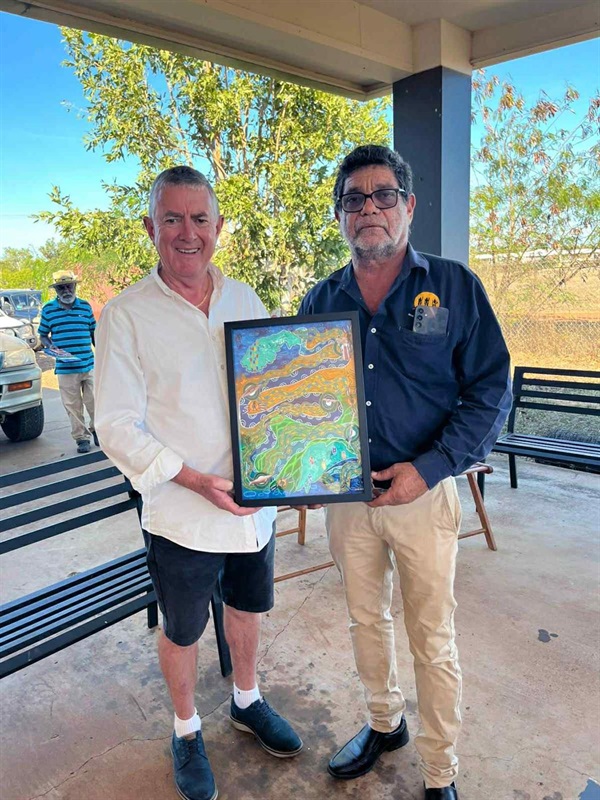
Baw Baw Shire Mayor Danny Goss has led a history-making journey to Far North Queensland to repatriate 37 precious cultural items from Baw Baw Shire back to the rightful custodians, the Lardil People of Mornington Island. On August 29, the Mayor embarked on his journey.
Upon arrival, he was met by Mornington Shire Council Mayor Mr Richard Sewter who hosted a morning tea at the local arts centre, where the official handover took place.
Mayor Danny Goss said the repatriation journey was deeply meaningful and a significant step on the path to reconciliation.
“We’re honoured to return 37 important cultural items to their rightful custodians — the Lardil People of Mornington Island. It’s a small but significant step towards a more respectful and united future,” he said.
“These items are some of the first examples of works that the Lardil people began creating for commercial sale. Since learning of their significance and rightful origin, council has been fully committed to returning these cultural treasures home.”
Mayor Goss said that this move is “about doing what’s right… and recognising the deep cultural connections that first peoples have with their heritage.”
As previously reported in the Traf District News, the artefacts were brought to Warragul in the 1980s by Colin and Elizabeth Goldberd who had purchased the pieces from the Lardil community. The family later gifted the collection to the West Gippsland Arts Centre, where the artefacts were safely kept and displayed for a short time. After learning that it is culturally insensitive for them to be displayed outside of the lands of their custodians, the artefacts were safely placed into storage, where they were rediscovered in 2023.
To council’s knowledge, this process has not been embarked on before, outside of established galleries and museums. Council obtained letters of support from both the Elders of Kurnai Nations and Wurundjeri Woi-wurrung, and importantly, the Lardil People, who look forward to having the items returned to their rightful Keeping Place.
Mayor Cr Danny Goss said this was a rare process — especially outside of national galleries and major institutions.
“We hope this demonstrates how the local government can play a meaningful role in reconciliation,” the Mayor said.
“With the support of the Lardil People, the Kurnai Nations Elders, and the Wurundjeri Woi-wurrung Cultural Heritage Aboriginal Corporation, we’re proud to be part of a movement working to restore Indigenous cultural heritage.”
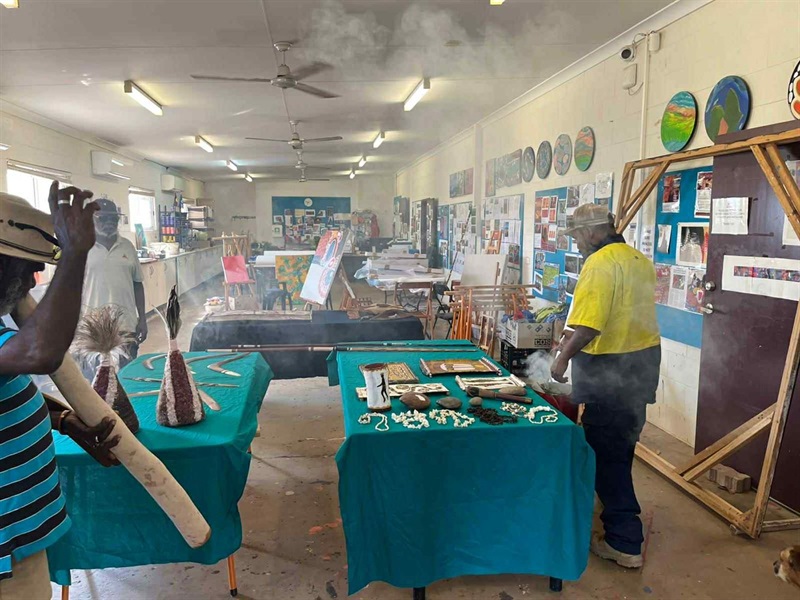
Following a special smoking ceremony on May 9 in Warragul, planning began for the artefacts’ journey home where they will once again serve their true purpose: passing on culture, stories, and identity.
The decision to repatriate the items was endorsed by Baw Baw Shire Council at the February 5, 2025 council meeting. The cost of repatriation was covered by the Mirndiyan Gununa Aboriginal Corporation who receive Australian Government funding to facilitate these types of projects.
Baw Baw Shire Mayor Cr Danny Goss and Mornington Shire Mayor Mr Richard Sewter at the official repatriation ceremony on Mornington Island. Images supplied.Welcoming the 37 culturally precious artefacts back home to Mornington Island.
The family of four woke at 3am to smoke and flames and the unmistakable pitch of fire alarms. They all got out safely, including two pet dogs, but the home was a write-off. Had it not been for the local volunteer fire brigade arriving within seven or eight minutes, the fire would have spread to neighbouring homes in this quiet little Trafalgar court. Let’s take a moment to thank these incredible volunteers who risk their own lives for the benefit of our community.
The lady of the house was in bed at the end of a long day, doing some texting and catching up on her mobile phone. She fell asleep. The problem in this case was that the phone was being charged at the time and it is likely it became smothered in blankets or a pillow.
Lack of ventilation is a major contributing factor when batteries catch fire. Any battery in charge mode must have air movement; or danger lurks. Your writer knows this having lost a home to fire because of batteries being charged in too tight a space with poor airflow. It is a costly lesson to learn and such fires are more common than most of us realise.
Max Hill is a retired policeman who is now professionally involved in the fire insurance investigation business. Max has visited many homes lost to fire so Traf District News asked Max to give us some pointers about what we need to do to be safer. Max provided the following advice and next month this newspaper will go into this subject in much more detail, including talking to the local fire brigade, a look at insurance, and other issues around batteries and fire.
Power Boards: Max points out that most of us use power boards made very cheaply in China. If the connection from the lead you plug in to the brass receiving ports (which you can’t see) is loose, there is a real possibility of fire. A spark reaches 3,700 degrees and that is enough to melt plastic and start a fire. Answer: Consider better quality boards and stay safer.
Ceiling Fans: When a ceiling fan rattles it almost certainly means a bearing is worn. That can cause a very hot spark and start a fire, possibly in the ceiling where it might take longer to be noticed. Answer: if your fans rattle, replace them.
Extension Leads: Max told us about a lead that was plugged into a wall socket but not attached to any tool or device, but still it caused a house fire. Answer: unplug anything that is not in use.
Old Laptop: Max told us of a young man with a fifteen year old laptop which he placed under his bed when he went to sleep.The laptop was switched off but still it caused a fire, perhaps because the battery and connections were old and loose. Answer; be aware there are dangers even when a device is turned off. Answer: be aware old technology can be a fire hazard.
MP Mary Aldred has used time in the federal parliament to champion regional newspapers, saying that “in triumph and tragedy, there’s someone who always turns up for regional Australia, and that’s the local newspaper.”
“Across towns and regions throughout Australia, the local paper weaves the threads that hold communities together… local news keeps people connected not just to events but to one another,” she continued.
MP Aldred named the regional newspapers in her electorate of Monash, including the South Gippsland Sentinel Times, the Warragul and Drouin Gazette, the Latrobe Valley Express, the Philip Island Advertiser, and our very own Traf District News.
“Regional journalists show up to meetings no-one else attends,” she said, a statement which rings true.
Between 2020 and 2022 over 100 regional newspapers in Australia ceased printing or moved to online-only publishing. The pandemic hit the industry hard and many businesses don’t have the funds to advertise anymore. Of course, many people are also finding their news elsewhere.
For the Traf District News, our only revenue is advertising, given that our newspaper is free for all locals to enjoy – an important aspect of a community newspaper. But many businesses are struggling at the moment and understandably need to cut back on advertising expenses. This leaves our newspaper, along with many other regional newspapers, vulnerable.
Aldred says there could be a solution. In 2023 and 2024, there was consultation on the News Media Assistance Program which should mandate $3 million of spending on advertising per year from 2025-26 for regional newspapers.
She also called on the government to finalise legislation to ensure Meta, TikTok and other platforms “join the negotiating table in good faith,” after the tech giants did not renew their deal with Australian publishers and stopped paying for Australian news content on their sites.
“There has never been a more important time to support our regional and local publishers. I’m calling on the federal government to get its act together and come good on commitments made which are well past their due date,” she said.
Aldred turns up for Baw Baw students
While back in her electorate, MP Mary Aldred took some time to speak to students at Marist Sion College in Warragul. She spoke to students about civics, parliament and the local community, calling it “one of the best parts of [her] job.”
“It was a terrific opportunity to speak to local students about some of these responsibilities, and hear their ideas on policy and local issues. It’s always wonderful to engage with young people across the Monash electorate, who have bright ideas, great questions and are committed to making a contribution to our local community,” she said.
Federal Member for Monash Mary Aldred speaks with year 12 students from Marist Sion College in Warragul.
At the end of September, the Bendigo Bank Yarram branch closed its doors permanently. An announcement, made in June, confirmed the “difficult decision” to close Yarram and nine other regional branches including Korrumburra.
Bendigo Bank argues that in an age of online banking, less people are visiting physical branches. A spokesperson claimed that only 26% of Yarram customers have visited the branch in the last year.
Local resident and vice-president of Yarram & District Progress Association, Kevin Mackin said that the community has been working hard, “trying to find a solution.”
He told Traf District News that they’d suggested options for the branch to have shorter hours and offer fewer services.
However, “Bendigo Bank has been particularly unwilling to discuss, negotiate or consider any option, other than their course of action,” he said.
All this means that Yarram customers will need to travel 64 km to the next closest commercial branch in Traralgon. There is a closer community bank in Toora, but Mackin says the bank has automatically transferred the accounts to Traralgon. He said that this only “added insult to injury.”
Mackin said that the decision and the preceding talks with the bank has destroyed its reputation in the town.
Federal Gippsland MP Darren Chester called the closure a “disgraceful decision.” He said the Bendigo Bank liked to promote itself as the better big bank, “but when it comes to shutting country branches, the Bendigo Bank is proving to be just as bad as the rest of them.”
With over 2100 bank branches closing between 2017 and 2023, locals are hoping that support for regional banks can come from higher up. In the last few years, there has been a Federal Regional Banking Taskforce which released a report in 2022 and a Federal Senate Inquiry into Rural and Regional Affairs which made recommendations last year.
Banking Code of Conduct was proposed which would mean banks need to meaningfully engage with the community and discuss potential impacts that would come from branch closures. The idea of a publicly owned bank was also discussed. In theory, a publicly owned bank would act in the interests of the community rather than shareholders. It was also recommended that Bank@Post services offered by Australia Post need to be improved.
For Trafalgar residents, our branch is protected as a community bank, meaning it’s owned by locals. It was opened by local business owners in the early 2000s that recognised that regional banks would be under threat.
The Trafalgar Community Bank recently had its branch refurbished, with manager Torina Johnston ensuring they are “here to stay.”
For Yarram, “a community bank is [the] preferred model,” Mackin said.
“The community bank in Trafalgar has been supportive, helping us to understand the difference [between community and corporate branches],” he said.
“We recognise the value of what they give to the local community,” he said, noting that the Trafalgar branch recently hit a milestone, $2 million given back to the community.
In the meantime, Mackin confirms the community “haven’t given up hope.”
Editor’s Note: Please note this story was written prior to the scheduled closure of the Yarram branch but published afterwards. We will continue to follow this story and provide updates when necessary.
We will not fill this article with a lot of statistics but two are important. First, homelessness officially increased in our area by 60% between the 2016 census and the 2021 census and we all know things are tougher now than they were in 2021. We also know that people living rough were very unlikely to fill in a census form, so the 60% figure could be significantly higher. Secondly, all the agencies dealing with homelessness and poverty report a sharp increase in the need for their services, due in a major way to very noticeable increases in the cost of living.
Jason and Kerry Rantall run Bettermentall Inc. and they are dealing with this major problem on a daily basis. They are trying to make a difference and they are making a difference, so we asked Jason how the problem can be solved.
“If we expect someone else is going to fix it, nothing will happen. We all need to all have some skin in it, in some form, and start looking after our own backyard. If we can look after our own community, we can solve the problem in our own community, and then another community can solve its problem and so on.”
The first thing toward helping, is to better understand that people living rough are from all walks of life, and all age groups are affected.
“It’s from young people, like kids, right through to the elderly, and there’s a whole range of reasons. Life gets too big on some, and they end up on the streets because they just can’t handle what’s going on emotionally and mentally and physically. There’s others that have had traumatic experiences, whether it be family violence, and they’re escaping to be safe. I mean imagine having to escape to the streets to feel safe. There’s violence against women, there’s violence in the home, there’s a whole range of reasons.
“I know a guy who lost the person he loved most; his wife. They had a home, they had jobs, they had plans; then she died suddenly, and he just couldn’t cope. He turned to alcohol, lost his job, lost his house, and was on the streets. So we never know what’s happening. And it can be such a quick slip.”
Jason wants you and me to know that the homeless aren’t all dangerous or unapproachable. They have slipped, for any number of valid reasons and they need help getting back.
Jason continued: “If people actually heard the stories, they’d have a bit more of an understanding why people are where they are. Instead of throwing stones and accusations and judgments at people, if they actually sat and listened to their stories, they would realise that none of them really want to be there.”
Jason will argue that we need more and more local people to get involved – ordinary people who could help set up a community hub, or help find accommodation, or volunteer some time at an existing centre, or run a raffle or collect warm clothing. Any one of a hundred things which will help the lost get back on their feet.
Jason says, talk to a homeless person if you see one, just as you would to anyone else. They are people who have lost their way temporarily and just by opening a dialogue you may be helping with their eventual recovery. If you would like to help Jason and Kerry with their work, or learn how you can do more to end homelessness, contact them on: 0412 418 431. Email: info@bettermentall.com.au. 36 Contingent Street, Trafalgar, VIC 2824.
On Wednesday July 16, Acting Minister for Community Sport, Gayle Tierney announced 827 grants amassing over $1 million for sport clubs around Victoria.
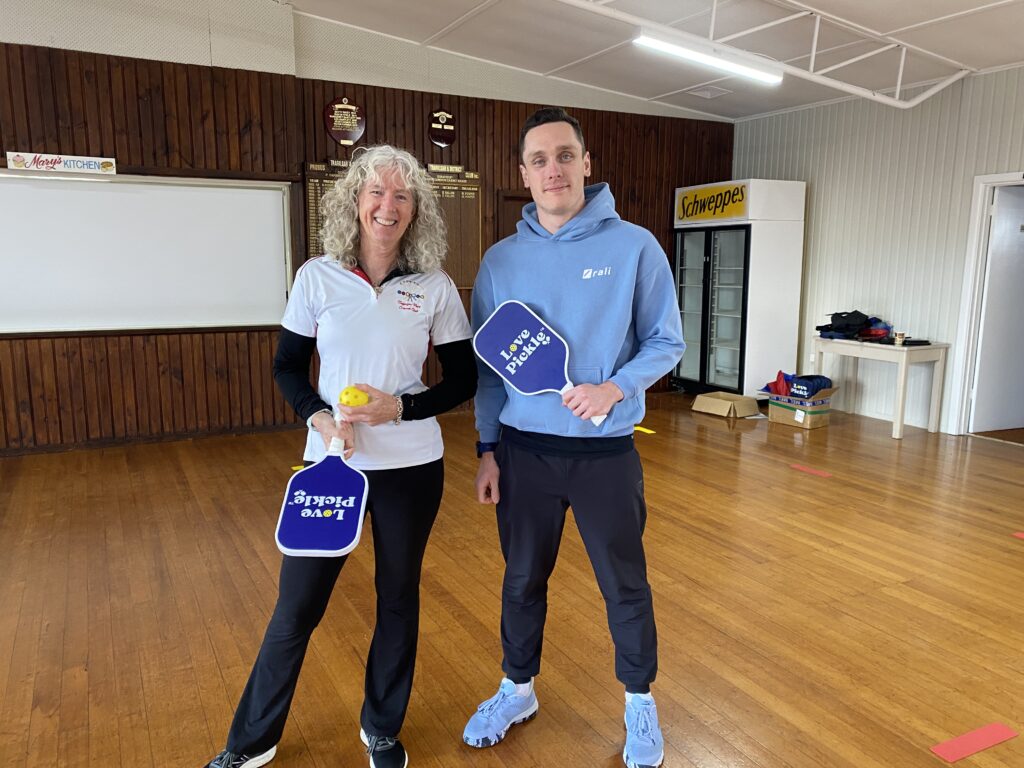
The Trafalgar Park Community Hub was granted $4,000 to introduce pickleball into the local community.
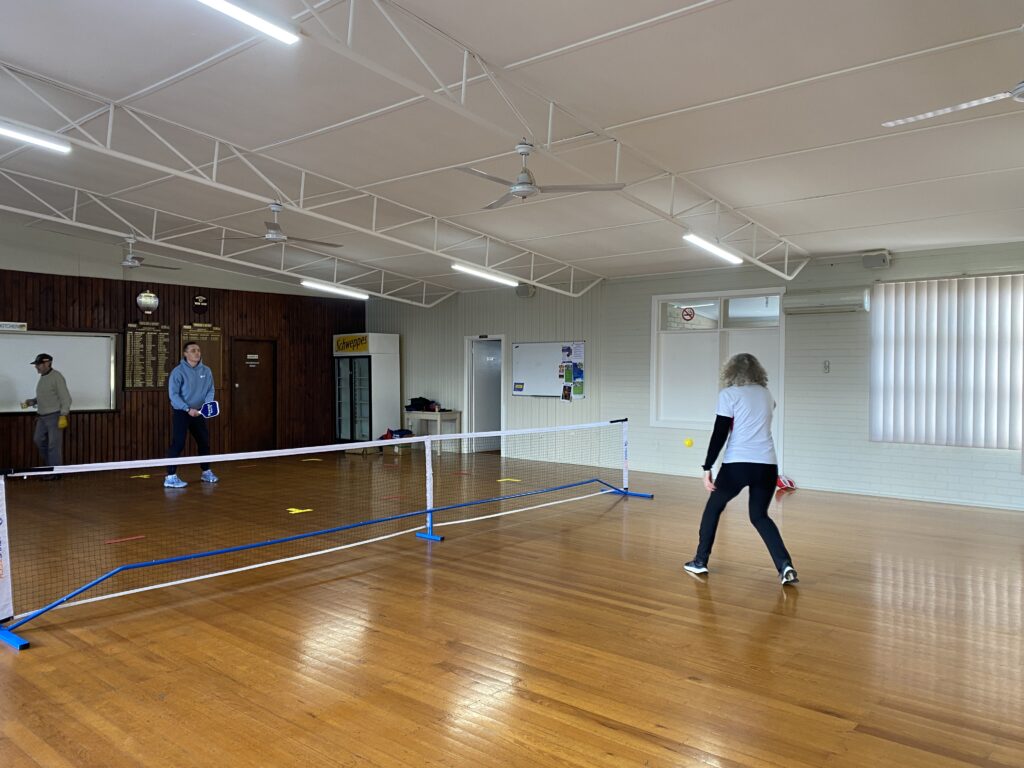
A cross between badminton, tennis and table tennis, pickleball is a sport for all ages and abilities that can be played in singles or doubles, indoors or outdoors.
Secretary of the hub Raewyn McMahon says it is “one of the fastest growing sports in the world.”
McMahon says she had seen the popularity of pickleball and was excited to introduce it into Trafalgar, saying it will be a “pretty cool” thing to offer to the community.
She is looking forward to creating a “great little club.”
Instructor Michael Murrell is equally as excited to see pickleball introduced into Trafalgar.
A seasoned pickleball player himself, having played in many tournaments, Murrell encourages everyone to give pickleball a try.
Though it is a sport commonly played amongst an older demographic, Murrell is hoping to see younger players get involved in the sport to create a “different style” of play.
The grant money will cover facilitation, advertising and the creation of a booking system. The money will also cover the purchasing of equipment.
Pickleball will be available to play socially from Tuesday September 16, from 6:00-7:30pm at the Trafalgar Tennis Club.
For more information and updates, please visit the ‘TCH Pickle Ball’ Facebook page.
Raewyn McMahon and instructor Michael MurrellRaewyn and Michael playing indoor pickleball.
In July, Traf District News reported on the return of a Buln Buln East soldier’s bugle to the area. Another chapter in the story of the bugle, thought to have belonged to George Eyre, has emerged.
On August 9, the Warragul RSL held an event to remember George Eyre and share the next chapter in his story.
As previously reported, George Eyre enlisted in 1916 and was shipped to the Western Front. Eyre took with him a customised bugle. Unfortunately, he was killed in action in April 1917 and the bugle was lost. It was recovered when an Australian found it while in England and traced it back to Warragul. It was then donated to the Warragul RSL.
In July, Warragul RSL president Lynn Mizen was able to get in contact with Peter Eyre, the great nephew of George Eyre. George’s oldest brother, James had a son, George Herbert who also enlisted and served in World War I. George Herbert was shot and wounded in action and returned to Australia in 1919. In 1946, he and his wife, Hilda, had a son, Peter.
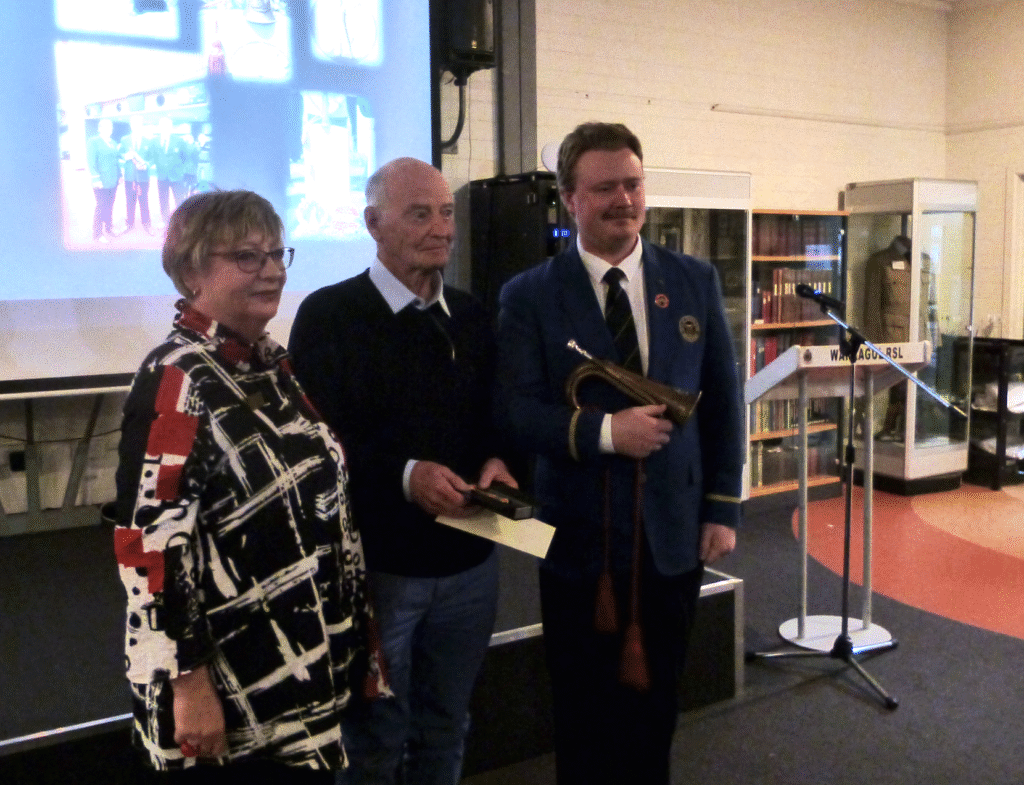
Peter and his wife Jenny attended the event and presented the Warragul RSL with a medal belonging to George ‘Bugle’ Eyre that Peter’s father had come into possession of. There will be a new display at the RSL which includes this medal.
Along with this news, there was also some other news. A WW1 historian, Tim Lysett, got in contact and believed the bugle to be commemorative and not a military issued bugle.
“There is no question that when the bugle was discovered in Norfolk in the early 1980s, that it was genuinely believed to be from the first World War and that the research conducted at that time to link it to George Eyre was done in absolute good faith,” Mizen said.
“Unfortunately, at this point in time, we cannot provide the evidence to prove that the bugle belonged to George Eyre, but nor can we prove that it didn’t. Further research and investigation is required and is underway,” she said.
Going forward, the bugle will be named the George Eyre Commemorative Bugle and will honour the Eyre family.
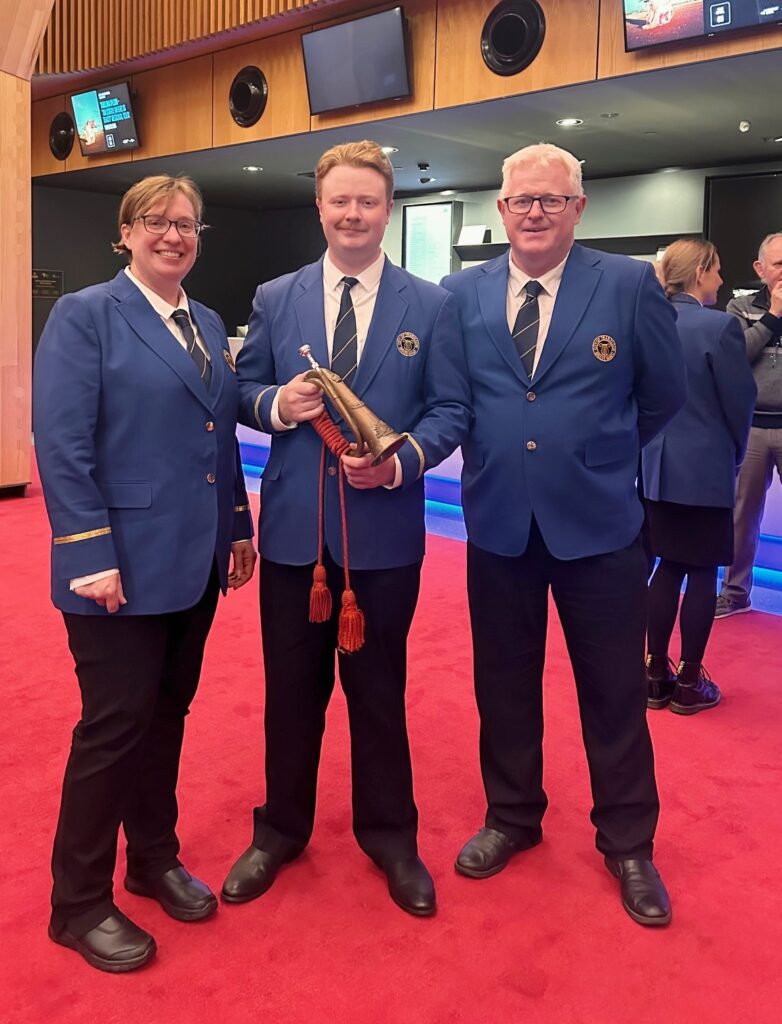
Lachlan Wilson from the Traralgon City Band played the bugle at the event, just as he did at the grave of Gerorge Eyre in France during the band’s European tour, honouring the memory and sacrifice of the fallen soldier.
Sarah and Anthony Lucas, also members of the Traralgon City Band’s tour, spoke at the event, recountering their experiences and paying tribute. Sarah called the opportunity to “honour those like George Eyre who have served and continue to serve [Australia]” a ‘privilege’.”
Sarah spoke highly of the experience .“To say we learnt a lot is an understatement,” she noted.
“We reflect on the fact that war does not just impact those who are fighting, the impact ripples through the towns, countries, families, friends and communities,” she continued.
Baw Baw Shire Mayor Danny Goss and Deputy Mayor Tricia Jones were also in attendance, with the latter receiving a personal thank you from RSL president Lynn Mizen for her involvement in the process.
Lachlan Wilson with the Bugle at the Gippsland Performing Arts Centre in Traralgon. Image supplied.Warragul RSL President Lynn Mizen, Peter Eyre, and Lachlan Wilson.
A town library has been a popular topic of discussion in Trafalgar for the past few years. The town currently has a travelling mobile library (MYLI) which visits Trafalgar on Tuesdays (9:30am – 12:30pm) and Fridays (11:00am – 1:30pm, 2:30pm – 6pm). It also makes stops in local towns like Thorpdale, Yarragon, and Willow Grove.
The closest permanent libraries to Trafalgar are the Moe Library (approximately 10kms away) and the Warragul Library (approximately 22kms). While these are fairly accessible by train or car, a permanent Trafalgar library would be more convenient.
In 2022, council officially endorsed the old Trafalgar Kindergarten at 28 Contingent Street as the preferred site for a town library.
The library is currently within the Long Term Infrastructure Plan, which outlines council’s plan for infrastructure projects over the next 10 years. According to a council spokesperson, “the overarching objective of the Long Term Infrastructure Plan is to provide the right infrastructure, at the right time, in the right places, and in a way that represents best value for money and sustainable use of resources.”
This plan has been on public display in August and will be reviewed and endorsed by council in October.
Council’s endorsed design for the library would cost approximately $1.3 million. A council spokesperson told Traf District News that they are seeking funding from the State Government Living Libraries Infrastructure Program, and subject to a successful grant application, the project would proceed in 2026/27.
Under this program earlier this year, the state government announced funding to deliver new or upgraded infrastructure projects at 19 libraries across.
Minister for Local Government, Nick Staikos said that funding libraries helps foster “lifelong learning.”
“We know that libraries are the heart of the communities they serve, which is why we’re pleased to support these nineteen community spaces to build lasting change,” he said.
Many of the projects that received funding are based in regional areas as well. Morwell Library received approximately $30,000 for the installation of a kitchenette while libraries in Gisborne and Bendigo will receive more than $400,000 each for major upgrades.
Research conducted by Philip Hider at the Charles Sturt University – which surveyed more than 100 regional and rural libraries in Australia – found that libraries act as a “community hub” and facilitate connection and engagement within the community. The fact that libraries also carry physical media, such as books and DVDs, as well as having computers, printing services and free Wi-Fi, was seen as important as well.
Former councillor, Darren Wallace endorsed the Contingent St library design back in 2022. Even after his defeat at last year’s election, he is “still trying to get the old kindergarten, which is a council building, turned into a static library.”
A council spokesperson said “council will explore engaging with the Trafalgar community to finalise any proposed plans in the near future.”
With this in mind, what do you think of a permanent library in Trafalgar?
The mobile library, operated by MYLI, in Trafalgar.
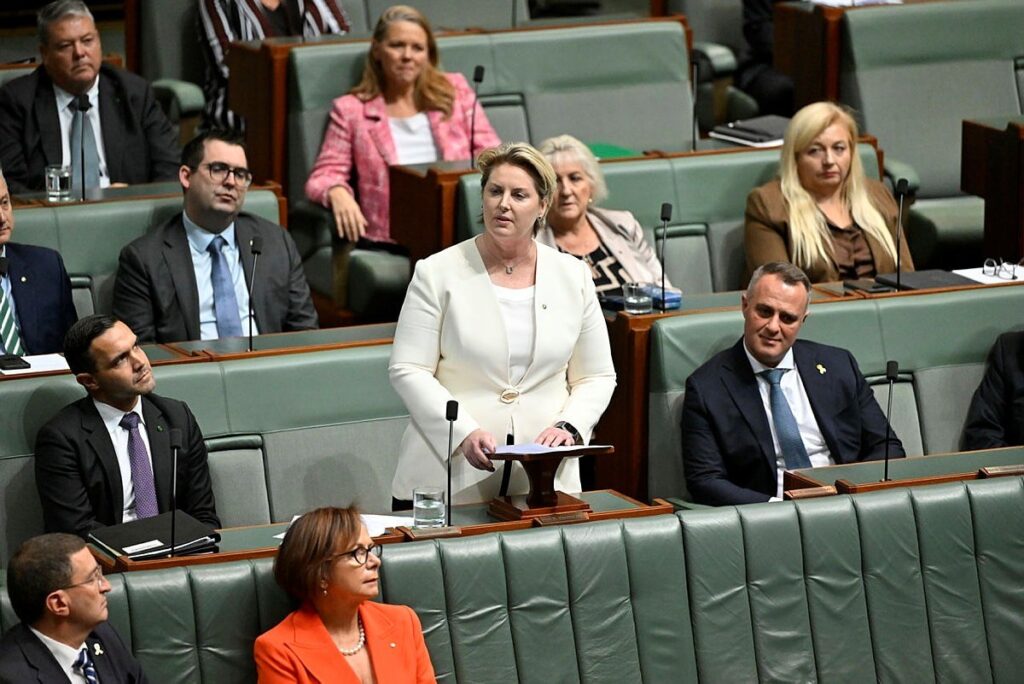
On July 31, Mary Aldred, newly elected Member for Monash delivered her maiden speech.
MP Aldred said that it was her; “life’s greatest privilege to rise as the member for Monash and an honour to address the House on behalf of [her] community.”
Aldred spoke highly of her electorate and thanked them for placing their trust in her.
“Monash is part of the great Gippsland region, where Australia’s richest soil meets the sea adjoining the world’s best beaches. In Monash, it’s callused hands and boots, not suits, that build national progress brick by brick. From dredge to boiler room, paddock to milking shed, harvester to timber yard, workshop to shopfront, I honour these great Australians. Our national success rides on their shoulders,” she said.
She thanked her supporters, including Senator Jane Hume, State MP Wayne Farnham and newly appointed Opposition Leader Sussan Ley, who visited Monash throughout the election campaign.
“My supporters were there for me every day I was a candidate, which spanned about 18 months—or 538 days if you’re counting,” Aldred said.
She also acknowledged her predecessor Russell Broadbent and said that he and his wife are “good people.”
“While we spent the last two years as opponents, the fact is that we were good friends for 20, and it was a privilege to support him over that time,” she said of Broadbent.
Fifty years on from her father’s election to federal parliament and nearly a decade since his passing, Aldred said that “my dad’s views on the world could be complicated. His love for me was not.” Aldred noted that she is the 1,246th Australian elected to federal parliament, and that her father, Ken Aldred, was the 660th. She also acknowledged her mum, Margie, a former teacher and small business owner, for instilling many values in her.
Aldred has many “local priorities” on her radar, including but not limited to a new West Gippsland Hospital.
Aldred has been appointed to several parliamentary roles. She will be the Deputy Chair of the House of Representatives Standing Committee on Communications, the Arts and Sport.
Aldred ended her speech with a pledge to her community; “I recognise that each day I spend in this place is a day closer to when I will leave. I plan to make each day count by advancing the cause for which I am here, a passionate belief in the purpose and potential of the people of Monash. To my electorate: I asked for your trust and confidence. You have given me the opportunity of a lifetime. I will work my heart out for you.”
Aldred’s speech was met with applause from her colleagues in the house and onlookers from the gallery.
Aldred is now encouraging local high school students to enter the 2025 My First Speech competition. The national competition invites year 10, 11 and 12 students to write and submit a 300-word first speech, imagining themselves as a newly elected Member of Parliament and speaking on the issues they care most about.
Three winners, one from each year level, will be flown to Canberra with a parent or guardian to deliver their speeches live in Parliament House.
Aldred said that “this is an outstanding opportunity for students in our local Monash community to stand up and be heard on the national stage.”
“I encourage all year 10, 11 and 12 students in Monash to take part… this is their opportunity to advocate on the issues that they are most passionate about,” she said. Entries can be submitted by September 15 at www.mfs.houseofrepresentatives.gov.au
Mary Aldred MP delivered her first speech to Parliament on July 31. Both images are supplied.
Aldred’s heartfelt speech was met with applause from her parliamentary colleagues.
Great news! Gardivalia will open on Saturday, October 25 & Sunday, October 26.
Discover Gippsland’s most breathtaking gardens this Spring. Gardivalia’s garden trail is set to dazzle with blooming backyards, hidden green gems, and floral masterpieces waiting to be explored throughout Baw Baw Shire.
In North Trafalgar, a delightful two acre garden ‘Bellissimi Alberi’ will bring all your senses alive with forest pansies, birches, magnolias, azaleas, roses and more.
In Darnum you will find ‘Gumview’, an informal garden with many beautiful magnolias, camelias, maples, peonies, a clivia collection and many bulbs.
Explore two gardens in Willow Grove, ‘Lakeview’ and ‘Dot’s Garden’. View the beautiful views of Blue Rock Lake from ‘Lakeview’, its old machinery displayed, roses on trellises, camellias, the orchard, and over 70 deciduous trees.
‘Dot’s Garden’ started as a farm and now has 58 small garden beds and many wonderful and amazing sculptures. Willow trees, crepe myrtles, roses, ornamental cherries, flowering gums, elms, magnolias and more. Views look east to the mountains.
Across and up to Icy Creek you will find ‘Meander’, a seven and half acre garden showcasing rare trees and shrubs against a backdrop of large eucalypts and mountains. Meander through the kitchen garden, mixed borders and woodland paths.
On Sunday, it’s the last chance to visit ‘Tall Timbers’ in Piedmont, walk through an expansive garden of many acres in a natural bush setting, with additional plantings of many exotic trees and shrubs around the creeks, cascades and large ponds.
Visit the ‘Old Neerim Schoolhouse’ in Neerim established in 1902, with expansive gardens, abundant produce, and stunning views. Laurie Collins ‘Sculpture Garden’ at Jindivick has over 60 metal sculptures in an acre among garden beds and trees and a gallery.
Traveling towards Warragul, visit ‘My Ross’ at Brandy Creek. Pathways, rock walls, roses, border plantings and a small lake form the structure, with stunning north views to the Baw Baws. On Bloomfield Road visit ‘Carlisle’ & ‘Darley Grange’. ‘Carlisle’ is a colorful country garden with a number of unusual and cleverly made water features, vibrant roses and seasonal perennials. ‘Darley Grange’ specializes in 80 different stunning bearded irises and orchids and large Irish Strawberry trees.
In Drouin, visit ‘Lois’ Garden’. For those who want to know more about succulents this is for you. Full of succulents and cacti, low maintenance, no watering, no hassles.
In Copelands Rd, Warragul you can walk around ‘Wrens Wood’, a five acre garden with oaks, gums, maples, conifers, roses, buddlejas, rhododendrons, camellias, fruit and nut trees, a vegetable and berry garden, ferns, vines & orchids.
In Warragul, you will find ‘Rustic Charm’, ‘Fiona’s Garden’ & ‘Warragul Community Centre’. ‘Rustic Charm’ has a small backyard with rustic, eclectic ornaments, and a mixture of plants and trees. There will be crafts, arts and mosaics on display. ‘Fiona’s Garden’ has many garden rooms on one acre: a show garden, permaculture vegetable and orchard, Bee hives and berries. ‘Fiona’s Garden’ will have a compost making demo at 11am on August 25. ‘Warragul Community Garden’ grows produce, flowers, fruit and herbs with beehives, and has a cubby house.
Programs will be available throughout the Baw Baw Shire. For more information and photos please go to our website on www.gardivalia.com.au
At the August Trafalgar Farmers’ Market I was surprised and delighted to see three Scottish Highland cows (also affectionately known as ‘Heilan Coos’) being introduced to the public. These long-haired, long-horned gentle animals attracted a lot of attention with kids and adults alike, lined up to look, to smile, to pat and to be photographed.
The oldest of the three is a four-year-old female named ‘Murphy’ and she was alert and bright and studied everything around her. Weighing in at 400 kilos, this small statured but solid animal was the major attraction. In the pen with her was her owner and breeder Glenn Adams, who was answering questions and all the time gently currying Murphy’s long red coat.
Longhorn Scottish Highland cows have had a checkered existence in Australia.
Scottish immigrants brought small numbers of this hardy breed to Australia from the mid-nineteenth century, but approximately fifty years later, none remained. The breed was re-established in 1954 with the importation of two cows and a bull from Scotland.
Glenn and his wife run Serenity Farm in Yarragon and Traf District News asked Glenn what sparked his interest in this unusual breed.
“Basically, it’s just the love of animals. I’m an ex-dairy farmer, and I left dairy farming quite some time ago and just fretted for farming again.
“We used to show Jerseys down at [the] Melbourne Show, and my wife would always disappear and go down to the beef section and look at the Highland cows and always said she wanted one.
“So, I bought one about six years ago, and now we’ve got about 50 of them running around the paddock.
“These are a heritage-listed breed and the genetic gene pool is getting thin. So, we are all about preserving the purity of the breed.
“We import some semen from Scotland and try and keep that gene pool pure and not mix it with anything.
“When the Vikings turned up in Scotland they came across these in cattle and that’s where the cups and drinking horns came from.”
Serenity Farm is set in serene country in the hills south of Yarragon and is open to the public to come and spend some time among the animals.
There are more than fifty highland cows and you can picnic among them, take walking tours of the farm, have a photo session with them by a professional photographer on site, and enjoy the quiet energy of the farm and these gentle animals.
While you are there patting and enjoying the cows, Glenn will give you a run down on the breed and what they are doing at Serenity Farm to preserve it. It will be a great family day out. You can contact Glenn Adams via email: glenn@serenityfarm.com.au or through Facebook.
“If you want to move forward, often look back, otherwise you’ll forget where you came from and where you need to go.”
An important part of being Australian is understanding our past and that is not forgotten in Trafalgar. Our hardworking Historical Society has information on almost everything, including when Trafalgar and surrounds were first established, as well as the important figures from our town’s history.
There were many pioneering families in Trafalgar who made this town what it is today; one outstanding man was Alexander Matheson. Matheson was one of the first residents of Trafalgar and contributed to the farming industry, while also being a significant figure in the town. He played a part in the building of the area and led a full and hardworking life.
Matheson was born in Perthshire, Scotland, in 1845, and immigrated to Warrnambool in the early 1870s, with his two friends Charles Mitchell and James Falconer. They were Christadelphians, which is a branch of Christianity. They differ from other Christians due to their practices and specific interpretations of the Bible.
In 1877, the trio decided to purchase land in Gippsland and built the railway line from Sale to Melbourne. Matheson bought land west of Loch’s Creek and opened a farm there. At the time, Trafalgar was unsuitable for farming because it was a wetland, but with lots of hard work and modern farming practices, Matheson soon had a very successful farm.
His farm was so successful that it won awards. In 1900, and 1901, Matheson won two 2nd prizes for the best managed farm in Victoria, from the journal, Leader, before winning another two 2nd prizes for the best dairy farm in 1899, and 1901. It was known as ‘Model Farm’, and many farmers would come to see his successful practices to try to better their own farms.
As a Christadelphian, Matheson regularly attended meetings in Trafalgar, with other members, to practice their faith. These meetings were usually hosted by Charles Mitchell in his home, but when he died in 1888, Matheson became the leader of the church group due to his good reputation.
In terms of family, Matheson had a large family and was married to Sophia Matheson. He and his wife moved to Hawthorn just before World War 1 and lived there until their deaths in 1931 and 1934, respectively. With Sophia, he had ten children, Jane, Sophia, Elizabeth, Sarah, Margaret May, Alex, Alice, Flor, Annie and Charles. Before leaving Scotland, he had a son, James, who was born out of wedlock to Mary Kelly, who died thirteen days later. He took James with him when he moved to Australia.
On 5 November, 1891, Isaac Evans opened a butter factory on his property and Matheson, along with Evans, Sam Giblett, H. E. Webb and Charles Murray, was a pioneering director of the factory. Charles Murray raised the idea in a meeting in May, and many farmers showed their interest. Due to the Great Depression, it was a slow start to get the factory on its feet, but in the first year, they were able to export 155 cases of butter to England.
Matheson commented on Trafalgar’s transformation into a successful farming area due to the tireless work of the community.
“To note now the cosy little homesteads and well kept farms dotted here and there, jets of steam issuing from factory and creamery roofs, smiling, waving areas of maize and other fodder crops, herds of cattle grazing on all sides, the former sheets of water now controlled and flowing within, the luxurious but profitless growth of bullrushes and ti-tree replaced by well-kept artificial pastures, all combine to give undeniable evidence of the hard work, well directed, that has brought about so marvellous a revolution.”
His pride to be a resident of Trafalgar is evident. The town is full of hardworking and passionate people and this continues to be true to this day. Matheson truly was an outstanding character in our town’s history and remains a role model for dedication and excellence in our community.
Set in Australia in the 90s, Netflix show ‘Videoland’ follows the story of 17-year-old girl named Hayley, who is learning to navigate her newfound sexuality.
Throughout the short series, Hayley seeks to find out how to live in her sexuality by watching queer films. Lucky for Hayley, she works at a video store, so she has no trouble finding these films.
‘Videoland’, was filmed in Moe, Victoria, at Future Flicks, one of four remaining traditional video stores in Victoria.
Owner of ‘Future Flicks’, Ricky Dyt, began the operation of the store in 1987.
“I think it has become really nostalgic.”
“I have a lot of people just come in and browse around and take photos.”
“People want to feel the old tradition of video stores,” Dyt said.
When he was approached by Jessica Smith and Scarlett Koehne from Pikelet Pictures, in late 2022, with their idea, Dyt was more than happy to work with them and transform his store “back into the 90s.”
The filming of the show commenced in June, 2023, and ran for about three weeks.
According to Dyt, ninety five percent of the show was filmed at Future Flicks.
“Ninety five per cent of the show was filmed here”, Dyt said.
Dyt explained how the only scenes not filmed at Future Flicks were filmed in a storage room at Old Gippstown.
Videoland featured a lot of locals as extras, and the quirky comedy is now streaming on Netflix.
Last December the state government announced increases to the compulsory fire service levy and the increases are hefty – close to a 100% increase for homeowners, big rises for businesses and a 169% increase for farmers. The levy is collected by local councils and passed on in full to the state government. The levy is collected annually to help fund fire fighting services.
Darren Wallace is a thirty year CFA veteran and is also the state councillor for this district to the body representing CFA volunteers; Volunteer Fire Brigades of Victoria (VFBV).
The state will collect an extra $168 million dollars this year and Wallace and his colleagues believe $60 million of that needs to go each year to replacing the CFA’s ageing fleet of vehicles.
Tankers are the workhorses of the CFA and 227 in the state’s fleet are more than 31 years old. Another 212 are in the 26 to 30 year range. The government is offering $30 million a year, for four years, for replacement vehicles, but Wallace argues that buys only sixty trucks (at $500,000 each) and at the end of the four year period the oldest trucks will have been replaced, but the 212 trucks in the 26 to 30 year old range will then be 30 years and more old. In Wallace’s view that achieves little.
He is not alone in that view. Adam Barnett, CEO of VFBV had this to say.
“The government is actually defunding CFA and investing less and less. That is like reducing your insurance as the rate of theft increases. In the most fire-prone place on earth – it is just madness.
“Further analysis has revealed the tens of millions of dollars being siphoned from CFA’s budget to be diverted to public service bodies and departments.”
Section 76 of the CFA Act stipulates that government contributions to the CFA are 22.5% from general revenue and 77.5% from the fire services property levy. If that formula applied to the increased funds raised from the levy, the CFA would receive an additional $129 million, but that is not the case.
Wallace remembers when a truck was considered old and ready for replacement at twenty years of age. That was lifted to twenty five about fifteen years ago and now there is no upper limit. But vehicles wear out and more than nine hundred of the state CFA’s tankers are twenty years and older.
A lot of extra money will be collected through the levy this year and Wallace and the CFA volunteers want $60 million of that per year to go toward vehicle replacement, arguing that the $30 million being offered won’t solve the problem.
Trafalgar CFA has one old tanker and it is a single cab appliance which means up to three firefighters have to ride on the back of the truck facing imminent danger. Coming home around midnight from a recent fire at Narracan, the volunteers on the back of the truck were freezing; and that was in summer. More than seven hundred tankers in the CFA fleet are single cab appliances so hundreds of volunteers are exposed to danger and severe weather every time they go out to serve.
CFA volunteers give up their time and safety and comfort to fight fires for their communities and frankly they deserve the best equipment available to keep them safe and effective
Wallace also added that the Trafalgar tanker is two wheel drive which is almost useless once off the bitumen and that puts firefighters at even more risk.
The Trafalgar brigade also has a pumper truck and a general purpose vehicle for which much of the funding for that comes from a generous public.
Like many people, the boredom of covid lockdowns resulted in trying new hobbies and getting back into old ones. For Trafalgar medical doctor, Hannah Farthing, it was jig-sawing.
Farthing traced her love for jig-sawing back to her childhood where she did her first jigsaw at around the age of three.
“I always sort of did them [jigsaws] growing up, but I got back into it during covid.”
Farthing explained that every night during covid, she would complete a thousand-piece jigsaw whilst watching TV; something her mum thought was “weird.”
From there Farthing went looking and stumbled on the Australian Jigsaw Puzzle Association – which she joined – and has been a part of ever since.
In 2024, Hannah competed in many competitions, including state, national, and world.
The Victorian state competition saw Farthing clean up nicely, placing first in both individuals and pairs, doing a 500-piece jigsaw in amazing time.
In nationals, Farthing placed 8th in individuals, and 1st in pairs and teams.
The world competition whisked Hannah off to Valladolid, Spain which saw her place 29th in individual, 10th in pairs, and 6th in teams.
When asked how Hannah prepares for competition, she boiled it down to practice.
“Most of the time I come home from work and do at least one, or two five hundred [piece jigsaws].”
“It also goes a lot further. It’s a bit of recording yourself doing puzzles, and then rewatching the footage to see what you could have done better,” Farthing said.
With the right amount of practice, Farthing believes that everyone has the potential to become a jigsaw champion.
“Puzzling non-competitively is something that the vast majority of people have done before. It is relatable to a lot of people.”
“I would certainly recommend doing some puzzles, joining a group, and seeing what is out there. A lot of people might just end up swapping puzzles or talking about how to approach a puzzle. Then if you want to be competitive, you can always lean into that,” Farthing said.
In 2025, the competition continues as Farthing plans to go back to defend her title as Victorian State Jigsaw Champion, and compete in the World Jigsaw Puzzle Championship, in September.
“I won Victoria last year, so I am hoping to defend that,” Farthing said.
Perhaps, dear reader, this is a sign for you to get back into an old hobby. You never know what could happen.
In late November, Parks Victoria saw its leadership change hands as Matthew Jackson stepped down and Graeme Dear was appointed as Interim CEO. Jackson had led the government agency since 2017, but left the position by mutual agreement.
Graham Dear brings with him 30 years of experience in public and private sector administration and has served on the Victorian Fisheries Authority Board. Dear is also a member of the Great Outdoors Taskforce – the group responsible for reviewing and making recommendations about future forest and land management in Victoria.
The Victorian Minister for Environment, Steve Dimopoulos, expressed his confidence in this move.
“His passion for the great outdoors and experience in administration means he is the right person to help Parks Victoria change,” he said.
“His leadership will ensure Parks Victoria continues to provide accessible, enjoyable outdoor experiences, while protecting and enhancing the state’s natural environment,” he said.
At the end of last year, Dimopoulos also announced that he had ordered a review of Parks Victoria. He wants to ensure that the organisation can serve the needs of Victorians to the best of its abilities.
He said that “It’s clear that Parks Victoria’s current operations need to be improved to meet community expectations.”
According to reporting by the ABC, the review will be conducted by the Melbourne based advisory firm KordaMentha.
Parks Victoria ensured that during this period of change and review, that it remains focused on ensuring our parks are open, safe and clean for all Victorians to enjoy, and we will continue to prioritise this important work over summer.
The agency has already shown this to be true, raising over $800,000 to establish a conservation sanctuary at Wilsons Promontory National Park, in South Gippsland.
This project has been a collaboration with a long-term charity partner, the People and Parks Foundation. Donations from generous Victorians will directly fund habitat restoration, species reintroduction, and critical pest control efforts.
The sanctuary would be the largest in Victoria and would create an environment where vulnerable wildlife and habitats can thrive. A new 10 km fence will prevent pests from entering the park, while continuing to provide access for Victorians and visitors to have empowering exposure to nature.
This sanctuary will ensure future generations can experience the best the Prom has to offer for years to come.
Parks Victoria encourages Victorians to continue to help fund this project. To donate towards the Prom Sanctuary, visit the People and Parks Foundation.
Jason and Kerry are passionate about supporting and improving our community by sharing their own challenges with mental health, and they have made a significant impact by opening the community hub, Bettermentall, in Trafalgar.
Together, they have created a safe and relaxed place where people can connect, learn about resources available, and build self-help with support. The hub has workshops, youth catch-up weekly, a men’s mental health group, mental health first aid and counselling, visiting speakers, and many referral opportunities to deal with anxiety and mental illness, “to help people take that first step towards recovery and healing.”
As a youth mental health first aid instructor, Kerry’s aim was to help those with bipolar and their families in a quest for a normal life, starting with helping Jason through his addictions, and now expanding her support and experience to our community. Jason has transformed from barely surviving to flourishing and being an excellent role model, making small changes and practising healthy lifestyle choices.
In his encouragement for people to believe in themselves, Jason promoted these ideals with the Have a Chat Run for Mental Health and Wellbeing last year.
Highlighting the 3299 suicides in Australia in 2022, and their impact on families and loved ones, Jason invited community members to walk and chat with him for the same number of kms over 100 days. He promoted local businesses or community members who sponsored and shared his beliefs of a healthier and informed life, and his daily experiences were widely documented in the media.
Bettermentall is a privately operated not-for-profit community service and depends solely on donations for its survival. From the Trafalgar community, thank you Jason and Kerry.
Jason and Kerry spoke through Traf District News. “We thank the community for this recognition with the Australia Day award. While we deeply appreciate this gesture, we want to emphasize that our work is always driven by passion and commitment to making a positive impact, not for recognition. It’s incredibly rewarding to be part of a community that values these efforts.
“We would also like to extend our heartfelt thanks to the community for their ongoing support—without them, Bettermentall would not be what it is today. Together, with the community’s support, we are building a more healthy, vibrant, and safe community.”
Ambrose Bajada – Trafalgar Junior Citizen of The Year
Ambrose has proven to be an outstanding example of leadership, in both his Trafalgar High School community and his many roles within the air force cadet program in Squadron 426 – Traralgon.
Prior to and during his position as a school captain, Ambrose attended school council meetings to both share his views as a young leader and also to offer students a voice. He has chaired several Student Representative Council meetings for the junior and senior SRC groups, as well as supporting several specialist leadership teams, including the Performing Arts and Community Events captains. He has led many school assemblies during 2024, including the election of the 2025 leadership team.
In his own time outside school hours, Ambrose has attended evening sessions and committed to training weekends with the 426 Squadron over many years. He has been a mentor to younger and lower ranked cadets and a chief instructor, supporting class planning, drill preparation, and executive training. He has shown a real passion for the planning of celebration events and supporting the ongoing Legacy Appeal, including leading ANZAC Day events in 2024. In 2023 he played a key role in supporting his squadron’s participation in air shows and in open days.
Well done Ambrose, and thank you from the Trafalgar community.
Editor’s Note: Traf District News will feature more about Ambrose in a future edition.
Graham Davey (Posthumous Award)
Graham Davey was a stalwart of the Trafalgar business and wider community and his dedication and passion for community was an inspiration.
Graham was very active with the Trafalgar Chamber of Commerce and Industry for more than forty years, which earned him a life membership. He was known for good humour, friendships and his historical perspective on local issues.
Graham and his wife Maria, operated Traf Men’s and Boy’s Wear for more than 30 years. They were well known for their generous support of local sports clubs and groups.
Neil Joiner (Posthumous Award)
Neil Joiner is well remembered for his passion for the Holden brand and the impact he made on establishing a nationally significant museum here in Trafalgar. This not-for-profit museum is run entirely by more than 60 volunteers, also eager to share their knowledge of the Holden related exhibits.
Following his very successful business career, Neil and his wife Annette, purchased and improved to museum standard, the old, disused Trafalgar Butter Factory premises. Neil’s vision has seen Holden-related exhibits that boast an impressive collection spanning 160 years of development.
Editor’s Note: Traf District News published a eulogy to Graham Davey in the April 2024 edition and Neil Joiner in the August 2024 edition, which can be downloaded from www.trafnews.com
John Lennon’s lyrics ringing true at this time of year.
“So this is Christmas,
And what have you done?
Another year over,
And a new one just begun,
And so this is Christmas.”
His song has become the annual mantra at home as we reflect upon the good times and beautiful memories created in 2024. Dare I say it has been a doozie.
2024 has challenged most of us feeling pushed and pulled in many directions. Unexpected events wiping people’s possessions, forcing them to rebuild and restructure their lives differently. Christmas can be perceived as a positive distraction encouraging our enthusiasm to the fore and begin decorating our home – inside and outside. Beautifully decorated trees with colourful baubles, tinsel, ornaments, and lights invite a joyful spirit to be shared among family and friends.
Moving forward into 2025 the Christmas spirit remains within; an energy force spurring me to strengthen connection to land. I can say nature is my kindred spirit guiding me to improve my horticultural skills harmoniously serving the land. The habitat forest is a personal project coming to fruition. In 2023 I started planning and researching appropriate native plants for stage one. My patience and careful consideration have paid off. The habitat forest will be an evolving project.
A GARDENER’S YEAR
For gardeners, think back to autumn, winter and your garden tasks and projects. Spring and summer are the times we reap our arduous efforts. The awesome blooms and fruits ready to harvest. Have you journaled progress throughout the year? Noting your successes and failures?
FESTIVE SEASON AMBIENCE
Essential oils of clove, cinnamon, pine, nutmeg, all spice, ginger, peppermint, sweet orange, frankincense, myrrh, cedarwood and eucalyptus can be used in an oil burner creating a lovely ambient fragrance.
Have you considered celebrating the festive season with native plants? Prostanthera lasianthos – Victorian Christmas bush and Adenanthos x cunninghamii – woolly bush. The latter grows to about 1 – 1.5 high x 1 metre wide and P. lasianthos is a compact bush flowering December to January, grows 2-6 metres high x 2-5 metres wide both suitable for home gardeners.
CHRISTMAS DIGESTIVES
Over-indulging at Christmas is easily done. Our overworked liver gets an unfavourable hiding making us lethargic and wanting to burst. Perhaps wearing stretchy pants may help to ease discomfort? One of my favourite digestive tisanes is mint. An easy herb to grow preferably in pots as the plant’s invasiveness can become problematic. Place a small handful of fresh mint leaves in an average teapot with hot water and infuse until ready.
A simple spice brew combined of cinnamon quill, star anise, cardamon pods, clove buds, and black pepper is refreshing and gut supportive. Add ingredients to a saucepan of water and bring to the boil for a few minutes. Allow to cool infusing spice flavour, strain, and serve. Can be drunk cold or warm, garnish with thinly sliced orange or lemon.
FESTIVE SEASON MESSAGE
Wishing everyone in Baw Baw shire and beyond a happy 2025 and safe festive season. To our awesome farmers providing produce throughout the year – a big thankyou. To all motorists heading away please drive safely.
Editor’s Note: Russell Broadbent is the sitting member for Monash, your electorate and he has represented this area for a considerable period of time. We asked Mr. Broadbent if he would write a regular column for this paper and this is the first. The views expressed by Mr Broadbent are not necessarily those of this newspaper.
In recent years, we’ve seen unprecedented and insidious government overreach in the name of ‘keeping people safe’. The latest installment is the misinformation and disinformation legislation, and proposed age restrictions on social media. The Misinformation and Disinformation – or ‘MAD’ – Bill will allow unelected bureaucrats to wield extraordinary and untested power. While social media platforms will be responsible for removing content, it is ACMA (Australian Communications and Media Authority) that will set the definitions and decide what constitutes ‘mis and disinformation’. Unelected bureaucrats will be appointed in *1984-style to a virtual ‘Ministry of Truth’, with a mandate to censor content that remotely resembles anything that opposes the prescribed government narrative of the day. I’ve already had a run-in with so-called fact-checkers at YouTube when they removed a parliamentary speech I gave in December 2022. Nothing I said was offensive or untruthful. So what was my crime? It was the questioning of excess deaths that violated their community guidelines. In October 2021, the ABC published an article regarding my comments on the mass vaccination of the Australian population for COVID-19. I was slammed by the Rural Doctors Association of Victoria for it, and my argument was labelled as – wait for it – ‘misinformation’. I agree with Voltaire who said: ‘I disagree with what you have to say, sir, but I will defend, to the death, your right to say it.’ Labelling dissenting views and opinions as misinformation is weak and childish. But make no mistake, there’s nothing innocent about this type of engagement.
Dismissing opinions and using terms like ‘misinformation’ or ‘conspiracy theory’ is a deliberate tactic employed by defence and intelligence agencies to control thought and behaviour. The statements I made, that were labelled ‘misinformation’ by the Rural Doctors Association, have subsequently proven to be true. The COVID-19 vaccine did not prevent transmission, and we had no real knowledge of long-term effects because there was no long-term safety data.
I regularly hear from the many Australians who have been adversely affected (injured) by the COVID-19 vaccines they were mandated to take, in violation of informed consent. These are harrowing stories and break my heart every time.
The MAD bill is evidence of policy infiltration by unelected bureaucrats, undermining our democratically elected government. I don’t recall Australians asking for a ‘misinformation’ and ‘disinformation’ bill before the last election, do you? This isn’t what they voted for. Australians voted for Labor under the premise that there would be a Royal Commission into the origins of COVID-19. That was Prime Minister Albanese’s election promise, and while it turned out to be an election lie, I’d argue it has also caused ‘serious harm’.
Has the now-Prime Minister spread mis or disinformation? During the parliamentary debate of the MAD bill, members of the Coalition gave great speeches about why the bill should be thrown out. But it’s concerning and contradictory to their party values, that they will bring their own version of the MAD bill to the upcoming election. Not only are the Labor Party and Liberal Party aligned on implementing social media age restrictions but – slowly and surely – both parties are moving toward censorship through so-called ‘misinformation’ and ‘disinformation’. I don’t believe the timing of the MAD bill among other pieces of legislation – like social media age restrictions, or the digital ID bill – is a coincidence. The Prime Minister announced age restrictions for social media in the same week that the MAD bill passed the lower house leaving many confused, and wondering if the MAD bill and age restriction legislation is combined.
It seems Labor has tried to make a package deal of the MAD bill and social media age restrictions, to make both seem palatable. It’s plausible to oppose the MAD bill, but how could you oppose age restrictions for social media – it’s going to protect children, and you can’t argue against that, right? Even the Liberals support age restrictions for social media. The party that represents freedom and liberty supports restricting choice for families. This is so disappointing, but it’s not the first time. While these pieces of legislation are separate, they will work in unison to the detriment of the Australian people. Effectively, the age verification process might require your ID to be uploaded to social media platforms. Do Australians really want their ID linked to their social media accounts, especially when they can be punished for expressing their opinion under the MAD bill?
We can’t allow the government even more power to intimidate individuals who are daring to question the narrative. Just the principle of the government setting rules for the household and family is outright wrong; parents need discretion to look after their kids as they see necessary. A huge pitfall of government policy is that Australians are not seen as having unique circumstances; they are lumped together and assumed that they can be dictated to with a restriction here, an incentive there, and taxes everywhere.
Many parents are already supervising their kids online and this legislation is not necessary, it just takes more decision-making power away from the family and awards it to the government.
The past few weeks has seen both lower and upper house members bombarded by a flood of emails, phone calls and letters from concerned Australians. Individuals and advocacy groups like the Aligned Council of Australia – made up of 39 organisations and over 1.7 million members – have joined together to send the message:
Australians don’t want this bill. For all the stifling antics and government overreach, one silver lining is that the people are responding by uniting for the cause. My message to the government is to stop with the ‘for your safety’ rhetoric. Australians have tuned out, and do not trust you with their freedoms.
Give Australians the freedom to look after themselves and their families, and the collective will take care of itself.
(* Mr Broadbent was making reference to the book ‘1984’, which was written by George Orwell and published in 1949)
Bereaved Victorian families will face significant increases in probate and letters of administration fees, with the state government announcing substantial hikes to process wills. These changes, effective from 18 December, will see fees rise as much as 650% for certain estate values.
At J MacGregor Legal, we do not agree with these substantial fee increases and the pressure they place on executors, who are already dealing with the difficult task of administering a deceased estate. Our office is committed to easing this burden by continuing to front the fees for estates up to $2 million. For estates exceeding this value, we will assess each situation individually. Our firm is dedicated to doing everything we can to support families through the challenging process of losing a loved one.
Below is a table detailing the changes in probate fees:
ESTATE VALUE
PREVIOUS FEE
NEW FEE
INCREASE %
$250,000 – $500,000
$68.60
$514.40
650%
$500,000 – $1 million
$367.40
$1,028.80
180%
$1 million – $2m
$685.90
$2,400.50
250%
$2 million – $3m
$1,502.40
$4,801
220%
$3 million – $5m
$2,318.90
$7,185.20
210%
$5 million – $7m
$2,318.90
$12,002.60
417%
$7 million or more
$2,318.90
$16,803.60
625%
The government justifies these increases by pointing to the disproportionate amount of court time taken up by larger estates, often due to disputes over will validity, unclear property rights, or perceived inequities among beneficiaries. Small estates valued under $250,000 will no longer pay lodging fees, a shift that the government claims will make the system fairer for most Victorians. However, we argue that for grieving families, the increased financial burden at a time of loss is unjustifiable.
If you have any questions about these changes, contact our office via phone, email or in person at 65 Princes Highway, Trafalgar.
This summer, over 130 campgrounds managed by Parks Victoria will provide a free place to camp. By doing this, the state government wants to help busy families get away to the great outdoors.
“Busy families deserve a great holiday in our great outdoors – and this summer, they can stay for free,” said Premier Jacinta Allen.
This opportunity will run from December 1, 2024 to June 30, 2025. These campgrounds are on top of over 250 camping areas in state forests that are already free for campers. For locals, there is free outdoor accommodation at several sites in Wilsons Promontory, the Upper Yarra Reservoir Park and the Baw Baw National Park.
This offer could save Victorian and interstate campers up to $7 million in booking fees. It builds on the Labor Government’s half-price camping initiative that’s been in place since 2019 and has saved campers a staggering $25.7 million.
Families who have already booked and paid to go camping won’t miss out. Existing bookings for the summer will be honoured and refunded.
Each year, more than 50 million people visit Victoria’s state forests and national parks.
“There is no better time than this summer to get out and enjoy nature, all while saving the cost of your holiday and boosting tourism in regional communities,” said Minister for Environment, Steve Dimopoulos.
However, Nationals Member for Eastern Victoria, Melina Bath has called out this decision, saying that the State Government has abandoned regional caravan park owners.
In Parliament, she asked Premier Allen to explain how the state government plans to support caravan park owners who will be affected by the loss of business.
“I would like the Premier to outline how the Allan government will support and/ or compensate caravan park owners or operators facing a substantial loss of business,” she said.
“[The announcement] is already causing serious distress for small business operators in Eastern Victoria,” she said.
She estimated that some businesses will lose up to 30% of their profits.
In response, Allen MP emphasised the amount of money that this program – and previous programs such as the half-price camping initiative – have saved campers.
“When busy Victorian families are trying to decide where to take a holiday this summer, I want them to choose regional Victoria,” she said.
“I will not apologise for helping those families save on the cost of their holiday whilst seeing the best our regional communities have to offer,” the premier said.
In a time when cost-of-living is affecting many across the state, incentivizing Victorians to travel to regional Victoria, thus encouraging them to spend money at regional businesses such as restaurants and shops, is a positive for many.
This comes at a time when the Labor Government is also facing backlash over moves to restrict mountain climbing in the state’s west.
After the shutdown of native timber harvesting last year, the government’s Great Outdoors Taskforce has been trying to determine the best use of state forest land going forward. This includes determining what outdoor activities may need to be restricted in order to protect the environment and endangered species.
Regardless of where you sit in the midst of these debates, why not take advantage of the opportunity for free camping and explore what Victoria has to offer?
Rob Tuckett of Tuckett Tyres, Hastings (and Cranbourne) has a favourite saying which he mentions to the many grumpy customers who come in with pothole damaged tyres and rims: ‘Your car has to be roadworthy but there is no law to say the roads have to be carworthy.’
Rob is seeing at least two customers a week whose tyres have been destroyed and of those one will also have damaged or destroyed a rim. It is an expensive business. Tuckett just ordered eight Mercedes Benz wheels at a cost of between $600 and $1,500 each. That sort of cost hurts and Rob Tuckett says that frustrated customers sometimes blame the brand of tyre which Tuckett says is unrealistic, because potholes tear low profile tyres apart, regardless of the brand.
Traf District News has been writing about the state of our roads for the past few issues and hastens to add that it is a state-wide problem, not simply a Baw Baw problem and it also needs to be said again, that not all roads in Baw Baw Shire are the responsibility of the Council. Baw Baw, like other councils, can only do as much roadworks as funding will allow. The problem is funding for roads is insufficient.
We spoke to Peter Dart of Trafalgar Tyre Service and he sees an average of two customers a week who have wrecked tyres from potholes. John Brown Tyres (Traf) told us that they agree with that figure and that damaged rims occur for many customers whose tyres have been destroyed.
A family member who lives on the Mornington Peninsula has lost two tyres at $400 each and had to have a rim re-rolled ($350) so he is out of pocket $1,150. You would think he could make a claim for recompense. No, he can’t. “I gave up on chasing that,” he told us. For a start the minimum amount before a claim will be considered is $1,640 and then it is a very difficult process to make the claim, requiring photographs of the damage and the pothole, location of the pothole to determine which authority is responsible and more red tape which makes the exercise seem futile.
Truck tyres and 4WD tyres are less susceptible to pothole damage because the tyres are tougher, with more tyre between road and rim, better clearance and tougher suspension. Low profile tyres which are on most late model cars are less able to withstand hitting a pothole.
Nationals Member for Eastern Victoria, Melina Bath, told Traf District News that road maintenance in Victoria plummeted a staggering 95% last year. Road “rehabilitated or resurfaced” in regional victoria fell to 0.4 million square metres, compared to 9 million square metres the previous year. Putting that figure in perspective, 0.4 million square metres translates to approximately 60 kilometrest of road resurfacing, compared to approximately 1,290 kilomtres the year before.
(*How did we arrive at the cost to Victorian motorists? There are 571 registered tyre dealers in Victoria. If we assume two damaged tyres a week for each at $150 each and a rim repair at $150 we arrive at $13 million per year.)
On November 20, the newly elected Baw Baw Shire Council unanimously appointed Cr. Danny Goss as mayor.
The council agreed that Mayor Goss would serve for 12 months before another election takes place next November.
Cr Goss was first elected to Council in 2016, and has previously served as Mayor from 2019 to 2021.
“I want to thank my colleagues here today for their support and generosity in nominating me for this job,” said Mayor Goss.
“I know a lot is expected and I know how to do the job,” he said.
The Mayor thanked and acknowledged his family, councillor officers, and councillors past and present.
“I thank my fellow councillors for trusting me, none of them have worked with me before, apart from Cr Jones, and they are still getting to know me,” he said.
Long-standing member of the council, Cr Tricia Jones, was appointed Deputy Mayor. First elected in 2008, she is entering her seventeenth consecutive year on council.
“Thank you to the councillor group for this opportunity to serve as Deputy Mayor,” she said.
“It’s an exciting time for the shire, with six fresh councillors who are passionate, excited, and we are on the ground floor to shape Baw Baw,” she said.
“Each councillor has a unique but shared vision to make Baw Baw a standout council,” she said.
The nine councillors will commence a four-year term as members of the Baw Baw Shire Council. Over 37,000 locals voted in the elections held in October and the results were finalised on November 7, following counting of all preferential votes.
Only two of these councillors, Cr Tricia Jones (West Ward) and Cr Danny Goss (Central Ward) have retained their seat from the previous term.
Former mayor, Annemarie McCabe, as well as East Ward members Michael Leaney and Darren Wallace, are notable absentees from the current lineup, all having failed to secure a seat.
“It is clearly what the community wanted… we saw that in the elections… all councillors should be pleased with the vote they received,” the Mayor said.
The East Ward was a close contest. More than 12,800 votes were cast. Approximately 600 first- preference votes separated the top five candidates. Ultimately, Adam Sheehan, Brendan Kingwill and Kate Wilson were successful in their candidacy, each gaining more than 16% of the total first preference vote cast.
In the Central Ward Paul Pratt and Suzanne Allen were successful. Allen said that she was “deeply humbled and grateful to have been elected as a Councillor.”
“Over the next four years, I look forward to working alongside a dynamic and passionate group of councillors who are all committed to making a positive difference for our community,” she said.
“I also feel the responsibility of ensuring that Baw Baw grows in a positive direction whilst meeting the needs of the community,” she said.
In the West Ward, Ben Lucas, who resigned from his seat in the Council in 2021 following drink-driving charges, received over 45% of the first preference votes to rejoin the council. Jess Hamilton was also appointed.
Mayor Cr Danny Goss said he sees himself as the “first among equals and certainly not the boss.”
He promised to mentor his fellow councillors and mediate a safe workplace.
The Mayor said that he was “very optimistic” of the elected council group.
“I say to the public, we will do this job to the best of our ability, and we will be open and transparent right across the board,” he said.
The mayor acknowledged that the group would “no doubt have challenges” but ensured that the councillors would react and respond to any issues respectfully.
“I think our community will be pleased with the progress this council makes,” he said.
“With the ongoing support of our CEO and the officers, I believe we will get some great things over the line in the next four years,” Deputy Mayor Tricia Jones said.
In addition to this election, the Council CEO, Mark Dupe, announced that he will resign at the end of this year. Mr Dupe said it had been an honour to lead the organisation, and thanked the staff and the wider community for their continued support. An interim Chief Executive Officer will be appointed in the near future.
With the Baw Baw Shire Council set, the elected councillors will begin their work as they serve their community.
All nine Councillors are currently participating in a mandatory and extensive induction program in accordance with the Local Government Act 2020.
In addition to this induction program, the Mayor and Deputy Mayor will participate in additional mandatory training designed to help them fulfil their roles as leaders of the Council.
“We are expected to be community leaders, and we will be,” the mayor said.
The elected council group, from left to right: Councillors Suzanne Allen, Paul Pratt, Brendan Kingwill, Tricia Jones, Ben Lucas, Danny Goss, Kate Wilson, Jess Hamilton and Adam Sheehan.
Editor’s Note: Traf District News provides food guides and reviews but hastens to add we are not qualified to be harsh critics and neither do we wish to be. The venues we present may or may not be advertisers and these reviews are neither paid for or requested by the venues. Also, we pay for any and all meals we review. These reviews are intended to give our readers an idea of what is on offer in Baw Baw Shire and surrounds.
If you are looking for a dining experience with a difference, we suggest a visit to Carrajung Estate Winery, previously well known as Toms Cap Vineyard, at Willung South, which was run brilliantly by Ann and Graham Morris.
Often when new people take over a successful business, it can disappoint. Not so in this case; we found head chef Patrick Haney provided an interesting menu when we visited for lunch a couple of Sundays ago. The service was brilliant and the food was top quality all the way.
This is not the place to go if you are looking for a quick inexpensive meal but it is certainly a fine dining experience, where you can take your time to look out over the vineyard and take in the cabins tucked away among the grape vines.
The wines are exceptionally good.
Carrajung Estate offers two and three bedroom accommodation, plus a large house which can sleep 12.
n September, The Baw Baw Shire Council awarded almost $100,000 in community grants. These grants will help 25 not-for-profit organisations and associations throughout the shire.
Applications for this round of funding were accepted in July and will help fund sporting clubs, arts groups, and environmental and animal care organisations.
Mayor Annemarie McCabe noted that all these groups are “doing important work to foster community spirit.”
The 25 grant recipients include the Gippsland Umpires Association, the Drouin Men’s Shed, the Erica and District Historical Society Inc., and the Yarragon Arts Council.
The grant can assist these organisations in affording a range of different services, products, or events.
The Yarragon Arts Council received $4,900 to pay performers for the Yarragon Studio Festival. Likewise, the Warragul Farmers’ Market received funds to pay for entertainment for the Family-Fun Fair held in November.Other organisations will now be able to install security equipment, such as the Gippsland Umpires Association, or provide greater protection for their patrons through sun shades, like the Warragul Amateur Swimming Club Inc.
This program began in 2022 with grants awarded in 2023. Following this previous round of grants, the council reviewed the project through community engagement and surveys to ensure that the program was easily accessible and understandable for the community.
The criteria are laid out in the Community Grants Program Guidelines which can be accessed on the Baw Baw Shire website. This lays out who can apply, what can be funded, how the applications are assessed, how to apply and what documentation is needed.
In February 2025, another round of grants will open for locals.
n two years the Trafalgar Fire Brigade will celebrate their centenary. To celebrate this, they want to publish a book detailing the brigade’s history.
We are asking members of the community to help us to produce this book by donating or loaning items. This can include photos and newspaper articles. We would also like to photograph old fire fighting equipment and uniforms.
The centenary marks 100 years of being available twenty-four hours a day, seven days a week, in all weather, to go to house fires, motor vehicle crashes, explosions, hazardous materials incidents and, of course, bushfires.
The Brigade has managed to survive and thrive through the Great Depression, World War 11, the Cold War, many major fire disasters and the COVID-19 pandemic.
On Sunday, November 10, there will be an opportunity to bring materials to the fire station at 61 Kitchener Street between 10:30 and 12:30pm. We will copy photos on the spot if you want to keep them and would also be happy to receive them as donations. If you are donating them it would be helpful if you could write on the back (unless they are glued into an album) the names of any people shown, where and when the photo was taken, what is happening in it and who the photographer was. Of course, often this information will not be known. Please put your own name on the back also if you would like the donation acknowledged.
You can also contact us at tfbhistory@outlook.com or through our Facebook page.
ctober is Breast Cancer Awareness Month and why is this important?
By the end of 2024 it is predicted that 20,973 women will be diagosed with breast cancer in Australia this year, but it doesn’t stop there. Did you know that men can also develop breast cancer? It is anticipated that 221 men will be diagnosed with breast cancer as well this year.
The chance of patients surviving breast cancer has improved over the years due to advances in treatment, but breast cancer still accounts for 14.1 percent of all cancer deaths in Australian women. Needless to say, the treatment for this cancer is life altering and even the strongest struggle to manage side effects.
My advice to you: prevention! By regular self-checks and early detection, you can reduce your chances of developing advanced breast cancer significantly.
As health professionals we often make these suggestions but what does this really mean? Each month you should do a breast self-examination, whether you are male or female. And if you have a partner, you could make it fun by checking each other.
Doing a breast self-exam means checking your breasts, by sight and by touch, for any changes, like a new lump. When checking by sight, remove your top and stand front on to a mirror with your hands on your hips. If your breasts appear unevenly shaped with distortion or swelling, including dimpling, puckering or bulging of the skin, you need to inform your general practitioner. Sometimes indications may also include changes in the nipple (inversion), redness, soreness, and rash, fluid coming out or swelling. Now repeat this check with your hands in the air.
The next step is to examine by touch… now don’t get distracted, stay with me. Lay on the bed using your right hand to feel your left breast, and then your left hand to feel your right breast. Starting in the armpit (yes believe it or not, there is breast tissue in the armpit), use a firm smooth touch keeping fingers flat and together. Press down with your fingers and move them in a circular motion that’s about the size of a twenty-cent piece (or an inch around). You will need to move your hand over to your collarbone, down to your abdomen, covering your entire breasts. You can also move your fingers down the breast vertically. Some people find it easier to check their breasts while showering. Examine the entire breast the same way you would if lying down.
Please remember that if you are at all concerned, please see your general practitioner.
Some people may have naturally lumpy breasts and it’s important to have them checked regularly.
The key is to get to know your breasts and if they have changed by sight or touch see a doctor. For comprehensive instructions please refer to guidelines from the Breast Cancer Network Australia at www.bcna.org.au
Knowing your breasts is a good way to reduce your risk of breast cancer. Happy checking.
Back in 2018 the then Minister for Roads and Safety, Luke Donnellan, announced the formation of RRV saying in part that RRV would be “a dedicated country roads body to make sure regional communities have the safe and reliable roads they deserve”.
That hasn’t eventuated and RRV has been quietly dropped. The RRV website was live until June, with the URL now redirecting to the projects page of the Transport Victoria website, with no mention of RRV, while the agency’s last Facebook post was in August last year.
Two weeks ago the Victorian Government announced a road maintenance blitz to invest almost $1 billion to rebuild and repair roads across the state.
To quote from the government statement: ‘Minister for Roads and Road Safety, Melissa Horne, launched the $964 million road maintenance blitz at the South Geelong depot of Fulton Hogan, one of the contractors that will deliver these works between now and mid-2025.
‘An army of road workers will begin delivering the equivalent of $2.6 million worth of works for every day of the year – with around 70 percent of funding going to regional Victoria.
‘Over the next nine months, crews will complete thousands of projects on Victoria’s road network, ranging from road rehabilitation and resurfacing, to patching potholes and maintaining bridges, traffic lights, signage and road infrastructure.’
Unfortunately none of that money appears to be earmarked for roads in Baw Baw Shire or the wider Gippsland area.
Another road initiative: the Victorian ‘Black Spot’ program has set aside $25.6 million for 57 known black spots, which is a step in the right direction, but none of those black spots occur in Baw Baw Shire.
The state government states that 700 potholes are being filled in Victoria every day and that is encouraging, but given Victoria has 150,000 kilometres of roads to maintain and repair it loses some significance.
The RACV conducts an annual survey among members and the 2024 survey attracted 7,000 responses. Potholes and poor road condition were the top issues identified, with an overwhelming 64 per cent of participants identifying these as the primary safety issue, up from 46 per cent in 2021.
Sixty per cent of survey participants thought that improving road surfaces should be the priority road safety solution.
RACV Head of Policy James Williams said the data from the survey indicated that the condition of regional roads had become a major safety concern for Victorians.
“As a safety advocate, it’s important that RACV closely examines what Victorians think are the factors contributing to unsafe road conditions, so we can provide that information to all levels of government and encourage action,” he said.
Channel 9 reported a comment from Traralgon truckie, Angelo Vicino, who said the cost of maintaining his vehicles had gone up 30 per cent in a year because of the appalling conditions.
“There’s a lot of roads [where] I can’t even sit at 90 km/h, that’s how bad they are,” Vicino said.
Potholes and poor roads are not limited to Baw Baw Shire and as we stated last month, the Baw Baw Council can only work with the funding it has – which isn’t enough.
Poor roads are a national issue and this newspaper will continue to talk to appropriate bodies to see if there are any real solutions in the offing. We will also talk to local trucking businesses to get their views on what poor roads are costing them.
Author’s Note: Jason Rantall committed to running more than 30 kilometres a day for 100 days. We are sitting on his porch after he just finished run number 98. Jason has ice packs strapped to his feet and more ice packs strapped to his ankles and he is sucking on an icicle with a coffee and a broth at the ready. We are not here to discuss why he ran, but how he managed mentally and physically to complete a feat most of us could not contemplate doing. This is a story of courage and commitment.
Jason decided to finish this epic 100 day run by pushing himself even harder and combining the last two runs into one 24 hour sleepless stint. He invited people to sponsor him and guess how many kilometres he would run, with all the money to go to his cause Bettermentall Health Inc.
But Jason wasn’t always fit and wasn’t always as capable. We go back to who he was and how he changed just a few short years ago.
“I was 99 kilos. I was an alcoholic. I was mentally unwell, physically unwell, spiritually lost. The whole of me was just broken. I just drank in the shed. I didn’t associate with people. I didn’t go anywhere with my family. They’d go out and I’d just drink all day. I’d feel guilt at first, but I’d get smashed and party alone with the music blaring.
“One day – after years of this – my wife Kerry said to me, ‘Jase, I can’t do this anymore’ and she meant it. I gave up smoking that night and next morning I ran 2.3k. I was determined to get it done even though it was a very hot day and I was unfit. I was in stubby shorts and a T-shirt and I didn’t even have proper runners. But somehow I ran every step of that first effort and that was the turning point.”
Some weeks into his incredible run, your scribe called Jason and he said, “I’m injured mate and I can’t run,” which I took to mean he had given up. Then he added, “So I am walking the 35ks.” This meant he was starting at three or four in the morning in order to complete his commitment and hold down a job and maintain some family equilibrium.
Traf District News (TDN): “
When you think about what is in front of you each day Jason, how do you find the strength to go on?”
Jason:
“I never, ever look how far I”ve got to go. If anything enters my head that it’s going to be a long day or it’s going to get hard, I shut it out. I don’t entertain it. I don’t allow it in. I don’t let it because in the past, everything controlled me. If I had something coming in my head, I’d play it, play on it, ask questions of it, entertain it, and it’d take me down. Now, I literally get out here. If you just saw me get out of bed in the mornings. I get up and I am bent over. Then I walk stiff legged hops for a while because my achilles just don’t want to work. I get myself in the shower, and then I put all the heat packs on the achilles and I just come out here, I click the watch and away I go.
“I have a strong will to continue growing. I think life is about a journey of growth. I want to challenge myself and see how far I can go because in the past, change challenged me. I wouldn’t step into change. The only time I would change was when it hit me in the face. Change challenged me. Now I challenge myself to find change. I actually challenge myself to look for things because growth is in the pain.
“Finally, I have to say that if this 100 day, 3249 kilometre run was for me, or about me, I can tell you now, I wouldn’t have kept running. It’s so much bigger than me, and that’s why I’ve been able to keep at it.”
Footnote:
Jason decided to run 3,249 kilometres over 100 days to raise awareness for mental health, 3,249 being the number of people who took their own lives in 2022.
Jason wore out seven pairs of runners and ran 3,002.4 kilometres.
On the last 24 hour run, he ran 155.4 kilometres.
The community was invited to run with Jason and community members ran 9,422 K’s.
Jason’s effort raised $70,000 but more money is expected to flow in.
Wife Kerry (left) and family at the end of a 100 day 3,000 kilometre run.
John Duck carries with him a story that has withstood the test of time. Forty years ago, Duck – spurred on by the generosity of Trafalgar and carried by his talent and hard work – ran the London Marathon for the second time.
He completed the 42 km in two hours, 22 minutes and seven seconds. With this time he placed 78th out of a field of 18,469 starters. Two years earlier, in 1982 he had placed 50th, but with a slower time.
“That particular year [1984] was probably my best year, I ran four marathons,” he said.
He ran four marathons, all in two hours and 22 minutes or less in the space of the year. He ran a personal best of two hours and 19 minutes in 1983 at the Hamilton Marathon in New Zealand.
Leading up to the 1984 London Marathon, Duck had finished a brilliant third at the Melbourne Marathon in October, 1983. This terrific achievement was adorned by $1000 in prize money. However, the higher finishers had won overseas trips to compete in international marathons.
In learning this, local legend Arthur Davis went door-to-door to collect funds to send John on a trip of his own to a marathon of his choice.
“By the end of the week, he handed me a cheque for $3,000,” he said.
“It was a complete surprise to me, I had no idea he was doing it,” he said.
Davis himself had become locally renowned and even nationally known due to his involvement as a solicitor in a highly publicised legal case surrounding three police officers who had struck and killed three students in a car accident.
Thanks to the fundraising of David and the generosity of his town, John decided he wanted to run the London Marathon again.
“It was the highest prestige race in the world at the time outside the Olympics,” he said.
“That race there, was regarded as the marathon that still stands with the greatest depth… to run 2:22 and place 78th,” he said.
With his time of 2:22:07, he would have placed 25th in this year’s London Marathon.
John got involved in athletics at school in Melbourne. He started as a race walker before transitioning to long-distance running. He ran his first marathon at 17 and continued to improve through his 20s and into his early 30s.
He ran over 50 marathons in his career.
His racing took him all over the world, from Austria to England, and Malaysia to New Zealand. Along with the sense of achievement he felt and his love for racing, travelling became a great motivator for John.
However, his trips were often short-lived and solely focused on the marathon.
“The organisers would pay for maybe three or four days before, and once you finish, you’re out of there,” he said.
However, the generosity of the residents of Trafalgar helped John experience many parts of the United Kingdom outside of the London Marathon. He stayed for five weeks, much longer than his usual overseas trips.
He stayed with ten different families in the UK who he had corresponded with. He had put a letter in a British running magazine to express his interest in meeting fellow runners and got plenty of responses. He has even remained in contact with several of these families over the last 40 years.
John no longer runs – hampered by injuries and a recent shoulder injury – but he still walks around 140 km a week.
John remembers many of his races fondly. From running past iconic castles and ferris wheels in Vienna to the consistent string of top finishes he achieved in Penang.
Mayor Cr Annemarie McCabe used what could be her final mayoral address at last month’s Baw Baw Shire Council meeting to call out her male colleagues.
“When I became a Councillor in 2020, I felt there was certainly an element of a ‘boys club’,” she said.
“Women were not respected, and it was an unprofessional and at times hostile environment, not a lot has changed over the 4 years,” she said.
These words follow months of tension within council meetings.
“I have seen firsthand and been subjected to appalling behaviour that would never be tolerated in a workplace,” she said.
There is very little legislation to protect councillors or ensure council meetings are respectful. Some improvements were made to increase the accountability of councillors in the Local Government Act 2020, with more changes to be enacted when new legislation is established.
The Local Government Act 2024 will introduce ongoing mandated training for mayors and councillors, an improved code of conduct and increased severity of punishments for councillor misconduct.
Cr Darren Wallace and Cr Michael Leaney both expressed their disagreement with Mayor McCabe’s use of the phrase, ‘boy’s club’.
“The so-called ‘boys’ club’ is a figment of Cr McCabe’s imagination. It’s a mask to hide her shortcomings in dealing with others. It doesn’t exist; the ‘boys’ club’ is just a lazy line to use when things aren’t going your way,” said Cr Wallace.
“For the Mayor to claim there was a “Boys Club” within council is not correct and devalues the work of all councillors,” said Cr Leaney.
Cr Goss called the mayor’s comments “very disappointing,” and said “I don’t believe the mayor’s comments are accurate or valid.”
Both Cr Wallace and Cr Goss claim that it is the current women in council who are the problem and not the fact that there are women in council.
“We have managed to work effectively and harmoniously with previous female councillors,” said Cr Goss.
“At the last election two highly intelligent, hardworking female councillors were replaced by two other female councillors,” he said.
They also specifically pointed the finger at the mayor, claiming she had created and emphasised a gender divide.
“I’d suggest [Mayor McCabe] has done everything possible to create a ‘girls’ club’ and whip up division based on gender,” said Cr Wallace.
“Seeking to wedge people into opposing camps that simply do not exist for no good reason doesn’t harbour cooperation and does not deliver what our community needs,” said Cr Leaney.
However, Mayor McCabe is not alone in her belief that the behaviour of some male councillors has been unacceptable.
“I felt personally attacked at several points in the one year,” said Cr Farhat Firdous.
“Everyone has got the right to differ in their views. But… do it with respect and do it without personally attacking anyone… I think part of it is misogyny, but part of it is just total lack of understanding,” she said.
Although Cr Leaney said “decisions have never been made along ‘gender’ lines from what I have witnessed.”
Cr Jazmin Tauru has previously spoken about the way in which terms like “woke” or “feminist brigade” have been frequently used to patronise or belittle the opinions of women in chambers.
Cr Firdous said that recent events – such as debates around a place naming policy and another incident in which a male councillor told women in council to “stick to the knitting” – have been a turning point for when the behaviour became unacceptable.
There has since been debate around the origin and connotations of this previously mentioned phrase, with some claiming that it was coined by management experts in a book published in the 1980s as a metaphor for ‘know what you do well and stick to it.’
However, there is also the obvious thought that this term originates from, or at least refers to, telling women to stick to household activities, especially within the context of a woman – in a male-dominated field – voicing her opinion.
Cr Firdous said that this language can be dangerous, especially when used and normalised within public discourse.
“We understand that those sayings and those management jargons are constructed upon a gendered way of doing things,” she said.
“You can’t take the gender away from that. If you say, stick to the knitting or stick to the cooking… it is gendered,” she said.
“I guess people fail to see how it can impact people who have been subject to that discrimination,” she said.
Although Cr Firdous said “I wouldn’t say that all of [the male councillors] are misogynists.”
However, as Mayor McCabe said “It only takes one councillor to make this an unsafe workplace.”
Cr Wallace in turn suggested that Mayor McCabe is the one who has set the tone and style of behaviour that is being called into question.
“Instead of blaming others, maybe she should reflect on her own behaviour,” he said.
“[She has shown] her total lack of respect for the position of mayor and her fellow colleagues,” he said.
It seems to be well within the mayor’s right to call out her fellow councillors if their behaviour does not align with what is expected. The Local Government Act 2020 states that part of the role of the mayor is to ‘promote behaviour among councillors that meets the standards of conduct.’
Perhaps it is best left to readers and voters to decide whether calling out poor behaviour counts as promoting good behaviour.
Regardless, it is clear that Baw Baw Shire has a council that is divided. The upcoming elections bring with them new possibilities for progression.
Cr Farhat Firdous and Deputy Mayor Tricia Jones are both planning to run for re-election, while Cr Jazmin Tauru will not. At the time of writing, Mayor Annemarie McCabe was undecided about her future on the council.
Most of the men currently in council, including Danny Goss, Michael Leaney and Darren Wallace, are standing again.
At the end of her address, Mayor Cr Annemarie McCabe urged shire residents to strongly consider who they are voting for in the upcoming October elections.
“I strongly encourage voters to do their utmost to get a good understanding of who the candidates are,” she said.
Her fellow councillors shared this sentiment.
“Make an informed choice and cast your ballot,” said Cr Wallace.
Cr Firdous is hoping for a balanced chamber so that the council can avoid unproductive conversations.
“That comes at a cost to the community. If you can’t get things through, then it’s a waste of resources,” she said.
“Make your vote count and elect councillors who are professional, accountable and who represent the diversity of our growing community,” said Mayor McCabe.
Menopause is not to be feared, but to be confidently understood and discussed openly. Searching for quality guidance and support as we transition through these inevitable cycles can leave women feeling exhausted. Fear and doubt find their way in, clouding our good judgement. We have the propensity to panic, feeling abandoned, judged, dismissed as we confront an avalanche of overwhelm. All we ask for is wholesome guidance.
Menopause is not taboo or an old woman’s disease. Open, direct, and honest conversations are well overdue at all levels from government to medical.
We assume medics, including specialists, are educated to some degree, providing females reasonable emotional, physical, and dietary support. As a postmenopausal female, I believed I was sufficiently educated acquiring tools to manage an inevitable transition. I was wrong. I was hit for one big six way over the boundary, ball never to be found! Medics and other practitioners failing me that created a path to unnecessary discomfort.
Let me peddle back a little. If you are female born with a reproductive system, menopause is on its way. The first stage is perimenopause then menopause and lastly postmenopause. Think of it as a mature form of puberty. Remember those days?
At the end of this article I provide a list of resources opening a pathway to self education and thus confidence.
Menopause to me is a feeling of being rewired internally, as if someone has unexpectedly ripped out my motherboard (serving me for most of my life) and replaced it with a new one without a manual of ‘how to navigate through a new cycle’. A big shock to the system.
Unfortunately, not all medics (regardless of gender) receive education in this field. Here is our first obstacle assuming they can help us. We visit our GP – they may refer us to a qualified practitioner, dismiss our symptoms, or offer a valium script or similar. Classic diagnosis is “it is in your head,” “you are too young to experience menopause,” “you are depressed,” “put up with it,” and the list goes on. We are left to fend for ourselves.
I fail to understand why menopause is underdiagnosed. Is it a lack of education funding? Of all the females on earth soon to enter the menopause cycle we need better guidance and support from medics and various health practitioners. In my experience journalling symptoms helped me to monitor them and build confidence conversing with health practitioners.
We need our GPs and I seriously appreciate that many are overworked and in short supply. Treat them kindly and respectfully. They too are people and many are great at their profession. Patient and practitioner benefit in creating a healthy working relationship.
Family and Partners
This article is relevant to everyone – mothers, daughters, sisters, grandmothers and male partners. Menopause symptoms affect men as they witness the many changes in their partners. Fellas, please support your partners. Accompany them to doctor appointments to learn of these changes and better support your family; be open to listening. Menopause affects everyone in various ways.
A few symptoms
Fatigue, not feeling right – sense of inner change, weight gain, loss of libido, anxiety, moodiness, itchy skin, feeling inflamed, erratic sleeping patterns, not feeling fresh upon waking, bleeding gums, hair thinning, facial hair (get it lasered), craving unhealthy foods, tinnitus, acne, change in cardiovascular health, low metabolism, stress levels (check cortisol) and any unusual sudden unexpected symptoms.
Get your thyroid tested TSH – T3 – T4; check for insulin resistance, cholesterol markers, biochemistry, hormone markers.
What can we do?
Strength training, change eating habits – reduce intake of processed foods. A qualified nutritionist can guide you to better health. Set healthy boundaries, educate ourselves, ask questions and continue asking. Do not give up!
Does your local medical centre have information posted on their notice board? Pamphlets?
Listen to a variety of podcasts but caution who you listen to – influencers are not a good source.
Consider practitioners in different fields to support your body and mental health:
Naturopath/homeopath, osteopath, qualified nutritionist, counsellor, acupuncturist (not sure, may be worth a try to manage pain symptoms), GP specialised in menopause, yoga.
Remember that menopause is a change of life, not a death sentence.
Resources / Books
Australian Menopause Society (great fact sheets and infographics)
Latest clinical research by Dr Vonda J Wright et al., The musculoskeletal syndrome of menopause, published online 30 July 2024.
The M Word. Dr. Ginni Mansberg. 2020 revised edition 2024 (Australian)
The Invisible Load. Dr. Libby Weaver. 2019 (Australian)
The Menopause Brain. Lisa Mosconi PhD., Neuroscientist. 2024 (Italian/American)
The Glucose Goddess Method. Jesse Inchauspe´. 2023 (French biochemist)
The New Menopause. Dr. Mary Claire Haver. 2024 (US Ob-Gyn)
Estrogen Matters. Avrum Bluming, MD and Carol Tavris, PhD
The Menopause Cookbook Magazine. Publisher Universal Media Co., available from local newsagent
Menopause The Musical, Athenaeum Theatre, Melbourne October 2024
Give away!
Send us a note and in a few words tell us what your thoughts are of menopause to win a copy of The Menopause Brain by Lisa Mosconi PhD. Email the editor at editor@trafnews.com
As we did last month, we have interviewed and profiled two candidates who are considering running for a seat on The Baw Baw Shire Council. Traf District News is not endorsing any of the candidates but simply wants to help introduce them to our readership. We will profile more candidates in the next issue as we close in on the elections in October.
Potential Council Candidate – Roy Lindsay By Jordan Ross
With experience managing ports in Australia and overseas, as well as a history of local community advocacy, Roy Linsday believes he is ready to be a member of The Baw Baw Shire Council.
While originally from Scotland, he has lived in the shire for around 20 years. Before this, his work in shipping led him to Papua New Guinea, then Geelong and Melbourne. With his management experience, he views the affairs of the council as business.
“Council is business not politics, it makes the business decisions that have to be made,” he said.
As he doesn’t see council as politics, he is staunchly against political affiliations and doesn’t want party voting to influence the elections.
“I don’t think there’s any place for party politics in local government,” he said.
“I am truly independent,” he said.
While he is critical of some decisions made by the current council, he also believes they deserve credit where credit is due.
“There are about 2,000 km of roads that they look after… that’s a lot of roads,” he said, recognising the difficulties in managing a range of different roads throughout the Shire.
Looking forward to a potential seat on the council, he wants to ensure that the community gets “value for money” from the council. Essentially meaning the council acts responsibly and efficiently to serve locals best.
With The Baw Baw Shire being one of the fastest growing areas in Victoria, Roy believes it is important to balance planning and preparation for population growth with ensuring the area maintains its regional charm.
He has witnessed the power and influence that small communities can wield. In 2018, he was involved in campaigning against the construction of a BP Service Station between Yarragon and Warragul. He went to VCAT along with other passionate locals and they won their battle.
“I think that’s the spirit of a small community… everybody comes out of the woodwork and fights,” he said.
He currently lives in Yarragon and is a candidate for the East Ward.
When I asked him why he most wanted to stand for council, he said;
“I don’t want to sound like a cliché, but [I want to] serve the community.”
Cliché or not, he certainly is approaching this opportunity with the right intentions.
Potential Council Candidate – Brendan Kingwill
I `was born and raised on a dairy farm in Yarragon and attended Yarragon Primary School, followed by Warragul Technical School.
From a young age, my parents instilled in me a strong sense of community involvement, getting me active in the local community and volunteering.
This early exposure to community service influenced my values and I became the President of the Yarragon Cricket Club and Deputy Chair of Dowton Park Recreation Reserve at the age of 18.
During this period, I worked part-time with the Department of Community Services, supporting individuals with disabilities, and also at Yarragon Kindergarten.
These roles eventually led me to become the Coordinator of the Moe/Narracan Youth Outreach Project, where I managed adventure-based and housing programs for at-risk youth and members of the Narracan Shire. This experience paved the way for a position in Canberra, where I spent the next few years.
After returning to the area and spending a decade in the welfare sector, I shifted my focus to marketing, publicity, and promotion. I was involved with the Baw Baw Shire’s Twin Town Promotion and Mardi Gras.
In 1998, I purchased a small takeaway business in Yarragon and a year later acquired another in Trafalgar, which remains operational today, 25 years later.
I expanded my business network to include stores in Korumburra, Heathcote, Geelong, and Warragul.
I have been actively involved with the Trafalgar Chamber of Commerce and was recently honoured to receive a Life Membership for my contributions.
Over the years, I have held numerous board positions, including Chair of the Baw Baw Business Advisory Board, Victorian Small Business Council, and eight years on the Gippsland Business Council. Additionally, I have served on the Trafalgar Chamber of Commerce for 25 years, including 18 years in executive roles.
I am married with two daughters, a stepdaughter, and a stepson (deceased). From this family, I am now a grandfather to ten grandchildren, ranging in age from 1 to 10.
I am running for Council because I am concerned that certain service patterns might become entrenched as policy. With the new boundaries, smaller towns are being overlooked, resulting in sub-standard work in our CBDs and neglected rural roads. We are paying premium rates for experts hired by the Shire, only to spend additional funds on consultants to review their work. This financial waste of ratepayer money could be better used to repair roads, invest in sporting grounds and our local community centres.
Good governance starts with good councillors who understand how our communities work best together. I want to bring my years of experience in the private sector to local government so we can fix the issues plaguing our Shire. Not just the basics like roads, rates and rubbish but addressing the issues relating to poor customer service and community engagement between Council officers and the public.
The Trafalgar Citizen of the Year seeks to recognise people who have significantly contributed to the local community. The award began in 2005 and in 2011 a youth category was added. The award for 2025 will be presented on January 26.
The Citizen of the Year committee wants you to start thinking of appropriate people who deserve to be recognised as Trafalgar’s 2025 citizen of the year. Talk to your friends and people in your network to decide on a person or persons you would like to nominate.
When deciding who to vote for, The Trafalgar Community Development Association encourages you to consider how the person’s actions may have inspired you or contributed significantly to the Trafalgar community. This could be through volunteering, community participation or their work.
Use the entry form on this page and note that entries must be received no later than October 31
There can be little doubt roads in Gippsland and the rest of the state are in poor condition with some commentators calling Victoria the ‘Pothole State.’ Anyone who drives will be well aware that vigilance is required to avoid potholes, some so bad they can actually do damage and must also present a safety risk.
‘Roads, rates and rubbish’ is often cited as the primary role of any local council and it is easy to assume that all roads are the responsibility of councils, but this is not so.
The reality is that highways and arterial roads are the responsibility of the state government. Maintenance of non-arterial roads – essentially streets – are the responsibility of councils. For example, Princes Highway, Trafalgar is the responsibility of the state as is the Trafalgar-Thorpdale Road, as is the Trafalgar Willow Grove Road. The street you live in is almost certainly a council responsibility.
Baw Baw Shire Council spent just under $6 million on roads last year, which is equivalent to just under 10% of the income it derives from rates and it clearly isn’t enough. However, while council is responsible for maintenance of much of the road infrastructure, it simply can’t sufficiently fund all road maintenance through rates. The federal government funds a lot of the roadworks and the state funds some.
David Hair, Manager, Infrastructure at Baw Baw Shire told Traf District News that the council has 1800 kilometres of roads to look after. Putting that into perspective, that is the distance from Warragul to Brisbane and it is a massive task. Mr Hair also told us that 900 kilometres of roads are unsealed and that the council is constantly grading those roads.
The good news is that the federal government significantly increased council’s Roads to Recovery funding allocation from $8.9 million from 2019 – 2024, to $15.7 million for 2024 – 2029 (FY). This will enable the further delivery of road reconstruction projects. Council is also lobbying the state government for $3 million to allow Regional Roads Victoria to design a fit-for-purpose arterial road system to replace the very old roads in the shire.
The National Transport Research Association recently conducted a survey of 8,400 kilometres of Victoria’s roads and found 91% to be in ‘poor’ or ‘very poor’ condition. A total of 296 lives were lost on Victorian roads in 2023, an increase of 22.8%, or 55 deaths, the highest number of deaths in over 15 years. Is there a connection between deteriorating road conditions and increased deaths?
There is another misconception that the money raised through vehicle registration goes back into roads. It doesn’t. There were 5.4 million vehicles registered in Victoria in 2023 and by our rough calculations, that earned around $4 billion. The state government has set aside $964 million for roads this financial year which is less than a quarter of registration income. Many people believe that registration money – like fuel excise taxes – goes directly to roads, but that is not how it works
Rather than repair roads properly, it seems, in some instances, reducing speed limits on roads in poor condition is a way the government gets around the problem.
If you damage your car, as a colleague of mine did recently, destroying two tyres and rims on Cardinia Road, his efforts to obtain compensation failed. The government has set a threshold of $1,640 for any claim, meaning that if you do $500 worth of damage, or $1,400 worth of damage they won’t entertain compensation. Only if your claim is $1,640 or above will it be entertained.
The simple truth is that not enough money is being spent on our roads but it is unreasonable to blame the council for that as they can only do as much as available funding allows.
We will bring you more on this important topic in the November edition.
See what people say – Vox Pop – elsewhere in this issue.
Olivia’s Place is a Drouin-based charity that is dedicated to supporting new families. They provide assistance from pregnancy, early parenting and up until the youngest child’s first birthday. In 2023, they provided services to over 200 Gippsland families and distributed more than $130,000 in material aid.
Olivia’s Place was established in 2012 by Kirsten Finger and Melissa Raymond. Both of these women were new mothers and were experiencing the challenges of learning to be parents. While maternal child health nurses were able to provide help with medical issues, they found that there was a gap in local services.
“There was nobody to help you with things like, what happens if things don’t go as planned? How do you manage feeding a baby at 3:00am? What do we do as new parents?” said Pheba Daniel, the current Operating Director of Olivia’s Place.
After realising there was a widespread need for this kind of support, Kirsten and Melissa stepped in to help their community and founded the organisation.
Now, Olivia’s Place supports a range of parents and families, who need different kinds of assistance for different reasons. Many are experiencing financial strain and unemployment in the current economic climate. Others are unfortunately impacted by family violence or poor mental health.
They provide practical, material and emotional support to families who are struggling and help link them to the services they need.
Olivia’s Place is currently accepting donations from the community of capsules, bassinets, disposable nappy bags, and cots to fill the needs of their current network of families.
“We constantly receive testimonials about how Olivia’s Place has been a lifeline providing those much-needed items,” Pheba said.
“Support from our community is invaluable to our mission to further serve Gippsland families,” she said.
As the current financial crisis continues to impact the lives of Victorians, the need for support is rising, meaning Olivia’s Place has to balance supporting their current families while accepting the new ones who reach out. While they are based in Drouin, a significant number of their families are based in Latrobe Valley.
While Olivia’s Place is grateful for the donations they receive, they also welcome and encourage those who want to volunteer.
The organisation has very few paid staff, so they consider volunteers to be the heart of Olivia’s Place. They greatly appreciate their dedication, compassion and hard work.
“Olivia’s Place is always looking for additional volunteers to help organise donations,” she said. There are office positions for those who have experience in finance, administration or events management, or help is needed to organise donations and clean material aid before it can be rehomed to their clients.
“We have space for everyone at Olivia’s Place and would love for people to use their current skill set and see how you can help today. Please call Olivia’s Place if you’d like to volunteer with us,” she said.
At the organisation, all staff and volunteers have access to professional training specific to their role at Olivia’s Place.
Olivia’s Place wants to and has the means to help those who are struggling or just need some extra support. If this sounds like you, they encourage you to reach out.
“If you are pregnant or going through the early stages of pregnancy and finding that experience challenging, you don’t need to go through this alone,” Pheba said.
“Olivia’s Place would love for the opportunity to be there to walk alongside you and provide you with the support you need and want. We understand that this is difficult, but together let’s build a village to support your family to thrive,” she said.
You can connect with Olivia’s Place at oliviasplace.org.au or call (03) 5622 1022.
Editor’s Note: By the time of publication, Olivia’s Place’s annual Charity Gala Dinner and Auction will have already been held on August 31. The event is their primary fundraiser. We hope that this event is a massive success and that the generosity of their supporters will lead to continued support for families in Gippsland. We will provide an update on the success of the gala in our October Issue.
Victoria’s youth crime crisis is impacting community safety with the latest Crime Statistics Agency confirming youth offending has increased by 32% in Baw Baw and by 20% across Gippsland.
In the Baw Baw Shire, a majority of offences took place in Warragul with the most common offences being criminal damage and breaches in family violence orders. Increases in cost of living have also seen rises in theft across the state.
From April 2022 to March 2023 there were 1695 alleged offender incidents for youths aged between 10 – 17 years in Gippsland; by March 2024 this surged to 2043 in the past 12 months. In Baw Baw Shire, there were approximately 400 offences committed by those 17 and under.
After bail reforms were passed through Parliament last October, new legislation came into place in March of this year.
The reforms have been criticised by Liberal, Nationals and Greens MPs who point to Labor’s budget cuts on crime diversion and prevention programs and the increasing vacancies on police rosters.
The Nationals are demanding the Allan Labor Government introduce reforms within the youth justice system and bolster police powers through legislative amendments.
This call to curb youth crime comes after Dr Ashley Gordon was fatally injured during a home invasion in January.
Dr Gordon’s Latrobe Valley family are demanding the state government crackdown on youth crime through their parliamentary petition that seeks greater ‘stop and search’ powers for police; a reinstatement of section 30B of the Bail Act; and a cancellation of plans to raise the age of criminal responsibility from 10 to 14.
The Nationals’ Member for Eastern Victoria, Melina Bath said her experience sitting with and listening to Natalie, Dr Ashley Gordon’s sister and his extended family, with Member for Morwell, Martin Cameron was harrowing.
“No one should have to experience what the Gordon family has,” she said.
New data shows that over 2700 youths breached bail over the past year, the equivalent of one breach every three hours.
“It is beyond frustrating for police who work hard to get youth offenders off the street, only for bail granted through the court,” she said.
The bail laws were not introduced without reason though.
Under previous legislation, bail laws disproportionately impacted women, children and young people, Aboriginal and Torres Strait Islander people, as well as people living with a disability.
These stricter bail laws led to increases in those in remand and pre-trial detention and ingenious people are more likely to be remanded in custody than given bail. According to the Australian Bureau of Statistics, approximately 34% of Aboriginal and Torres Strait Islander people who are incarcerated are unsentenced.
Last year, a Coronial Inquest found that previous bail laws discriminate against Aboriginal people, are incompatible with Victoria’s Human Rights Charter and should be changed urgently.
While the new data published by the Crime Statistics Agency looks worrying, there are alternative elements to be considered.
While there has been an increase in youth offender incidents, when accounting for population growth, figures seem more consistent. In 2024 there were 3,365 offenders per 100,000 persons aged between 10 and 17 – not dissimilar from 3,358 in 2017.
While youth crime incidents (as well as crime rates across all ages) have increased from 2023 to 2024, they are still lower than the reported number of offences in 2019, 2020 and 2021.
Many youth offenders are also victims of unsafe, abusive or neglectful households, meaning the solution may not be incarceration, stricter bail laws or more severe punishment, but increased opportunities for support and education.
For more than thirty years the shop at 16 Contingent Street was a men’s wear business and a famous local icon. And now it is being reimagined as a wellness centre.
Kellie Robinson is behind this idea and believes the time is right and hastens to assure us that while she intends the centre to be well used by healing practitioners, it will become more than that. “When I wanted to go to a workshop I had to travel to Melbourne, or the Mornington Peninsula or similar because there is no such facility here and I think Trafalgar is big enough and mature enough that a centre like this is sustainable. I want it to be a hub of creative people and wellness people coming together.
”Art can be therapeutic in itself, so bringing different creative workshops to the space along with healing modalities will add to the positive energy,” Kellie said.
Traf District News visited the centre and it is impressive; very large with white painted brick walls and several private rooms set up for masseurs, kinesiologists, Bowen practitioners, acupuncturists and similar.
In the movie ‘Field Of Dreams’, Kevin Costner, who played an Iowa corn farmer, had a vision to build a baseball diamond in the middle of his cornfield and was guided to ‘build it and they will come’ and come they did; the spirits of past famous baseball players came to use the field in the middle of the night. Kellie Robinson has a similar vision and has created a large welcoming space which is yet to be fully defined. It is a working canvas waiting to be completed.
Kellie, who is a professional photographer, runs her business from the centre and welcomes other creative people to use the facility. The private rooms can be hired on a daily basis for $80, which is unusual because such facilities often require a weekly or monthly commitment.
“I have wanted to build such a centre for some time and was planning to build a beautiful barn on our rural property but then I noticed this space and it is perfect. It is big and central with plenty of parking and cafes and businesses nearby which can cater to the people using the centre.”
To Kellie this is not about making a lot of money from the centre because she will be happy to cover the rent and outgoings. This means wellness practitioners and people running workshops, can afford to charge less for their services while still making a profit.
Already there are a number of workshops available, examples being Women’s Circle (Sept 16), Preloved Clothing Market (Sept 7), Chair Yoga (every Thursday), Nutrition Workshop (last Monday each month) and more. Details can be found on http://https://thecreativewellness.studio/
Kellie believes older people can really benefit from chair yoga which is gentle but still effectively increases flexibility and fitness.
If you wish to use the centre and want to know more, contact Kellie on 0438 331 279
If you are keen to buy a home but coming up short on the deposit you need, then this article is well worth reading, because the Victorian Government has set aside millions of dollars to help bridge that gap. The Homebuyer Fund was set up several years ago and its sole purpose is to help Victorians buy a home who may otherwise struggle to do so. Finding the deposit can be a big stretch and this scheme is designed to help, with the government providing a lot of the deposit money.
Here is an example. If you were to buy a $600,000 home, the bank could lend you $420,000 and the government would kick in and buy 25% equity by providing $150,000. You would then only have to find 5% ($30,000). Without that you would have to find all of the deposit because banks are not allowed to lend the full purchase price.
It is important to understand that the government is not lending the money to you so that means you are not burdened with paying the government back every month. The government becomes an equity partner with you, which means they own some of your home. Sure, the money has to be paid back to the government but only when the house is sold. You are not locked into paying the bank back on a regular basis and can leave that until the house is sold. However, there are ways you can pay the government out if you wish but there is no obligation to do so.
In essence, this scheme will allow more people to buy a home who otherwise would not be able to find the full deposit required. It allows people to own a better home than perhaps they otherwise would have been able to afford. That is its purpose.
In the example above, the government is providing 25% of the value of the home and is a co-owner until the time the home is sold.
This scheme can be particularly helpful for single people who don’t have a joint income but also first home buyers or families who would otherwise struggle to find the required deposit.
Torina Johnston and Gavin Duffy at the Community Bank Trafalgar & District have both had a lot of experience managing these particular loans and the bank has helped quite a number of people to buy a home through this scheme, not just in our district but throughout Victoria. The Bendigo Bank, a key partner with the government, is a great place to start.
Speaking of start, before you rush out to find a home, there are a few conditions that you need to understand and the bank will help you with that. They will explain what is needed to pre-qualify. There is also a government website which will provide you with a lot of information (see image right).
The government has set property price caps for this program and in our part of the world the upper limit is $700,000. This simply means the government will not provide 25% for a home worth more than $700,000 because they figure if you can afford that, you don’t need their help. Equally important, you don’t have to spend $600,000 or $700,000. If you find the home you want at $500,000 and you have pre-qualified, the scheme can apply.
Likewise, if you had more than the bare 5% deposit you can then choose to keep the government input at 25% and have a smaller bank loan. These examples are to show that the scheme has some flexibility.
If you are aboriginal you may be eligible for 35% instead of $25%
So, if you are wondering what next, your next move is to call the bank and Bendigo Bank is a major partner with the government in the Homebuyer Fund, so they can and will advise you thoroughly.
So call Torina Johnston or Gavin Duffy at Trafalgar and District Community Bank on 5633 2783. And if you wish to check the government site you will find a lot of information at www.sro.vic.gov.au/homebuyer.
Community members joined Baw Baw Shire Council staff and gave their green thumbs a workout at Robin Hood Reserve on Sunday, July 28th as part of National Tree Day.
Around 30 people braved the cold and wet winter weather to help revegetate the area and plant approximately 800 trees in Drouin West. This tree-planting project will also help to ensure indigenous plants are growing throughout Baw Baw.
The newly planted shrubs will help to transform the natural habitat in the area and provide future vegetation cover.
A free community barbecue, hosted by the Drouin Rotary Club, gave volunteers the fuel they needed throughout the morning.
Council’s National Tree Day forms part of the wider National Tree Day celebrations across the country.
Established in 1996 by Planet Ark, it is the largest nationwide tree planting and nature care event. National Tree Day is a call to action for all Australians to get their hands dirty, give back to their communities and learn more about the world around them.
Local schools celebrated Schools Tree Day on Friday, July 26th. These events help ensure children are educated about the importance of tree-planting and other environmental protection projects.
Baw Baw Shire Mayor Cr Annemarie McCabe said it was great to see community members give back to the natural environment and help create a greener future for generations to come.
“Our National Tree Day event is something that the council proudly hosts each year and feeds into our Environmental Sustainability Strategy 2022 – 2030, which details the council’s environmental management and sustainability goals, aspirations and commitments for the next eight years,” Cr McCabe said.
“Protecting and enhancing the natural environment is a key goal within this strategy and it’s events such as these that contribute to achieving this,” she said.
Last year, the local community celebrated with an event in Brooker Park in Warragul. Many other revegetation projects, run by council as well as separate organisations, have been completed throughout the shire in recent years.
Tree planting and plant revegetation are crucial in supporting life on our planet. Trees provide habitat and food for animals, produce oxygen and absorb and store carbon dioxide. Without trees to store carbon dioxide, these gases are released into the atmosphere and contribute to rising global temperatures. Trees also move water from the land into the atmosphere, ensuring rainfall and fertile soil.
The State Government is aiming to fight the housing crisis and put an end to unaffordable housing with a range of new land taxes. Some of the land tax legislation was first introduced at the start of 2024 but adjustments were implemented in June, with more following in 2025.
These land taxes apply to investment properties, unoccupied homes, holiday homes, commercial properties, or vacant land.
It divided parliament during debates last November, with the opposition staunchly against new taxes. The Greens Party advocated for these new legislations as the state attempted to battle the housing crisis.
Particular focus has been placed on unoccupied properties, including homes and apartments. If a property is vacant for six months in a calendar year it will become taxable. The longer a property is vacant the more the tax will increase.
The State Government wants to encourage those with unused properties to sell or rent them, creating more housing options and easing the housing crisis.
“Expanding vacant residential land tax will free up empty houses for rent and sale, boosting supply and making homes more affordable,” said Treasurer Tim Pallas.
This tax is already present in Melbourne’s inner and middle suburbs and will be expanded across the state in 2025, including regional areas.
In 2022 there were approximately 300,000 empty homes and earlier this year the Government assessed five specific apartment complexes in inner Melbourne and found over 170 apartments to be vacant and eligible for this new tax.
Existing dwellings that are vacant for one year will still pay 1 per cent of the capital improved value, but those vacant for two consecutive years will pay 2 per cent and those vacant for three or more consecutive years will pay 3 per cent – hopefully prompting owners of vacant homes to make these properties available to live in.
The cost of living crisis, the expensive housing market and the approximately 100,000 people experiencing homelessness in Victoria, mean that the state is in desperate need of more affordable housing.
Since the beginning of this year, land tax now applies to properties valued at over $50,000 instead of just properties valued at over $300,000.
The Victorian Government will also introduce a levy on all revenue collected from short-stay accommodation (such as Airbnb) of up to 7.5% next year. It has been reported that the levies received will be used to fund the construction of social and affordable housing across Victoria.
Holiday homes are generally exempt from the vacant land tax, including those owned by a trust or a company.
From 2026, empty residential land will also be eligible for a similar tax, incentivising landowners to sell or build homes.
“We know we need more homes for Victorians and by cracking down on vacant properties we are easing the housing pressures,” Pallas said.
“This is all about freeing up empty houses for rent and vacant land for new homes, particularly across the outer suburbs and regional Victoria,” he said.
There has been some debate about how these changes may affect property investment with many believing that it will encourage investors to look elsewhere.
Last year, The Property Investment Professionals of Australia named Victoria as the worst state in the nation for renters. Opinion is divided on whether a lack of new investment properties will increase the pressure being felt by renters, or whether vacant homes being listed for rent will provide more options for those needing affordable housing.
Local MP Melina Bath believes that the taxes will actually prompt vacant homeowners to sell rather than rent out their properties.
“There are only two plausible outcomes of Labor’s land tax – a rental property fire sale or increased rents – neither is a palatable option,” she said.
Bath made it clear that she was against all of the new taxes.
“In the midst of a cost-of-living crisis it is unfathomable land tax has been introduced by the Allan Government when people can least afford it,” Bath said.
“Labor is punishing Victorian homeowners and investors for its own economic mismanagement through this appalling tax that’s driving up costs for homeowners, increasing rents, increasing the cost of doing business and impacting our most vulnerable citizens,” she said.
In the face of the new land taxes, Bath also urged Eastern Victorian landholders to check their liability.
“I am urging anyone who has received a land tax bill for the first time and is unsure of their rights, to ensure they are not paying tax when they should not be,” Bath said.
“There are many examples of land tax bills being incorrectly issued to people, organisations and community groups who qualify for exemptions,” Bath said.
Bath said it is important to note that while residents may no longer be eligible for an exemption based on property value alone, there are other exemptions, and it is important to check the criteria before paying.
With the Labor Government already enacting these new taxation laws and with more on the way, those with unused properties will have to sell up or rent out, or bear the consequences amid a severe housing shortage.
Whether Victoria has found an effective solution to supply affordable housing, only time will tell.
Phillip Island is renowned for its vibrant wildlife and breathtaking coastal vistas. Ind undergoes a metamorphosis during winter. The clear blue waters that glisten under the summer sun, take on a deeper hue and the beaches, typically bustling with sun-seekers and surfers, now exude a peaceful solitude.
While you may need to pack your warmest jacket and beanie, winter is the perfect time to visit if you’re seeking the unique tranquillity of Phillip Island during the off-season. You’ll leave feeling relaxed, rejuvenated and refreshed, having experienced the island’s raw beauty.
For wildlife enthusiasts, winter on Phillip Island brings migratory humpback and southern right whales passing through the coastal waters, joining the permanent populations of little penguins, Australian fur seals, bottle-nosed dolphins and abundant birdlife.
Whales, dolphins and seals can be encountered up close in their natural habitat from a Wildlife Coast Cruises tour, while a walk, ride or drive along the Bass Coast and Phillip Island Whale Discovery Trail offers the opportunity to explore coastal lookouts and whale watch from land.
The iconic Phillip Island Penguin Parade welcomes visitors every night of the year as the world’s smallest penguins waddle home to their burrows across the sand each night at sunset. For those travelling with little ones, winter is the perfect time to visit as the earlier sunsets bring the penguins in at a more family friendly hour.
Cosy cafes, modern eateries, waterfront restaurants, funky cocktail bars, traditional pubs, wineries and breweries are scattered across the island featuring menus that celebrate the region’s produce and food artisans. From sampling cool climate wines at Phillip Island Winery, to basking in the alpine ski lodge atmosphere while enjoying a brew at The Wooli Tavern, or enjoying freshly caught seafood from San Remo Fisherman’s Co-op, there are winter flavours to suit all tastes.
Beyond its natural wonders and culinary offerings, winter on Phillip Island provides the chance to disconnect from the hustle and bustle of daily life and reconnect with oneself and with loved ones. Whether you opt to unwind by a crackling fire in a cosy cottage or set off on an adventure to uncover hidden gems on a guided tour with Local Way Tours, Phillip Island’s welcoming atmosphere encourages moments of reflection and creates lasting memories.
Ramada Resort Phillip Island offers the opportunity to immerse yourself in nature, surrounded by 65 acres of bushland while being afforded all the creature comforts of luxury accommodation and proximity to the attractions of Phillip Island.
There is lots of fun for families, with the excitement at Phillip Island Go-Karts or roll a bowl in family friendly competition at Phillip Island Ten Pin Bowling and Entertainment Centre, or enjoy their laser tag and arcade games.
Get lost in a world of magic, illusions and mazes at A Maze’N Things, or warm up at Phillip Island Chocolate Factory with a steaming mug of hot chocolate. Maru Koala and Animal Park near Phillip Island offers immersive animal experiences with native Australian wildlife, providing the opportunity to learn about conservation efforts firsthand.
For those seeking outdoor adventures, the island’s coastal trails offer scenic walks suitable for families, where kids can explore accessible boardwalks or rock pools teeming with marine life.
Phillip Island in winter offers a blend of natural beauty, local charm and family-friendly activities that create lasting memories. Whether you’re captivated by the wildlife, enjoying local cuisine, or exploring the island’s scenic trails, each experience reflects the island’s charm and invites visitors to unwind and reconnect.
Embrace the tranquillity and warmth of Phillip Island during this season, where abundant experiences offer both discovery and relaxation in equal measure, making it an ideal destination for all seeking a memorable winter escape.
Plan your winter escape at www.visitphillipisland.com.au
Editor’s Note: Neil Joiner was a significant influence in Trafalgar and his passing is a great loss. Traf District News will honour Neil with an obituary in next month’s issue. In the meantime, three people who knew Neil well, share their recollections.
He made us feel that the museum was a part of all of us – Jen Middleton – Holden Museum Volunteer
Most mornings I would get a call from Neil ‘How are you going? Are you around today? We need to talk. Pop in and I’ll shout you a cuppa.’
Nothing was too much trouble and no problem could not be solved, was how Neil worked. His patience with people was amazing and he was always telling me, ‘It will be okay, we will sort it.”
As the years went on (8 years in total) I noticed it was me saying, “We will sort it”, without realising he had given me the confidence to do the work.
He was a great leader and everyone loved his passion. It was infectious. We all loved working for him and achieving our goals. Be it a new display, or just a general cleanup ready for an event. He made us all feel that the museum was a part of all of us and our achievements were well received.
Neil never stopped and I’m sure never slept, receiving emails at 2am was not unusual, I would say, “Don’t you sleep?” and he would say, “Sleeping is for the dead.”
Sleep now Neil, knowing we are keeping your dream alive.
Discussing the world over a beer – By Brendan Kingwill
I first met Neil about 25 years ago. Quite an intimidating character, a little standoffish but friendly enough. He referred to me as “upstart” and never allowed me to get ahead of myself.
I soon realised how business savvy Neil was so I started to take note of his opinion when it came to business. This became a great resource and often a sounding board for me.
As the years passed on, not only did Neil become a great friend, he allowed me to become close with his family. I got to see what a wonderful father and grandparent he was and how much he loved and cared for his famiy. This certainly made him a great role model. Neil was never short of an opinion and he expressed them with great passion. He loved a good argument and shared his sense of humour regally.
He was an extremely generous soul who backed up his passions with action.
His wisdom and humour will be missed on a Friday night as we regularly discussed all the world’s events over a beer.
His plan to have a “Common Sense” Political party may never happen, but the dream will continue.
The loss of Neil is devastating to his family and friends, but also an extreme loss to our small community.
A determined optimist with a vision – By Mary Aldred – Federal Liberal Candidate for Monash
S
ome people dedicate themselves completely to their family, some people dedicate themselves completely to their community and some people dedicate their all to a vocation. Neil Joiner’s heart was big enough to dedicate himself to all three.
It was an honour to have known Neil for over 20 years through the Liberal Party and his community work in Trafalgar. Contributions he volunteered because he believed in them. Neil loved Trafalgar. And he loved Holdens.
Neil had a vision to bring the Holden Museum to Trafalgar. For a number of years he was told why it couldn’t be done. But Neil was one of those special people in life who choose to focus on getting things done, instead of how difficult they are. Neil persisted and achieved his dream, and we are all the better for it. The Holden Museum is an ornament not just to Traf, but to our great Gippsland region.
Neil loved his family and his friends. It has been a privilege to join the table 33 crew at the Criterion on different occasions that included Neil and Annette, their son Andrew, BK of course, and Maria and the late, great Graham Davey.
Neil was a practical, no nonsense person. He was also an optimist. Every time I would phone Neil about something he would answer with a cheery; “G’day Mary, how are you?” I will miss that cheery optimism. I will also miss the persistence and practical nature of Neil. All of us are enriched by Neil Joiner’s legacy of dedication to his family, his community and his vocation. Vale Neil.
Council addressed the issue of the proposed sale of the Baw Baw Technology Centre, formerly the Narracan Shire Offices, on the Princes Highway in Trafalgar with councillors being divided on the idea.
“To me, it’s surplus to requirements.” Cr. Goss
The sale would be; “So short-sighted.” Cr. Cook
It would be; “A grave mistake.”” Resident Mick Bourke
“Personally, I think council needs to get out of this space.” Cr. Wallace. Trafalgar resident Mick Burke provided the only public written submission and argued that “the sale would be a grave mistake that would, in my opinion, sacrifice one important community facility for another. In making the decision whether or not to sell the land, Council must guarantee to the Trafalgar community that this land will not be needed in 20, 50, 100 years’ time,” he added. “It cannot give such a guarantee.”
Councillor Darren Wallace argued for the sale, stating the Trafalgar community has a certain level of ownership of the former Narracan Shire building and having had the second oval cut recently from general revenue, believes; “Personally, I think council needs to get out of the space and allow the growth to happen,” he said. “Whatever money we get we can put back into the same community for a long-term asset that is desperately required.”
Cr. Wallace said the second oval had been discussed in Trafalgar for more than 20 years and its omission from the budget is a hot button topic in the town. “The backlash of this project being withdrawn from the budget and long-term infrastructure can’t be understated,”= he said. “The community desperately wants this number two oval delivered.”
Five submissions relating to the sale of the building were received during community consultation in May, one of those in support and the other four opposed, some suggesting council use the building to develop a permanent library.
The building was constructed in 1979 and was originally used as the Narracan Shire Council offices and chambers before it became the Technology Centre. It is set back from the road and is next door to the Trafalgar Community Centre.
Council officers described the property as under-let and recommended selling the four and a half thousand square metre site via public auction, arguing that selling the property is one way in which council can generate additional income.
Councillor Kostos said the sale of the old building had been discussed over a number of years. “I believe in my heart that retaining the money for the second oval in Trafalgar will be a far better benefit to the people of Trafalgar than retaining the building.”
Councillor Cook warned that whoever bought the property could do what they want with it and it could become a fast food outlet or a service station or similar.
There was much discussion and philosophical differences, but in the end councillors voted in favour of selling the building and in favour of directing proceeds from the sale to the much talked about second recreation oval.
Council staff advised Traf District News that the building is expected to go on the market in the next two months for a spring auction.
Council agreed the statue of Admiral Lord Horatio Nelson, hero of the Battle of Trafalgar in 1805, would remain as part of the road reserve; Nelson, with 27 warships, defeated a larger flotilla of French and Spanish ships. A lesser but important battle occurred in council last month.
The body of an unidentified man believed to be in his sixties was found by a passerby in Waterloo Road, Trafalgar, last Sunday morning. Also unidentified is the vehicle and the driver which police believe hit and killed him, sometime between 7:10 pm Saturday night and early Sunday morning. The body was discovered shortly after 10 am and police have said it had been there for some time
The man was wearing black tracksuit pants with two vertical white stripes, a black jumper and a black and white shirt. He also sported a grey beard. When found, he was shoeless which could indicate he was homeless, or sleeping rough, but police suggest this is not necessarily so; amnesia could be a factor or he could have had some sort of medical episode or illness.
Detective Sergeant Peter Romanis from the Major Collision Investigation Unit told Traf District News that police really need the public’s help to solve this unfortunate death.
“We appeal to the public who may have seen him because he was spotted in the town on Saturday afternoon and again at 7:10 Saturday evening in Waterloo Road. Any information can be given directly to a police station so any members of the public who may have any information, or any dash cam footage that might have had this man walking on Waterloo Road on Saturday night or Sunday morning. We are asking for community assistance in piecing together what happened.”
The body was found in a spoon drain on the northside of Waterloo Road, near the cross over from Davey Drive.
“Debris at the scene suggests the man was hit at some speed. “Given the level of debris that was on the road, there’s no chance that whoever’s done this may not have realised. It’s absolutely apparent to me that someone will have known that they’ve struck this individual. The debris field was quite large.” Det Sgt Romanis told Traf District News.
Included in the debris was part of a headlight and indicators and enough evidence to suggest the vehicle was white.
The vehicle is likely to have damage to the passenger side headlight and the public are asked to keep an eye out for a damaged white vehicle.
Detective Sergeant Romanis appealed to the driver of the car to come forward.
“Imagine if it was your friend, your family, what would you expect someone to do in that circumstance? I know what the right thing to do is and that’s to come and speak with us. Put yourself in their shoes and come and speak with us about what happened.”
And if anyone has anything to add, the police urge them to contact Crime Stoppers (1800 333 000) and they can do so anonymously if they don’t wish to have their name attributed to it, or contact your local police station. “But we really are appealing to the community for assistance in piecing together what happened.” Det. Sgt. Romanis added.
Fatal pedestrian deaths have increased and it is a concern for police. There were 25 pedestrian fatalities this year, up from 16 last year and that is a staggering increase of 56%. The five year average is 19 pedestrian deaths per year, so this year’s increase is 31% above the five year average.
This death brings Eastern Victoria’s total to ten.
Summary:
Police need your help in identifying a man who was killed in Waterloo Road sometime in the early hours of last Sunday, by a vehicle which left the scene and it is known that the vehicle was white and will have a damaged passenger side headlight and surrounds.
If you have anything that might help, call Crime Stoppers on 1800 333 000 or make a report to your nearest police station.
Erica Preschool will continue to run its kindergarten service in 2025.
An arrangement was reached between the Early Years Manager (EYM), YKinders, and the Department of Education to continue the Erica Preschool kindergarten service.
YKinders, the largest EYM provider in Victoria, initially decided to close the preschool in April.
Baw Baw Shire Mayor Cr Annemarie McCabe says she is thrilled with the news for the local community.
“All of our councillors supported the community in advocating for this,” she said.
“We would like to thank each and every member of the community who spoke up and advocated for this service in Erica,” she said
“This was an example of Council helping the community to advocate and be heard,” she said.
However, Council was aware that this agreement may only ensure the kindergarten’s continuation short term. Councillor Michael Leaney shared this sentiment at the Baw Baw Shire Council Meeting in June.
“Everyone needs to realise that the decision was made to add in 2025, to continue the service for one year, I personally do not want to be back with the community battling this out again in another year,” he said.
“There needs to be long-term security given to the community,” Cr Leaney said.
The future of the preschool was also under threat in 2021 when it was temporarily closed due to low enrolment.
Cr Leaney also thanked politicians Wayne Farnham, Melina Bath, and Harriet Shing for their continued efforts to support Erica Preschool.
Erica Preschool operates from a Council-owned facility, which could accommodate up to 22 children. It has been operating under YKinders for approximately 15 years.
Despite there being only ten children enrolled in the preschool this year, the service is important to the local community in Erica and Rawson. The closest kindergarten program outside the township is in Moe, meaning that if the kinder were to close, families would need to travel over 30km to access the service.
Whilst kindergarten attendance is not compulsory, participation in an early childhood program is known to improve educational outcomes for children.
“We will continue to advocate to ensure that this is a long-term commitment beyond just 2025,” Mayor Cr McCabe said.
Operation Regal commenced Friday June 7 for the King’s Birthday long weekend and was a critical focus for all police.
Across Victoria 122 lives have been lost on our roads this year, with 47 of them in Eastern Region. Additionally, many, many more people have been seriously injured.
Every life lost or serious injury incurred is a tragedy and has a huge impact on the health and wellbeing of our community, especially the families and friends of those lost; and to our police colleagues who respond to and deal with the trauma.
Over the weekend, all police focused on enforcing the factors that lead to trauma on our roads including speed, drink and drug driving, fatigue and mobile phone use.
All police do a fantastic job, however, road safety is everyone’s responsibility. If we all take time and drive to conditions as well as the road rules, we will all contribute to lowering the impact of deaths and injuries on our roads.
Please stay safe and drive safely.
FACEBOOK
Did you know the Baw Baw Police Service has an EYEWATCH page?
I ask you to please ‘like’ this page on their account so that the articles will appear on your social media feed.
Articles help local police with investigations where the community can help solve crime and help locate any missing people. Other articles are public interest and good work done by police and community.
Community assistance is much appreciated. You can call Trafalgar police or crime stoppers with any information 1800 333 000.
REMINDER- CRIME PREVENTION
KNOW YOUR NEIGHBOUR- I recommend that the community take time to swap contact details with their neighbours. Speak with them about security issues, take time to tell them when you’re at work or on holidays. This approach can be very productive in having another set of eyes watch over things and alert any suspicious behaviour. It is amazing how many of us just don’t communicate with our neighbours. Look out for each other. Elderly people especially require contact and that little bit of extra concern.
ENGRAVE VALUABLES – Mark all your valuable items with identifying symbols or words. Any item can be marked and if it becomes lost or stolen it can be easily identifiable to the police. Farm machinery, big ticket items like motorbikes, boats, jet skis etc., once marked in a secret location can be identified for life. Keep one step ahead of the crooks. Marking can help identify any property that may be recovered later down the track. Even a scratch in a strategic location can assist with identifying people’s property at a later date.
RECORDS/LOGS/PHOTOS – Any item that is owned should be logged on the computer or diary listing serial numbers. If possible take photographs of those possessions you value. These measures are great for identifying property lost or stolen. Serial numbers and warranty cards etc., can be photographed and stored for possible value later on if lost or stolen.
If anyone out there wants assistance with a security check feel free to contact the station via phone or email and we are happy to assist. We can attend if available to conduct the checks.
Regards
Chris NOTT, Acting Senior Sergeant 36262. Warragul Police Station | Victoria Police. Eastern Region Division 5 | Baw Baw PSA. email: chris.nott@police. vic.gov.au | phone: (03) 5622 7100. Address: 37 Palmerstone Street, Warragul Vic 3820 | Mob 0467 853 899
Apple species can be traced to Tian Shan, a region of Kazakhstan; an independent nation bordering China. There are approximately 30 species to the Malus genus belonging to the Rosaceae family. Our common apple – Malus domestica, has evolved by cultivating and domesticating Malus sylvestris – the crab apple and its biological parent Malus sieversii.
We are fortunate through the efforts of a few dedicated growers, some in Gippsland, providing consumers a wide range of apple cultivars. There are juicy, floury, crisp, and soft textures. It is sad many consumers are unaware of the many varieties we grow in Gippsland, Yarra Valley, Goulburn Valley and Petty’s Orchard in Templestowe. Could this be because consumers rely on mainstream food outlets? One of Australia’s favourite apples is the Granny Smith, a uniquely cultivated variety in the mid-1800’s by Maria Ann Smith, a Sussex born, UK immigrant of North Sydney.
Growing apples If you decide to grow apples, winter is the best time to purchase bare root fruit trees. The trees are professionally grafted onto selected root stock ensuring consistent fruit. Growing from seed is not viable, it is hit and miss. Nurseries sell dwarf and columnar trees that are suitable for small spaces. Standard varieties are available for larger gardens. Most apple trees require a pollinator to successfully produce fruit (two different compatible varieties planted close by). Monoecious plants self-pollinate, dioecious plants are either male or female. Prior to purchase, check with the nursery. Self-fertile trees do not require a pollinator.
Where to find Hazeldean Forest Farm, Strzelecki` Heritage Apples, Heritage Fruit Society, Picnic Point Farm and PlantNet (located in Queensland providing plant care and other related fruit tree information) offer heritage varieties and various apple products. Hazeldean’s apple cider vinegar is seriously delicious. Grower’s produce is often available from visiting local community markets.
Pests and disease Apples are prone to pest and disease. Soil preparation a few months prior to purchase provides a healthy environment reducing disease. Good soil equates to delicious fruit. Codling moth, aphids, fruit fly, pear and cherry slug, woolly aphid and powdery mildew are a few pests and disease.
Nutrition Apples are a good source of phytonutrients in the form of antioxidants. Pectin assists with unbalanced cholesterol levels. It binds heavy metals from absorbed pollution to transport safely out of our body. Apples are delicious and can be eaten raw, cooked, stewed, barbecued – or baked into strudel or pie. Crab apples are too bitter to eat; they are best prepared into jelly, easy to make and delicious on almost most sweet and savoury dishes. Pairs nicely with cheese.
One of my absolute favourite is the apple sandwich. Thinly slice an apple and preferred cheese, alternate layers on good quality sourdough bread, I usually do three layers of each and you have made yourself a very delicious snack. Toast the sandwich and lightly butter the bread. Delicious!
Apple’s history The Roman Empire loved to conquer what they could back in the day. Whilst on their journey into Britain, they brought in apples and spread them throughout their travels. As time passed by, apples continued an evolutionary process in Britain. When Henry VIII reigned, he ordered his fruitier Richard Harris to introduce new species into his orchard at Teynham, Kent. This action saved many varieties from probable extinction. Supplying a wide selection of species enabled nurserymen who were employed by the large estates to concentrate on creating new apple varieties. Let us be grateful to Henry VIII (on this occasion) and his nurserymen and estate owners determined in their apple innovation pursuit. Without their concentrated efforts the apple’s gene pool faced an uncertain future.
Post WW2 agricultural practices in orchard production improved with the aid of chemicals controlling pest and disease. As new rootstocks were introduced, nurserymen grafted selected varieties considering manageable tree height at harvest. This reduced the need for tall ladders as apple trees grow quite tall. Commercial picking and pruning involved intense labour that increased production costs. The non-commercial varieties were put aside for maintaining gene stock.
Companions Apple trees companion favourably with nasturtiums, scented pelargonium, borage, wormwood (pest repellent), tansy, white clover, and foxglove.
Great resources to read up are All About Apples – Allen Gilbert, and The Complete Book of Fruit Growing in Australia – Louis Glowinski, both Australian authors.
Jason Rantall understands mental illness. At age fourteen he started drinking in a desperate effort to find relief from his pain and continued on this destructive path up until the age of forty-four. In that time he was diagnosed with OCD, bi-polar disorder, psychosis, depression, anxiety and more. A real and painful cocktail of illness.
Over the past seven years Jason has transformed his life from barely surviving to flourishing. Jason fought demons for a very long time and is now incredibly healthy, fit and well and is about to embark on an amazing run to help others.
The number 3,249 seems odd but when you understand that figure represents the number of Australians who died by suicide in 2022, it is a powerful motivator. That figure equates nearly nine suicides a day. Jason wants us all to be more aware of mental illness and to reduce the stigma attached to it and he wants to help those in need every day of his one hundred day running journey.
Every day Jason will run around thirty two kilometres and he invites you to join him to run or ride and have a chat. During the one hundred day run there will be events people can attend where Jason will be giving public appearances and speaking of his personal experiences. Some of these are listed later in this article and can be found on the www.bettermentall.com. au/have-a-chat-run/ webpage and socials.
Jason understands there are still not enough pathways in communities for people to openly speak and that more work needs to be done. Many people are still hiding, not coming out, still isolating and going it alone. He believes as a community we have a responsibility to create easier pathways for people and this run is one such pathway.
The idea is to give people hope; to say it is possible for you to find a way out of what troubles you. To show there is a way out for those in the battle and give hope to their families.
Jason’s ‘Have A Chat-Run with Jason’ kicks off on on July 11 from 36 Contingent Street and all are welcome to attend. The event starts at 9:30 and Jason will commence his run around midday. In the meantime there will be plenty going on.
Sponsorship: Jason and Kerry need financial support for this major undertaking and individuals and corporations can help. The aim is to raise $15,000 and donation is easy through the website.
There are also options to sponsor a leg, or an event and full details can be found at www.https://bettermentall.com.au/have-a-chat-run/
Jason’s Story: “I’ve been diagnosed with OCD, bipolar, psychosis, depression, anxiety, and all these things.
“I had a challenging upbringing and I was a troubled kid. I couldn’t get the help I needed. Back in the ’70s and ’80s, mental health was even less understood than it is now. But doctor after doctor, couldn’t give me any reasoning of what was wrong and by the age of thirteen they put it down to puberty. There were no answers, but I had a lot of crazy thoughts going in my mind.
“At the age of 14, I found alcohol. I found peace in the alcohol because sadly, we do find peace. But what happens is it kept me in it for 30 years and kept me locked in the pain.
“But I had all these dreams of being something. I was quite intelligent. I was doing well at school, I was good at sport. All these things. Life was going well in those senses but in my head, it wasn’t. Then school started unraveling. I failed year 12, which really hit me. Alcohol got bigger and bigger on me. It controlled me up until the age of 44. So for 30 years.
“I always managed to work. I hung my hat on the fact that I provided financially, not well. In my occupation of nineteen years, I was very protected because it was a big organisation. If it was in a small organization, I’m not quite sure I would have kept my job for that long. I would often turn up under the weather, hung over. My drinking was constant. It took me away from everything including my family. It took me away from the things I loved. In the end, I was isolated in the shed. I’d go to work, come in, drink, write myself off, get up, go to work, write myself off, drink.
“Over those years I made multiple attempts on my life. I kept drinking. I had a breakup with my first partner, and that sent me more into the alcohol. At the age of 38, I met Kerry, my wife now, and things started to turn around there.
“There was a lot more security there with her, but we were still troubled. I was an alcoholic and chain smoker, very unhealthy physically, mentally. I was almost invisible; nobody knew I really existed, they just knew of Kerry and the kids.
“Kerry was constantly worried about how she was going to find me.
“And one day she said; “I can’t do this anymore – either things change or it’s over. You have got a choice. “
“I wanted to change. I wanted my family and I didn’t want to lose myself. I look back now and I know that the attempts on my life, I didn’t want to die. I just wanted the pain to end and I didn’t know any other way. It was a resting place for me.
“I made the choice to start running the very next day and give up smoking.
I started running on a real hot day. It was 40 degrees in February. There I was running around the hills of Narracan and that’s where the changes began. I’ve changed everything. But slowly, everything’s been slow. It’s been seven-year progress. “
TDN: That’s an incredible personal story and very courageous of you to share it. That helped you form this group, Bettermentall Together?
“I wanted to share my story with people because I knew the pain people go through and I wanted to help. I wanted to shout from the rooftop. Kerry and I started a monthly support group in a little white house in Traf. The need grew. We saw that people were really getting something out of us telling our story because it gave hope to those living with mental health challenges and their loved ones, because people want hope. They want to see that it is possible to find ways. If we don’t believe something is possible, why are we going to try?
“Then Kerry, in her wisdom, said; ‘Let’s get a shop.’ I’m thinking, This is all just… We’re just giving our time for nothing. I’m thinking, a shop, how’s this going to work? Anyway, I don’t know why, but we went with it and we ended up with a shop and started the drop-in service. More people are knowing what we’re doing and seeing and hearing about how comfortable it is to come in and see.
“But we couldn’t afford to continue but one day Moira and Dee from the Uniting Church in Traf walked into our shop and offered us a place. It was like a shining light.
Bettermentall is now permanently located at 36 Contingent Street and offers many programs, too many in fact to list here, but you can find out more by going to www. bettermentall. com.au
Baw Baw Shire Council elections will occur in November and eligible voters get to decide who represents them for the next four years.
There are three wards in Baw Baw Shire and each ward has three councillors. Traf District News understands that at least three current councillors across the shire will not recontest and any councillor hoping for another term must take their chances in the ballot, the same as any new prospective councillors.
The prospective candidates in the picture below are Wayne Newton (East Ward), Suzanne Allen (Central Ward), Ric Nicolson (East), Paul Christian (East) and Leni Teng (East). Missing from this photo is Stephanie Mirams (East) and several other candidates will join shortly.
Trafalgar, Yarragon and surrounds fall into East Ward which is currently represented by Councillors Peter Kostos, Michael Leaney and Darren Wallace.
The group of potential councillors in the picture below are associated with Restore Baw Baw whose website states ‘Community First: Uniting For A Stronger Baw Baw Shire.’ So, what does that mean? Their opening statement reads: ‘Our mission is simple; to inform and engage residents about the upcoming local shire elections.’
To quote directly from the website; ‘At the heart of Restore Baw Baw is our commitment to restoring our shire to its core functions, community values and expectations. We believe in delivering essential local services, maintaining vital facilities and fostering a sense of community spirit. By working together, we can uphold these values and ensure that Baw Baw Shire remains a vibrant and thriving place to live.’
One of the creators of Restore Baw Baw is Wayne Newton, a long time resident and business owner based in Willow Grove and Wayne is one of the team hoping to be elected. Restore Baw Baw was developed to provide a platform for all candidates without discrimination and is not aligned to any political party or business interests. It is there as a resource for voters and prospective candidates.
Wayne believes Baw Baw Shire, like many councils, has lost touch with its core purpose and become far too embroiled in areas beyond its purview. “Council’s core responsibilities are rates, roads and rubbish. It should not be the role of council to involve itself in contentious social issues. Arguing about street names and pronouns doesn’t achieve much, if anything and it certainly doesn’t get the potholes fixed. We need council to realign itself with its core functions and all of the prospective candidates who align with us are committed to that.”
The elections will be via postal vote which will be mailed out from October 8 with voting closed on October 25. Results will be announced on November 15. If you are not on the roll and wish to be, you have until August 30 to enrol and be eligible to vote.
Restore Baw Baw website will provide details of all of its prospective candidates and this paper will bring you more information on candidates in coming issues. The website also contains practical information on the election process.
If you wish to find out how you might become a candidate or if you simply want to assist, visit the website (restorebawbaw.com) for further information.
Friends of The Earth Australia (FoE) – a non-governmental organisation advocating for social and environmental issues – reported that Esso is planning to build a massive, toxic, industrial dump in the middle of a United Nations-listed wetland on the eastern side of Corner Inlet on Victoria’s Gippsland Coast.
Corner Inlet is a scenic destination with over forty sandy barrier beaches and marine life of ecological importance. It is considered by people across the state as a haven for fishing, boating and diving. Esso, also known as ExxonMobil Australia, has been conducting offshore mining, recovering oil and gas from the Bass Strait just out from Corner Inlet. This operation began in 1969 when the first of 19 offshore mining platforms was constructed.
FoE has reported that Esso is planning to dump decommissioned oil and gas platforms into the middle of the Corner Inlet site. This dump would include thousands of tonnes of hazardous radioactive waste, huge amounts of asbestos, oil, and other hydrocarbons, as well as mercury, lead and other heavy metals. Eventually, the waste materials would be broken down and transported away.
Since the 1970s, The Ramsar Convention has protected over 2,000 wetland sites across the globe. Corner Inlet is one of 66 Ramsar Wetland sites in Australia.
Friends of the Earth (FoE) Offshore Fossil Gas Campaigner, Jeff Waters said he was seeking an urgent meeting with the Federal Minister for the Environment and Water asking for assurances that the Corner Inlet Ramsar site will be protected.
“This is an enormous toxic threat to an internationally important wetland, and governments need to act immediately,” he said.
The Sydney Morning Herald reported that according to the Victorian Environment Minister, The Victorian government has not been approached by ExxonMobil with a proposal for a breaking and recycling yard for retired oil and gas platforms from Bass Strait at Corner Inlet. They also stated that any projects that could impact a Ramsar-listed site would be assessed under environment and biodiversity regulations. In contradiction to this, Jeff Waters claimed in an interview with 3CR Radical Radio that Esso is already in negotiations with all levels of government about these plans.
A spokesperson from Esso stated that they plan to utilise its existing port facility at Barry Beach Marine Terminal (BBMT) to break down and recycle the materials. It is the same facility where they were constructed 60 years ago.
According to Esso, the top sections of the platforms will be transported on barges to Barry Beach Marine Terminal and unloaded at the existing port facility. They will be dismantled and recycled onshore. Esso also stated that the structures will not come into contact with the water at Corner Inlet. They want to ensure all activities at BBMT would be in line with environmental regulations.
This would include approximately 60,000 tonnes of steel that could be recycled and repurposed. Esso has proposed that the materials could be used to manufacture offshore wind turbines, providing the area with a cleaner energy alternative.
While Esso believes that this process can be done without harming the local environment, Friends of the Earth believes otherwise and has the right to question the methods and priorities of the oil and gas giant. “How are they going to remove thousands of tonnes of hazardous radioactive waste? Where will it be stored?” Waters said.
“That Esso wants to build a massive, highly toxic, multi-story breaking yard in the middle of this fragile wetland is just another demonstration of how it holds Australia in contempt,” he said.
“The industry should be made to pay for a world’s-best-practice recycling centre, with European-style environmental safeguards,” he said.
While the future of Corner Inlet currently seems uncertain, with conflicting and contradictory reports from these two parties, the hope is that the wildlife and beauty of the bay will remain as untouched as possible.
Corner Inlet is an attractive tourist destination within the state, a prominent wetland for a range of migratory birds and a home to unique marine flora and fauna.
Any damage to the area could have a devastating impact on the local population as well as the ecological environment.
The Trafalgar District News was unable to reach Jeff Waters of FoE for additional comment during the time of writing this story. We will endeavour to discover more on this subject over coming months.
Welcome to our first photography section and if there is enough interest from our readers it will become a regular feature.
Are you a keen photographer or do you know one? If so, we would welcome images for the next issue. If this page kicks off, Traf District News will be happy to organise photographic outings, events and exhibitions and we will do what we can to encourage photography as a fun hobby.
We realise that newsprint is not the ideal medium for photographs so again, if this page continues, we will consider printing a selection of good images into a glossy book.
The inspiration for this column came from Chris Hardy from Yarragon. Chris is a keen photographer and the images on this page are all his.
Do you have some you would like to submit for the next issue? If so, contact us at articles@trafnews.com
When Victoria shut down the native timber industry on January 1 last year it was seen as a great victory for the environment. A long campaign had been waged on behalf of the endangered Leadbeater’s Possum. Government listened and the harvesting of native timber was stopped abruptly throughout Victoria, seven years earlier than expected. There are many factors threatening the possum, including urban development, infrastructure (roads etc) farming and pests but forestry was singled out.
It sounds like an environmental success story and a great victory – but is it? The need for hardwood hasn’t stopped and harvesting of native forest hardwood continues and endangered species are still endangered. What the shutdown achieved was to transfer the problems to Tasmania and some Tasmanians are not happy.
The need for hardwood logs in Victoria didn’t magically stop the day logging was banned. Hardwood logs are still being milled in Gippsland but the logs are coming in from Tasmania (and elsewhere).
Hundreds of truck-loads of logs are coming across Bass Strait on the Spirit of Tasmania and the Searoad Mersey. As many as six log trucks have been on the Spirit at any one crossing and that is causing some frustration as trucks are crowding out tourist cars and campervans and the Tasmanian tourism industry isn’t happy with that.
A spokesman for the Bob Brown Foundation told Traf District News that they have been told that all the logs coming out of Tasmania are coming from privately owned plantations but former Tasmanian Greens Senator, Paul O’Halloran, who actively tracks these logging movements, suggests some of the logs are coming from the pristine Meunna and Tarkine areas which is a breeding ground for the threatened Swift Parrot. The parrot breeds in Tasmania and crosses Bass Strait to Southern Victoria every year.
There are an estimated 500 birds left in the wild and this number could be as low as 100 by 2031 if present trends continue. Is the Swift Parrot any less valuable than the Leadbeater’s Possum? Is putting one species at risk to save another myopic and short-term thinking?
What this article is trying to point out is that closing down an industry in order to save a species, only to transfer that issue elsewhere and in so doing, adding significant financial and environmental costs to the timber industry, is not an ideal solution.
The world is worried about CO2 emissions and transport adds significant emissions, so consider this equation.
Let’s look at the environmental cost of transporting logs from Tasmania to a mill in Gippsland, compared to bringing logs from within Gippsland to a mill in Gippsland.
A log truck emits between 2.5kg and 3.5kg of greenhouse gases per kilometre travelled and, of course, it depends on the condition of the truck, size, weight, and many other factors, but for this exercise we will use the lower figure of 2.5kg.
Gippsland to Gippsland. Let’s say 50k one-way trip. Greenhouse gasses emitted = 125kg. Tasmania: Logging coupe to Devonport Ferry Terminal estimate 100 kilometres = 250kg of CO2. Geelong Ferry Terminal to Gippsland estimated 300 kilometres = 750kg; total 1,000kg of greenhouse gas emissions. It is very difficult to calculate the greenhouse gas emissions of the overnight ferry trip but it would add significantly to the total greenhouse gas emissions because a ferry uses tonnes of heavy fuel per hour.
Summary: On a simple one-way trip analysis, logs coming from Tasmania release at least four times more greenhouse gas emissions than local delivery. Of course, the trucks run both ways so these figures could be nearly doubled.
By closing our local industry, we have shifted the environmental species threat from Victoria to Tasmania and we have added significantly to the cost to the environment through increased greenhouse gas emissions.
But it doesn’t end there. Traf District News has been told that 80-year-old Tasmanian hardwood logs are being shipped to Sarawak to be trimmed and cleaned and then returned to Victoria. That involves a shipping distance of approximately 17,000 kilometres. It is anyone’s guess how much greenhouse gas is dumped into the atmosphere because of this transportation.
There is no guarantee that Gippsland will be able to continue to buy logs from Tasmania in the long term. Before Victoria closed its native timber forest industry there were strong moves in Tasmania to similarly ban logging and that mood persists.
The issue in Tasmania is heating up. On one side, the industry is asking the government to open up more logging coupes in the Tarkine and other currently no-go areas and the government indicates it is keen to assist. On the other side, the environmentalists are seeking an end to native forest logging. Victorian mills, cashed up with an estimated $200 million government transition package and buying up Tasmanian logs, are putting further pressure on Tasmania’s timber resources.
This newspaper is not making an argument for the return of native forest harvesting in Victoria as it was before January 1. What we are pointing out is that the closure was based on environmental grounds and that has achieved very little.
We are still milling hardwood in Gippsland because it is needed, but by closing our local industry we have added significantly to the environmental and monetary cost of doing business.
Late last year a young Gippsland forestry worker spoke at a Traralgon rally about recently harvesting a logging coupe his grandfather had planted fifty years earlier. That is sustainable and responsible forestry and that perhaps makes more sense than closing a $770 million dollar industry to save a possum, potentially at the expense of a parrot.
Closing the industry in Victoria hasn’t ended the need for hardwoods and if there is no guarantee we will be able to buy logs from Tassie in the long term, perhaps it is time to find a way to properly develop a sustainable industry in Gippsland.
A forestry scientist is now harvesting hardwood for milling which he planted in the Otways thirty years ago, so it may be possible to shorten the growing period. If we need hardwood then perhaps we need to revisit how we produce
The author: Devoted fifteen years and some fifteen thousand hours to Landcare including starting Landcare groups, serving on district Landcare boards and at committee level with Landcare Victoria Inc. He believes there is a distinction between the Landcare movement and the extreme green activists whose actions often appear more political than environmental.
Information sources: NRM South, Birdlife Australia, ABC, Traf District News, Bob Brown Foundation, Australian Wood Review, Margules Groome. Photo Credits: All pictures supplied by the Bob Brown Foundation
A concise definition of companion planting is where two or more plants grow in symbiotic (harmonious) relationship. Correctly grouping plants requires planning and good research. To learn and understand their unique characteristics helps to create a beautiful healthy garden for all to admire. As gardeners our reasons to companion vary.
Our effort to produce stunning blooms, rehabilitating poor soil, attract beneficial insects and pollinators is most rewarding irrespective where we live and land size available to us. I have always found companion planting to be my first gardening method due to its success over many years.
Plants are intelligent. They know how to extract nutrients deep in the ground to make available for the plant’s survival. Photosynthesis supports the process.
The many unseen critters working industriously below our feet – microbes, insects, worms, mycorrhizal fungi, and beneficial soil bacteria create beautiful humus for good plant health. In return, they flourish and fruit for our enjoyment and harvest. This can only be achieved when giving plants the ideal spot to grow and good feed. A good example of what not to do is plant shade loving Daphne odora in full sun or Oregano vulgare underneath gum trees.
Often, we fall in love with ‘I have to buy that plant’ without proper research. The outcome is often disappointing. We have done our money feeling disappointed the plant has not performed as we expected. Companion planting is not an old-fashioned concept. It is incredibly simple if you follow a few horticultural guidelines. Companion planting is often implemented among biodynamic, organic and permaculture practices. If you are not a confident gardener, start with a small area and a few plants; note your observations.
Companion planting extends beyond growing garlic and lettuce together. There are horticultural complexities and many elements to consider. Learning this method encourages the gardener to understand how plants function in their environment, and why they require correct growing and feeding conditions to flourish. This method is suitable for courtyards and small spaces using fixed position or moveable pots.
Listed are a few combinations: Potato and lettuce, radishes, spring onions, strawberries, celery. Companion marigolds to ward off pests, peas to provide nitrogen. Apricot and dill, parsnips, anise, carrot. Underplant with white clover, buckwheat to attract predatory insects. Avoid planting near plums, strawberries or solanaceae plants. Apricot susceptible to fungal and verticillium wilt. Borecole (collard greens, broccoli, kale) with dill, mint, sage, rosemary suggests an improved borecole flavour. Companion with late cabbage or potatoes. Avoid strawberries, tomatoes. Tip: learn the plant’s botanical name to properly identify; common names can be misleading.
Soil Health and Allelopathy Allelopathy is when plants release toxins to discourage nearby plant growth either positively or negatively. An example is planting underneath gum trees. Overall, we want to achieve healthy soil, good yield, and attract beneficial insects. Remember there are no perfect combinations. The below mentioned guidelines kickstart the process, experiment and have fun.
To get you started, here are some questions and pointers breaking down the process: Why do I want to create a companion plant garden? Steep slope, combat soil erosion? Do I want to create an aesthetic landscape? Wildflower prairie? Organically nourish soil to create a healthier microbial environment? Low or high maintenance garden? I want to increase yields, soil biology and chemistry. Deter pests? Attract beneficial insects? (Consider interplanting.) Create a low allergen, native bushfood garden? What aspect (direction) is the garden bed facing? Does that area receive sufficient light? Airflow? What plants including trees exist on my property? Are seasons problematic? (Wind, rain, extreme heat.) Soil type – clay, sandy loam, clay loam etc., alkaline, acidic? Am I in a bushfire zone? Wetland environment? Suppress weeds? (Remember not all weeds are bad, some are sadly given a bad reputation.) Consider plant cycle – annual, biennial, perennial.
Property infrastructure Where is my infrastructure located? It is crucial to know exact location of gas, phone, water, sewerage, and power, the “she’ll be right attitude” is dangerous. If unsure have a qualified tradesperson check for underground utilities. Dial before you dig is a good place to start. For many on rural / semi-rural and potential new home buyers to purchase these types of properties you must KNOW exact locations of septic tank and effluent lines. Septic specialists offer information where to avoid planting around these systems. When you think about it, would you consume food grown from untreated human effluence? Planting shrubs or trees too close to pipes give roots an excellent opportunity to seek food and may infiltrate pipes causing them to break discharging untreated sewerage. Not a pleasing situation for the homeowner and never underestimate a plant’s root system.
Here is a personal experience I will share with you about root systems. At our previous home we had a beautiful twenty year plus Japanese maple in our front yard. After some heavy rains I heard water trickling inside the lounge room wall. I went outside to investigate pulling up one of the downpipes and was horrified to see the Japanese maple roots growing upwards inside the downpipe. We called out a plumber to investigate and clean out any blocked pipes. He removed metres of matted roots, brought in the excavator to remove, and lay new pipes. Unknown to us, the tree had crushed terracotta pipes causing vast damage.
By now you should be confident to start out.
Definitions Allelopathy – antagonistic by repelling nearby plants. Aspects – north, south, east, and west. Deciduous – plants drop their leaves annually and new growth re-emerges in spring. Evergreen – plants hold onto their leaves greening all year round. Genus – plant category. Herbaceous – fleshy, soft stems, non woody plants. Interplanting – growing two or more crops in the same place at the same time, good use of space. Mycorrhizal fungi – a symbiotic association between a green plant and a fungus (Wikipedia). Photosynthesis – a process used by plants using sunlight to synthesize nutrients from carbon dioxide and water releasing oxygen. The green leaf colour is called chlorophyll. Plant cycle – annual (grows, dies back setting seed in one cycle), biennial (plant cycle of two years – grows, set seed, and dies back), perennial (lives more than two years). Semi deciduous – plants that lose leaves for a short time. Symbiotic – where two or more species live in harmony. Trap plants – plants specifically chosen to attract pests detouring from good crops.
RESOURCES Companion planting charts (mostly based on northern hemisphere observations) CFA Victoria website – how to prepare your property and plant selection key Council and Landcare publications TM Organics – Tim Marshall (Australian) books United Nations Soil publications
About the author As a child Diana always loved nature – plants, medicinal herbs, animals, and anything connected to the natural world.
Over the years she consistently wrote garden articles and presented plant topics to various garden clubs and worked in different areas of the industry.
Diana completed a full time Diploma of Horticulture and Sustainability.
Baw Baw Council is making quite an effort to encourage Trafalgar residents to have a say in the future structure and development of the town. We have heard complaints that the public generally have little say or input but this was not the case last month.
Staff from the Council planning division, along with staff from Tract Consultants, conducted two drop-in sessions at the Community Hall on May 9 and a follow up public meeting the next day. A total of seven staff were in attendance to listen and to field questions.
There were fifty-nine sticky notes containing ideas and suggestions placed by the public on the various maps and charts from the two drop-in sessions. Each of those sticky notes represented an idea from a member of the public and every one will be considered in the draft planning process.
At the meeting many more ideas were floated and two in particular are worth mentioning.
One concerned resident worries that as the town grows and population increases one or both of the supermarket giants will move into town to the detriment of IGA. In this resident’s view, once that happens a town loses its identity; loses its village feel and becomes a less homely and friendly village. His question to the meeting was how can this be avoided but there were no immediate answers.
Another major concern was drainage and flooding. An engineer with vast experience in that area is concerned that not enough attention is given to proper drainage and this will cause problems.
He reminded us that Trafalgar sits at the foot of the Strzelecki Ranges and rain hitting the ranges naturally flows down and through the town. The area which is now farmland north of the town was once part of the Moe Swamp which stretched from Yarragon to Moe and was the natural soak for all this water, but rainfall doesn’t get that far now because of the highway, which is higher than the surrounding land and acts like a dam wall.
Adequate drainage can overcome the problem but his fear is that drainage is treated on an ad hoc ‘as needed’ basis and not looked at as a whole. These concerns were raised with the staff who were present.
Submissions are still being sought from the public and a draft plan will be ready in September. If you want to have your say do so by email to bawbaw@bawbawshire.vic.gov.au, attention ‘Strategic Planning’. It was decided that when the draft is ready, a public meeting will be called to discuss all aspects of it and the council staff agreed they would attend.
“We’ve turned up to open up our shops and both ends were blocked off,” Nicole Grey, owner of café Eat Live Fresh said. “For three hours I had staff on I didn’t need, fresh food all prepped up ready to go and no traffic. No foot traffic, nothing.” The quote above was published in the Warragul Gazette April 2 which went on to add: Sarah Jenkins, owner of Jenkins Home Hardware, said while the footpaths were still open, many people were unaware of that fact. “Business could have happened, the footpaths weren’t closed, but people didn’t know that.” she said. Ms Grey said with proper notification businesses on the street “Could have informed our customers that they can park somewhere else and pop in and that they can access the shop just fine.” The lack of communication was the most frustrating aspect of the incident, both owners said. “We’re not upset at the roadworks. The roads needed resurfacing and that’s great but we expect communication so that we can do things to minimise that disruption,” Ms. Jenkins said. Two weeks on and Traf District News spoke to a Contingent Street business owner to find out what went wrong. Council said it was a Vicroads responsibility and not a council issue. Vicroads contracted local company, Fowlers Asphalting and Fowlers subcontracted the work to another company. “A woman from the asphalting company turned up and said all the parked cars in Contingent Street had to be moved to allow for resurfacing. This was news to us. “Supposedly, we were all notified but none of the businesses in Contingent Street received any notification. It is difficult to quantify the loss to business but Baw Baw Council has subsequently said a claim for loss of income is a possibility.” It didn’t get any better some days later when the line markers turned up and closed off the street without proceeding. “It was too cold for the paint to dry on one day and too wet on another.” he told Traf District News. Trafalgar Chamber of Commerce and Industry will be seeking further clarification.
Cool nights, warm days and March Equinox leads us into the next seasonal cycle. For many gardeners, including me, autumn is a time we reflect on our gardening success and failures. What can I improve for the following season? The cooler season gives us the opportunity to tidy up, rest garden beds, plan and prepare soils for a spring cornucopia. Autumn is the time we see deciduous plants hibernate, reserving their energy throughout the colder months to reemerge in spring. During this process, the green leaf colour known as chlorophyll begins to die back. Chlorophyll is created through a photosynthesis process energising the plant’s life force to fruit and bloom. The plant retreats inwards reserving its energy until it is time to reawaken. Leaf colour changes from green to warming, intense shades of red, orange, yellow and brown. At the right time plants release most or all its leaves – “letting go” as she prepares for dormancy. A beautiful, spectacular display of warming colours litter the landscape. Good, nourishing litter that is useful to create healthy compost. I usually mulch the leaves before adding to the compost bin that creates a finer compost. It is always good practice to check if any bugs or disease are present among the leaves, if so, do not add to your compost bin. Collect the leaves and dispose of them thoughtfully to reduce possible spread into fresh, clean garden beds.
Edible and ornamental plants Deciduous trees – fruit and exotics drop their leaves. Some plants (vegetable and ornamental) die back fully to be pulled out and composted (where appropriate) making way to nourish soil beds in preparation for spring and some winter crops. Remember to collect seed and clearly label the particulars.
Rejuvenating beds, planning, maintenance I usually dedicate two beds to sit and rest for at least nine months. Another bed dedicated for winter crops that are nutritionally demanding, example – broccoli and kale. The beds are alternated seasonally as part of my crop rotation system. Succession planting is good practice to consider extending a crop’s harvest. A diary dedicated to our garden practices is a must. It helps us to better navigate the year’s successes and failures. Documenting our observations helps us to form better practice and remedy any difficult challenges. Most of us would agree that nature throws us a few unexpected climate challenges compounding our understanding of how to work with nature; questioning what processes we need to change or adjust.
Garden tasks – checklist Autumn is a great time to check over garden tools and attend to repairs. Check raised beds for splitting, deterioration. Check irrigation system. If space permits, set aside a couple of beds to rest during the year. Replenish spent soil with organic matter. Never add potting mix to soil because they are two different growing mediums. Clean and sharpen all tools including spades. After each use all tools must be wiped down (weak solution of vinegar and water) to prevent spread of disease. Check first aid kit. Remove plant labels and put them in a safe place. If left on the plant outside, they fade over time. The plastic ties merge into the plant as it grows creating wounds in the bark that may be detrimental to the plant. I usually place them in a dedicated box or envelope. Replace garden stakes if broken. Ensure a good supply of plant food on hand. Check gloves for holes, always wash after use. Good quality masks to wear when opening bags of potting mix and any growing medium. Do you have a leaky watering can?
Plants to consider growing Australian natives. Kale, beetroot, broad beans, carrots, endive, snow peas, turnips, parsley, oregano, garlic, cauliflower, saffron. Poppy, foxglove, calendula, carnation, cornflower, cosmos, sweet pea, camellia, and various flowering bulbs, tubers, and corms – tulips, daffodils, iris, hyacinth. Tip: If you love coriander, plant seedlings or sow seeds in autumn / winter. The plant loves moist conditions; leaving it too late the plant will bolt to seed.
Autumn landscapes and art exhibition If you are not a keen gardener there are many regions you can visit to experience the stunning open autumnal landscape. Here in Victoria the Harvest Moon Festival and Victorian Autumn Festivals are celebrated. Marysville, Mt Dandenong, Bright, and Victoria’s High Country are stunning places to visit. For us locally we can enjoy our own backyards – Mirboo North, Walhalla, Broughton Hall and further out Buchan Caves Reserve. A few years back I had the opportunity to visit an exhibition at New York Botanical Gardens where artist Philip Haas created an interpretation of Giuseppe Arcimboldo’s Four Seasons. Philip created four massive artworks representing winter, autumn, spring, and summer. I leave you with a poem written by an Australian writer Monty Edwards.
Unpredictable Autumn There is no “ought” in Autumn- It’s bound to disobey. It doesn’t like to keep a rule, But far prefers to play. Sometimes cool and sometimes warm, Sometimes sunshine, sometimes storm, Think it over. You will find Autumn can’t make up its mind! Please be safe and let me know how you are getting on with your tasks.
Late last year Vicroads changed speed signs on the approach to Trafalgar from Moe to make the Davey Drive/Princes Highway intersection safer. Before the changes, much of the traffic arriving at Davey Drive was travelling well in excess of 60 kph, even though there was a 60 kph sign about 100 metres from the intersection. Signage went abruptly from 110 kph to 60 kph, which was insufficient warning for traffic to slow. The solution was to commence an 80 kph zone 800 metres back and it has worked. While it is not perhaps the ideal solution, it has seen a significant improvement. Traffic is travelling noticeably slower when it arrives at Davey Drive. The other end of town has a similar problem according to some of the residents who contacted Traf District News to put their case. Spokesman Dennis Jones organised a group of concerned residents to talk to this paper. Dennis hastened to add that Vicroads was aware that changes are needed and the work was supposed to occur last year, but nothing has eventuated. Anne, a Dodemaides Road resident, told us “Turning right from Dodemaides is definitely difficult and quite dangerous – in fact when you look at the size of the gap between lanes and the fact that there is a right turn lane off the highway as well as a U turn lane coming from Traf there definitely isn’t any space or design for cars from Dodemaides to sit in the middle and turn right. “When we were first here I used to try turning there but then one time I crossed into the middle just as a 4WD vehicle pulled into the right turn lane coming from Yarragon – he couldn’t turn past me to cross the highway and I couldn’t see a thing to be able to turn right – it was a stalemate until I took the risk of pulling out blind and I have never turned right out of there again.” The main problem appears to be that inbound traffic is allowed to be travelling at 80 kph. The 60 kph zone doesn’t commence until after the Dodemaides Road intersection. Dennis Jones and his team believe changing the speed signs would have a positive effect. “Changing the current 80 sign for a 60 sign and slowing approaching traffic down from further back – similar to what occurred at the other end of town – should be effective and inexpensive. “It would also help cut down noise which is quite significant. When trucks see the current 60 sign and apply their engine brakes, it becomes very noisy. We are all aware that Vicroads has a responsibility to keep traffic moving but safety and comfort should also be major considerations. “We believe that with very little expense both safety and noise levels could be improved significantly.” Dennis spoke to MP Wayne Farnham who said he was aware of the problem having driven through it several times recently and Wayne offered to follow up with Vicroads local people to move the project along. Footnote: At the time of writing, 80k speed signs on the West bound lanes have been changed to 60.
Scams come in various sizes and guises; from simple scams involving a few dollars, to elaborate stories which can take years to develop and which can rob their victims of small fortunes. The following two stories are true. Your writer has direct involvement in both.
Grandma’s Gold: They met on a dating site, she a stunning blonde from Eastern Europe looking for a husband and a new life in a democratic country; he, a lonely Gippsland farmer in his forties. She had no ready money but she did have a significant amount of gold inherited from her grandmother which had been kept secret from the authorities. She was keen to come to Australia and all she needed was the cost of a passport and the airfare. The farmer promptly sent the money. But she hit a hurdle. Authorities in her country had to be bribed in order to get the gold out. Given the gold was worth around $200,000, a $3,000 bribe was certainly worth paying and they would live happily ever after. The money was sent to cover the bribe. About this time my wife and I and another neighbour became involved and tried hard to convince the farmer he was being scammed; but he wouldn’t have it. Loneliness was a stronger motivator than reason. Quite some time went by and then she was in Singapore. So close! But the Singaporean authorities were demanding an assay and an audit of the gold in order to establish a transit tax and this was to cost a few thousand dollars. Again, we tried very hard to alert him, but again we failed. He simply refused to believe he was being conned. Eventually, I helped this poor bloke track the scam to Nigeria and I actually spoke to the scammers, pretending to be a senior officer with the Nairobi Fraud Squad. As soon as I mentioned any detail, the phone went dead. My farmer friend reluctantly confided that the entire exercise, which dragged on for some time, cost him in excess of $120,000.
The lonely cleaner: She is a decent woman in her seventies in Melbourne. He posed as a British citizen who worked for the UN in the Middle East and then moved to Europe and then to Australia where he is currently imprisoned on ‘trumped up’ visa charges. They met on the internet some years ago and she still believes he is genuine; even though he has scammed more than $100,000 from this lonely vulnerable woman who could ill afford to lose it. She is still working as a cleaner. His latest ploy is to seek money to get him out of prison. Traf District News has seen the letter supposedly from the British High Commission in Canberra and it is clearly a fake. It goes on to suggest that with a little more money he could get out of prison and finally join her in Melbourne. The real tragedy here is that this poor woman may give him yet more money because she can’t accept that this person she has never met, is a fraud. She lives in hope they will meet soon. There are common threads in these two stories and common practices employed by the scammers.
1. They seek out the very lonely. 2. They build confidence and rapport over time, exchanging personal and intimate details. 3. They claim to be equally lonely and commit to a permanent relationship and they are happy to come to Australia. 4. They ask for very small amounts of money to begin with, gradually upping the ante. 5. They are master manipulators.
This sort of scam is huge. Scamwatch reports that it tallied up the dollars of the romantic scams reported to it in 2021 and it was a staggering $37million. Given many such scams are never reported, the real figure is likely to be huge. You might think most of the people caught in romantic scams are elderly but not so. Scamwatch reports that nearly half of those reported to it are under 35. It could be happening to a friend or relative of yours, so be mindful. Not all scams are big but they all have one thing in common; they prey on the honest, the fearful and the vulnerable. This scam is currently on my mobile. Note: Your past due toll bill may affect your credit. Please resolve it promptly https://link-ish.life.au. Clicking the link takes me to a convincing invoice from the Linkt Corporation requesting $5.83. How many busy people who use Linkt tollways, would pay this small amount rather than spend time checking its validity? How many would get it out of the way and move on and if you are the scammer and a few hundred people fall for your little scam every week, then big money is to be made. Citilink’s official website warns of this particular scam. Another favourite is what looks like an official text from Australia Post asking to complete an order and pay some money. Australia Post warn it’s a scam but how many people don’t bother to check and fall victim to the cyber criminals? A very popular scam doing the rounds a few years back was the inheritance racket. I received one from a law firm in London which tracked me down as the only living relative of an obscure and distant unknown aunt in England who had left me a tidy sum of £2,480.00. My luck was truly in and all I had to do was provide my bank details. Earlier this year I noticed a $307.05 charge on my credit card I did not recognise from a company called Simple Site in Copenhagen. I went to our local bank which recognised it as a scam and the money was returned to my account. Currently in my ‘spam’ folder is an order from PayPal for some bitcoin I supposedly ordered. All I have to do is confirm the order and provide some bank details. That is the key. If anyone asks for your personal details, particularly your bank details, don’t provide anything and make sure you have this conversation with your friends and relatives. If in doubt, check the Australian Government site ‘Scamwatch’ and remember the sixteenth century adage ‘If it sounds too good to be true, it probably is.’
The Latrobe Valley economy is in a downward spiral and it is likely to get a little worse. It is estimated that the local economy could lose $2 billion over the next decade with the premature closure of the native timber logging industry last December, Yallourn in 2028 and Loy Yang in 2035. The native timber logging industry was worth $770 million and secured 2,500 jobs, according to a 2016 report by Deloitte. The closure of the Reflex paper making plant at Maryvale was a flow-on from the closure of the native timber logging industry. The mill produced up to 200,000 tonnes of white paper per year, with 300 reams of paper created a minute. An estimated 200 jobs were lost with the Reflex closure. A socio-economic study data of for Victoria’s seventy-nine local government areas concluded that the Central Goldfields and Latrobe City Council were “the two most socio-economically disadvantaged” Local Government Areas (LGA’s) in Victoria. This data was compiled from the last census and therefore before the native timber industry closure. To put this into perspective, a reduction of $2 billion in the local economy represents about a 30% contraction. That’s the bad news. The good news is that there are many activities which can and will lift the economy and one that could make a major economic contribution is the vision for the Great Latrobe Park. It is only a vision at this stage but its supporters believe it needs to be seriously considered and it needs to be considered now. They believe there is a once-in-a-millenium opportunity to transform the three coal mines into a thriving economic zone to lift the local economy and replace the financial loss faced. Currently the thinking around the Hazelwood mine, which is now filling and Yallourn and Loy Yang which will soon follow, is to rehabilitate them. The GLP committee suggests that the planned rehabilitation will do very little to lift the local economy but they believe these massive pits and surrounding lands could be turned into a valuable multi-purpose asset. Hazelwood is a huge pit, six kilometres long, 3.5 kilometres wide and on average, 100 metres deep. It is nearly one and a half times the size of Sydney Harbour in volume. Or, for a more local perspective, it would take close to three Blue Rock Lakes to fill it. Yallourn is even bigger. The two mines are only five kilometres apart and are geologically linked, as is Loy Yang. There is an obligation on the owners to rehabilitate these giant pits but what if that work went beyond just rehabilitation to complete repurposing? They are three of the largest pits of their kind anywhere in the world and they present an opportunity to do something spectacular for the Latrobe Valley and for Victoria. Current thinking at corporate and government level is to see the three mines in isolation and manage them in isolation. Hazelwood is currently being filled with water which will take at least another decade. Current thinking suggests the same will occur at Yallourn and Loy Yang. So, let’s go on an ‘Imagine if…’ journey for the next few paragraphs to see what could be possible. Imagine if Hazelwood had beaches selectively dotted around its perimeter? Imagine if it became a multipurpose marine area able to accommodate yachting, hang-gliding, speed boating, canoeing, swimming, fishing and bathing areas; and yes, it is big enough that these could be completely separate zones. It may also be suitable for an aquaculture industry. Imagine if it contained wineries, market gardens, and similar. Hazelwood has another major valuable asset which could be utilised; and that is billions of litres of hot water from the aquifers below the floor. That hot water is an incredible resource, so imagine if that cheap energy was used to heat hotels, a business and commercial park, new housing, universities and colleges, museums, an Indigenous centre, etcetera. Imagine the appeal cheap energy would have to the business and tourism sectors in this state and the opportunities that could present. Imagine if it had world-class hotels dotted around its perimeter, with walking tracks, cycling, golf courses, sports complexes, bird hides, reserves for endangered animal and plant species, and more. Imagine if it had world-class subterranean tourist accommodation built into its wall overlooking its vastness, similar to Lake Taal in the Philippines. Imagine if it had health spas and health resorts, museums, art galleries, all utilising cheap energy in the form of abundant hot water. Imagine if a major geothermal industry was developed to take advantage of this abundant and inexpensive energy resource. Imagine if Hazelwood and Yallourn were linked, with similar developments at each end with a nature oasis between them, linked by walking tracks and a tourist railway. If it sounds like ‘pie-in-the-sky’, consider the Eden Project in Cornwall. A bold vision turned an unused commercial clay pit into a world class tourist attraction. Among other things it has the world’s largest indoor rainforest all housed in a very large dome. A second large dome houses plants in a mediterranean environment. There are outdoor botanic gardens and many attractions to attract paying visitors. The Eden Project has lifted the Cornish economy and the same could occur in the Latrobe Valley. The Great Latrobe Park committee believe these ideas should be considered now, to flesh out the possibilities, before it is too late to do so. Currently, the mine owners are set to foot the bill for rehabilitation, but it must be remembered that they are commercial corporations whose primary responsibility is to their shareholders and not the Victorian community. It must be remembered that these mines have only been privatised for thirty years. For the first seventy years, the Latrobe Valley was run by the SEC, wholly owned by the Victorian State Government, which earned billions of dollars of revenue from electricity sales in that seventy-year period and earned $30 billion when it sold them off to private enterprise. It can be argued that the state has an obligation to contribute but that obligation is also a great opportunity, an opportunity to develop a new economic model for the Latrobe Valley whose economy has been flattened in recent years. The team at Great Latrobe Park (GLP) are a serious group of retired people who are all committed to community development and they are highly credentialed. Below is the briefest explanation of who some of them are. Rob: a geologist with twenty-five years’ experience in the Latrobe Valley mines and a lecturer in Engineering Geology. David: A regional planner in Gippsland for thirty years and author of a book on the topic. Nina: Former president of the Moe Development Group and more recently ‘Growing Together Latrobe.’ a supportive organisation for school and community gardens. Nina is the catalyst for forming this group. Bob: A senior mechanical engineer with the SEC for 14 years and knows the geology of all these mine pits as well as anyone. Barbara: Studied Ag. Science and a career in Agricultural Education at secondary and tertiary levels. Extensive Landcare and water management experience. Richard: More than thirty years in senior positions in the brown coal mining industry. Responsible for redirecting and moving the Morwell River and Strzelecki Highway to allow open cut mining. Ross: Trained as an economist with thirty-five years experience with the PMG national headquarters (which became Australia Post) working in industrial relations and network planning. Peter B: Retired surgeon with 30 years’ experience in the Latrobe Valley. Peter K: Retired dentist and philanthropist and patron of the Latrobe Valley Orchestra. Monique: Marketing and IT specialist. Rosemary: A lifetime involved with community welfare. Margaret: An educator before retirement. Brendan: An engineer with a long career in microcomputer development and later, with Australian Paper, managing health and safety and hazard management. Some of these ideas may be workable and others not so, but the idea of seizing an opportunity to examine the potential needs to be considered urgent. What next? Members of the GLP committee will be directly addressing community groups across the region to put these ideas forward and they are already talking to mine owners, government and other industry bodies. You can learn more by visiting www.glp.org.au
If you can picture the great coal mines of the Latrobe Valley reimagined as a world-class tourist destination you will understand the concept behind the Great Latrobe Park.
Nina Burke is the founder of the group and she explained to Traf District News; “The cessation of mining in the Latrobe Valley is a once in a millennium opportunity to create a positive legacy.
“This is an opportunity to create something visually attractive and economically useful for the people of the Latrobe Valley. In my mind, a park is the most valuable thing we could do for this area. It could be used as a foundation for business opportunity, economic development, health and wellbeing for our community. As such, this vision takes the project beyond simple rehabilitation to active and suitable repurposing.”
Great Latrobe Park comprises 11 individuals including Richard Polmear, former Mine Engineering Manager and Director of Mining at Hazelwood with more than 30 years’ experience and Robert Gaulton, formerly the Senior Latrobe Valley geologist with the State Electricity Commission of Victoria. Richard and Robert have long brown-coal mining careers and are in a perfect position to understand the issues.
GLP is a non-aligned volunteer collective of concerned community members with considerable expertise in health, regional planning, engineering, mining, geoengineering, agricultural science, business, education, economics and more.
Rehabilitation of the Hazelwood and Yallourn mine lands – and eventually Loy Yang, is a massive task and should involve many organisations, including state government, local council, mine owners, farming bodies, water and catchment authorities, environmentalists and more – all working together. This according to GLP, is not yet in train.
GLP sees its role as promoting discussion on possibilities and weighing suggestions/ alternatives from others, in the interests of the broader Latrobe Valley community.
Hazelwood and Yallourn mine lands should not be seen in isolation according to Robert Gaulton; “The two are interconnected and future use needs to consider this. There’s nowhere else in the world with holes of this size that have attempted to be remediated, particularly in soft rock such as brown coal. These are some of the largest mining voids in the world and one has a township perched right on the edge.” Loy Yang is also connected to Hazelwood at the sub-surface level so a cohesive approach is needed.”
The assumption that all the mine voids should automatically be filled to overburden level needs to be justified as water is a scarce and finite resource with many important uses including the environment, according to the group.
A certain amount of water in the Hazelwood mine void is necessary to suppress the aquifer pressures, but the precise level and the technical justification for it are as yet unclear.
At Hazelwood, they have removed about a billion tons of weight in the form of dirt and coal with maybe 100 million tons of dirt having been placed back within the void since 1998.
There’s a net shortfall. So, in order to maintain stability, Hazelwood needs to depressurize to stop the buildup of pressure in the aquifers. Otherwise, the floor will heave and with the floor heave, the sides may collapse. There are many competing needs for water. Hazelwood alone proposes to take about one and a quarter Sydney Harbour’s worth of water. Yallourn would require a similar amount and Loy Yang about the combined Yallourn and Hazelwood volume. Where does this water come from?
Robert; “There’s certainly geological and geotechnical arguments which require at least partial filling of Hazelwood mine void. The assumption that all the mine voids should automatically be refilled to overburden level though, requires more justification and the proper consideration of alternative options.”
Asked by Traf District News if GLP was achieving traction, Nina said; “Due to Richard’s strategic interventions, we’re now making some progress with government authorities and other people who have skin in the game. So, GLP is currently being recognized as an advocate for providing balanced community input.
“In summary, our objectives are: • Replacement economic activity for the current and future losses (power station and mine operations and the timber industry and flow-ons), and
• A liveable environment, with aesthetics to attract new residents and maintain the ones we have. “GLP believes repurposing the mine lands is a significant opportunity towards these objectives.
“We are a group of volunteers who have the interests of our community at heart. For this matter to be satisfactorily progressed it will require ongoing commitment from more than GLP.”
Editor: Traf District News will bring more on this group in future issues.
A small team of Trafalgar locals get together every year to run this event. They love the rewarding experience they receive from being a part of this worthy fundraiser. The generosity of the community is overwhelming and since this commenced in 2018, $94,219.33 has been raised. This year the total should reach over $100,000! The team would really appreciate the support of more people. Do you have one or two hours to spare on Good Friday (March 29)? A big thank you to Trafalgar Football / Netball club who have filled the roster for Thursday (March 28). This began in 2018 with Michael Patterson and Graham Davey. Michael is coordinating a roster for volunteers to “rattle the tins” at the traffic lights. If you would like to be a part of this rewarding experience, please contact Michael on 0418 534 487 or email trafalgarhotel@bigpond. com to be added to the roster.
In late February, Dr Kerrie Piper congratulated her newest puppy school graduates: Rip, Argus, Douglas, Luna and Marshall!
These pups and their owners had worked hard over five weeks building their bonds and learning how to sit, drop, stand, stay and come; amongst many other tricks. In between all the learning, there was also plenty of safe socialisation and play, and certainly plenty of happy wags and adorable moments to cherish.
All puppies passed a final exam with flying colours, prior to receiving their own personalised graduation certificate. Witnessing puppies blossom into confident companions is truly rewarding, and Dr Kerrie Piper was thrilled to be able to be a part of this journey.
The first few weeks of a puppy’s life is an important developmental period. It is a great time for your puppy to get to know other dogs and other people, and be exposed to different experiences in a positive and safe manner.
Our puppy school is suitable for both first-time owners and experienced owners alike. Dr Kerrie Piper brings with her a lifetime of experience training dogs, cats (and other critters too), as well as her extensive knowledge in veterinary medicine and behaviour as an experienced veterinarian with further qualifications in veterinary behaviour.
Dr Kerrie runs classes regularly but chooses to keep class sizes small and intimate to allow each pup to shine. This means that classes and waiting lists can fill up quickly, so if you are thinking of getting a new pup, don’t hesitate to contact us about our puppy class.
The Trafalgar community is in shock with the sudden loss of a well-respected icon of the community. Most will remember Graham from his time as the owner of Traf Men’s and Boys Wear alongside his wife Maria. Graham operated this business for 33 years, only selling up and retiring around four years ago. Graham also established the Trafalgar Laundromat which he only recently sold.
There would not be many young athletes in town who didn’t receive an award donated by Graham and his wife. Their generosity to local sports and charities extended well past the boundaries of Trafalgar. His dedication and passion for the local community was an inspiration to those around him. Graeme’s efforts with the Trafalgar Chamber earned him a life membership which was acknowledgement for the years of work Graham put into the community.
Graham was a dedicated supporter of the Trafalgar Football club while some years supporting Warragul when his son was playing there. He was a one-eyed St Kilda member and an incredibly passionate supporter. Passion is a word that keeps appearing as we remember Graham, whether it be in business, sport or community but is particularly so with his family.
Graham’s passing will leave a void in our community and in the lives of many but none more than his family. A loving husband, father and grandfather.
Graham is survived by his wife Maria, children Ryan and Michelle, sister Shirl, brother Ian and their families.
Traf District News was present at the council meeting last year where a proposal for a childcare centre in School Road, Trafalgar was discussed, debated and then approved.
Three councillors voted for, two against and one abstained which resulted in a decision to grant a planning permit. But it doesn’t end there as objectors are taking the decision to VCAT for a hearing sometime after July.
At the council meeting, objector Debra Robson, who lives in the vicinity of the proposed childcare centre, presented many arguments against the proposal on behalf of 32 objectors. She had very limited time to speak and made a strong case, but wasn’t able to convince Councillors Firdous, Leaney and McCabe, who voted for the proposal. Councillors Wallace and Tauru voted against. While nearby residents are concerned their properties will decrease in value, they insist it is not a case of ‘not in my backyard’ citing a range of reasons why they believe the decision should be overturned.
Foremost of the objectors concerns is in regard to the safety of the children. It is on a very busy road which sees more than 370 vehicle movements a day and there is real concern about injury to children.
At six years of age, children have essentially no peripheral vision* which takes many years to fully develop and this presents added risk. The proposed centre has fifteen car parks which will be for the 14 staff members, residents are concerned there will be double parking, and reverse parking into School Road, presenting a real danger to very young children.
Additionally, the only access to the entry of the centre is via the carpark, creating an unsafe pathway for children and families. Before the vote in council last year Councillor Darren Wallace raised the carpark and traffic concerns declaring “It’s not going to be on my conscience, as a long-term Trafalgar resident, if anything terrible ever happens on this site.” The centre will be less than seventy metres from a busy 5-way intersection which carries thirty tonne cattle and gravel trucks regularly throughout the day, in addition to being busy with many cars and school buses. It is the main thoroughfare between Thorpdale and Trafalgar. The proposed centre is only metres away from two schools and the objectors fear for the safety of the children particularly at school drop-off and pick up times as traffic numbers will continue to increase, as will foot and bicycle traffic.
They believe a safer, more suitable location should be found. There is an argument that the site may be too small for the proposed 72 children and 14 staff. There must be a minimum of 234 square metres of unencumbered indoor space and 504 square metres of unencumbered outdoor space to meet the state government’s own minimum requirements for children in early childhood development environments. Due to the size of the property, all 15 carparks are of minimum size.
The site cannot accommodate a horseshoe driveway, nor a walking path for safe drop-off and pick up. At the council meeting Councillor Wallace said the fact the developer had to go to two storeys was clear the site was too small. “Why should we accept poorly planned and over-developed sites?” he added. Another concern for surrounding residents lies in the loss of township character given the style and heritage homes in the vicinity.
It is the responsibility of the Baw Baw Shire to ensure development is appropriate and addresses existing roads and maintains the rural character of the township. The objectors believe that this modern two storey building will diminish the neighbourhood and heritage character of the surrounding homes. None of the objectors have any issue with childcare centres and agree more are needed in Trafalgar.
Currently there is another childcare centre application with council, in what many of the residents believe to be in a more suitable and safer location in Trafalgar. Traf District News spoke to Tom Pye who lives next door to the proposed centre and Tom told us his bedroom is only metres from where the rubbish bins for the centre will be located. Tom suffers from emphysema among other things and uses oxygen to get through the day and he has to sleep during the day.
Tom’s wife Sue is concerned that the noise of cars and kids and the lack of sleep will worsen Tom’s already poor health. Sue is calling for acoustic fencing should the centre go ahead but realises that will only have minimum impact. Perhaps the final word for now belongs to Councillor Leaney who said at the meeting last year that if council refused the matter and it went to VCAT “I dare say they (the applicant) would be successful.” It is going to VCAT and the objectors certainly hope you are not right councillor. *(Clark University Study 1976)
The further we live from an urban centre, the lower our life expectancy according to a recent study.
Rural Australians are also twice as likely to die from preventable illness. The latest research shows that rural men are 2.5 times and women 2.8 times more likely to die from potentially avoidable causes than those in urban areas.
This statistic, along with demographic information, health risk factors and health outcomes are some of the data provided in the National Rural Health Alliance Rural Health in Australia Snapshot 2023. The snapshot also provides data on health workforce distribution in rural, regional, and remote Australia.
“The statistics show that the further you are from an urban setting, the more likely you may die of disease due to various factors, including the tyranny of distance and workforce shortages,” said the Alliance Chief Executive Susi Tegen. “Fit for purpose funding is critical to ensure that the necessary policy and infrastructure is in place,” she added.
The Snapshot shows that small rural towns of less than 5,000 people, have access to almost 60 per cent fewer health professionals than major cities per capita, indicating continuing workforce and access challenges in rural areas. Major cities have more choice and more General Practitioners and other health practitioners providing primary care compared to large regional centres, small rural towns, remote areas and very remote areas.
Many rural people have no access to primary healthcare services within an hour’s drive from their home. They use Medicare up to 50 per cent less than those in cities, indicating that people rather not go through the difficult process of a long journey and long waiting time to access health care. As a result, the burden of disease in remote areas is 1.4 times that of major cities.
“There is clear evidence that per-person spending on healthcare is not equitable, and that this inequity is contributing to poorer health outcomes in rural areas,” said Ms Tegen.
“The biggest deficits are in accessing primary health care which then leads to higher rates of costly and potentially preventable hospitalisations and increased hospital expenditure. This is a sad reflection on the rest of Australia, when not every citizen has the same access to a basic healthcare need.
“We welcome the Government’s reforms and look forward to a rural health system reform that reflects population health need and place-based and led planning and service delivery, to address this discrepancy of health care access.” she said.
The National Rural Health comprises 50 national organisations committed to improving the health and wellbeing of the 7 million people in rural and remote Australia.
Membership includes representation from the Aboriginal and Torres Strait Islander health sector, health professional organisations, health service providers, health educators and students.
It’s that time of the year and the fourth ‘Show Me Some Art’ festival’ is on again.
The festival has a jam-packed program starting out the day with the ‘all ages, all ability, colour run’. This is a great fun family activity where runners run a course while spectators throw ‘colour-bombs’ at them resulting in a very colourful finishing line.
The festival will have a wide range of market stalls displaying a huge range of art, jams, chutneys and various interesting items. The day will finish up with the ‘After Party’ at the old Moe town hall, with live music performed by local entertainers.
The festival began in March 2021 and struggled through the pandemic to become a huge success. Steve Bechaz and his family, along with a small committee of volunteers, set a packed program each year. Each festival has a strong mental health focus through awareness, information sharing, and fundraising.
Steve is an accomplished artist, who takes pride in the numerous completed murals popping up across Gippsland adding to his artistic achievements. Works such as the Lifeline’s WES service Mowell, Latrobe Community Health building and the Newborough RSL to mention a few.
A major purpose of the festival is to give these local artists, 60 in total, an opportunity to display their work and bring the community together while raising awareness of mental health issues, sharing information and highlighting local services.
Many local businesses support the ‘Show Me Some Art’ festival which raised over $16,000 last year.
This year’s event will also include artists, kids activities, face painting, musicians and mental health activities.
The festival kicks off from 10.00 am on March 16, in the Moe Botanical Gardens, Botanica Drive, Moe. Admission is free. All proceeds from the festival go to charity. Everybody is welcome.
Liam Durkin is the editor of the Latrobe Valley Express and two other newspaper titles and a significant news contributor to Traf Daily News. Liam was editor of Traf News for some years.
Traf District News (TDN):
“You have chosen journalism as a career but were you expected, or tempted, to go into the Durkin family potato and transport business?’
LD:‘“There was never any pressure put on me to do that. Dad did always say that the farm was there if ever I wanted it. But no, farming was never something that I envisaged as a career. There are quite a few people in the arts sphere that have come from the Durkin family. We’ve got Patrick Durkin, who’s at the Fin Review, and cousin Catherine who’s a presenter with Fox Sports. So I guess it might be in the genes somewhat. I always enjoyed writing and telling stories.
“Nan was always on to us about our grammar growing up, so maybe it could stem from that as well. But, yeah, I guess journalism was probably something that was always on the cards for me.’
TDN: “Did you go to school here locally, or were you educated elsewhere?”
LD: “I was shipped off to boarding school right from the start. So, from year seven right to year twelve. I was at Assumption College in Kilmore.
“It was quite daunting to start with. I would have been twelve years old when I started. I was one of two very young boys in a dormitory of 16 year olds, so I had to grow up pretty quickly. A few beltings along the way, but that was all part of it. I guess it made me grow up pretty quickly and I certainly learned to fend for myself.
“I wasn’t an excellent student in terms of flat out applying myself, but I think I applied myself when I had to and got reasonable marks in the end.”
TDN: “You are a keen sportsman, playing cricket and football. Did that come from your years at Assumption College?”
LD: “I was interested in sport regardless, but certainly it was a very sort of alpha male-dominated environment. Cricket is the sport I love the most. I enjoy football and I was pretty passionate about it when I was younger. It has tapered off a bit in recent years, but I do still play.
“It didn’t necessarily matter if you were any good or not, as long as you were playing. I think that was probably the way to earn some respect amongst your peers. If they could see you were willing to participate, that was much better than the alternative.’
“After Assumption College I had a year off because I’d been at boarding school for six years and never really had an opportunity to experience the workforce, apart from the times on the farm, but as I was only ever coming home on school holidays there weren’t many of those. So I had a year off just to dabble in the workforce and just mucked around with a few jobs here and there.
“After that I went to Deakin’s Melbourne Campus, which was in Burwood. I studied there for four years, doing my B.A. in professional writing.
“I wouldn’t say it was a battle, but it was certainly unrelenting in terms of assignments and submitting things on time. I think there’s a misconception with university that it’s a bit of a breeze but certainly when you’re there, it’s pretty intense.
“I was still playing cricket and footy back in the Valley. I felt it was important to keep doing that just to keep touch with my mates I had down here. So, yeah, I’d study during the week and then come home on the weekends to play, which was good. And then managed to finish up uni and graduate with an undergraduate in professional writing.”
TDN: “And then you started working for this newspaper?”
LD: “Actually, I need to thank Traf News, because I got my start here. The paper was at a bit of a crossroads. They weren’t sure who the next editor was or where it was going to be and essentially, there was an SOS put in one of the issues and basically they said that if they couldn’t find an editor, then that might be the end of Traf News. I was studying in that area, so I thought it might be a good opportunity to learn a few things about newspaper production and maybe get my foot in the door as well.
“So put my hand up at the age of 22. Luckily, two other people put their hands up as well and we all came on board which lightened the load.
“It was a bit of a whirlwind to start – a bit of a baptism of fire – but like most things, you get better the more you do it.”
TDN: “You are now 30 and I’d love to know what you think of the future.”
LD: “In terms of the newspaper game, it’s hard to quantify just where it’s heading, because even when I first started it seemed like people were talking about the end of the printed issue and moving solely to digital format. But I still feel there’s a great market and a great desire for a printed newspaper to be hitting letter boxes every week.
“It does seem like political correctness has just gone totally too far to the left or too far down one particular stream and whether there’s a way to correct that or not, I don’t know. It seems like no matter what you do, you’re going to offend someone regardless of what political views you have. It is very tricky. And this comment is probably, ironically, going to offend people, but it does seem like people enjoy being offended in this day and age.
“Perhaps one of the biggest challenges for the future is not so much fabricated facts, but fabricated evidence. If I was going to pinpoint the biggest challenge moving forward, that would be it. We have so many media streams, and that’s all well and good, but it seems like anyone who’s been to an online college or anyone who has been able to get a PHD out of a cereal box, automatically becomes an expert in a certain field. And their word is gospel and no one else can ever just disprove whatever they’ve got to say, or no one can ever dare challenge what they say. They could absolutely be off the mark, or they could absolutely be spot on. But it seems like there’s no room for disputing whatever evidence they seem to come forward with. So, yes, that term, ‘fabricated evidence’ is a major challenge.”
TDN: “Thanks for your time and your insights Liam.”
Harold Mitchell was an advertising icon, philanthropist and very successful businessman who died unexpectedly from complications arising from knee surgery. He was eighty-one.
Harold – the son of a sawmiller – came from humble beginnings in Trafalgar to develop and operate the biggest media placement business in Australia.
Harold and your writer shared parallel paths as young blokes. He went to Melbourne and was working in an advertising agency in Latrobe Street. I went from Trentham and was working in the advertising industry in the same little courtyard where Harold worked. We were both shy country kids.
In 1962 we both enrolled in a four-year diploma course at RMIT along with one hundred and thirty other hopefuls. We suffered cold lecture rooms, half cold pies and bad coffee in order to further our careers. Only twenty of us graduated. Another member of that group was a bloke named Bruce who told us one night that he was giving up advertising to pursue a career in music as his amateur folk group had secured a long-term gig on a cruise ship. I remember thinking that was a courageous move, but it worked out very well for Bruce Woodley and ‘The Seekers’.
Harold and I both worked in different advertising agencies in that time but at some point Harold spotted an opening and in 1976 founded Mitchell and Partners which went on to become the biggest media buying agency in Australia, which he later sold to an English crowd for a lot of money.
Harold made a lot of money and was estimated to be worth $370 million, but he gave a lot of it away. He was particularly fond of the arts and many groups benefitted from his generosity. He cared about community health and sports and was patron of many groups which he helped financially. At one point he owned the Melbourne Rebels Rugby team.
I last saw Harold in the eighties when I was writing articles on the future of the media for some magazine or other and went to Harold for insight. He told me then that he had managed to get on top of his weight problem and he had much earlier given up alcohol altogether.
It wasn’t always plain sailing for Mitchell. The first business he started went stunningly broke and he was bailed out by Kerry Packer.
Harold once said “Sometimes I reflect on where life has taken me – from the sawmills of Gippsland, to the intimate circles of Australia’s richest and most powerful media families”.
Many honours were bestowed on Harold Mitchell over the years. He deserved them all.
Pat Tatterson is the recipient of Trafalgar ‘s 2024 Citizen of the Year Award. She has served the Trafalgar community for over 60 years and she has done so in a number of different roles. She has been a nurse at the Warragul Hospital for 40 years, then worked at Andrews House, Trafalgar caring for the local elderly. Over these years Patricia demonstrated considerable care and compassion to those under her care.
Pat has been a member of the Trafalgar Fire Brigade for 53 years. When she joined the brigade, women were not allowed to fight fires and so she became a member of Trafalgar Fire Brigade Auxiliary. She was awarded a life membership for her dedication and ongoing service. During her time with the brigade, Patricia held the roles of president, secretary and treasurer.
Pat is a member of Trafalgar Bowls Club and has played bowls for 30 years. In 2017 she won the ladies championship. She assists with Bingo on a Tuesday evening, manages the kitchen, has been a selector for the pennant teams and is a board member at the club.
Pat joined Trafalgar Lions Club in 2014 and became secretary in 2017 until 2021. She was appointed Secretary again in 2023.
She assists in BBQs, cutting, stacking, bagging and selling wood, selling Christmas raffle tickets and oversees the Junior Public Speaking every year.
The latter role involves traveling to local schools and in all requires eight months to complete. This year alone the program engaged five local schools and 75 individual students.
Pat also mentors students from Trafalgar High School and has done so for the past five years. She meets with students every Monday night, providing a listening ear and a positive interaction with the local youth.
Pat also is a member of Trafalgar Thorpdale RSL sub-branch, and assists with the selling of products for Anzac Day fundraising. Her father served in World War II, and she is proud of all who served for our country.
When asked about her community involvement via the various community groups, Patricia stated; “I feel proud that I am helping them all to exist and that we are helping so many people.
“I am very proud to have received the award. I didn’t expect to get anything like this.”
Patricia is a most worthy recipient of the Trafalgar Citizen of the Year Award and we thank her for her services over the past 60 years.
Vanessa Hornby is the recipient of Trafalgar’s 2024 Young Citizen of the Year Award.
Vanessa started as a Youth Scout in 2018 and progressed to the Venturer Scouts. As a scout she was awarded the Peak Award for the age group, the Australian Scout Medallion. Vanessa also designed the OZ Venturer Victorian Contingent shirt.
In 2023, Vanessa returned to scouting as an adult volunteer. She now serves as a leader at 1st Trafalgar Scouting Group assisting groups from the Joey Scouts aged five to seven years, Cubs Scouts aged seven to 11, Scouts aged 11 to 15 and Venturer Scouts aged 15 to 18 years.
Attending RMIT University in Melbourne, Vanessa travels back and forwards from Melbourne to Trafalgar to support the local scouts group. In the 2023 Term 3 holidays Vanessa spent a week in the Dandenong Ranges with the Trafalgar Cubs Scouts, as well as their peers from Newborough and Leongatha as part of a state-wide event.
Vanessa has become a trained Participant – Bushwalking Tracked Environments so that she can take local scouts on hikes across the state and has been part of the hundreds of scouting youth who represent the inclusivity of scouting at the Midsummer Pride March.
In addition to her impressive contribution to 1st Trafalgar Scouting group, Vanessa also participated in a number of creative programs involving both the visual arts and music during her time as a student at Trafalgar High School.
During the COVID lockdown years, she was a strong contributor to not only the online learning but also online social programs run by the school. Vanessa also won the VCE Units 3 and 4 Visual Design subject award for the top score in the class in 2021.
Vanessa has participated in Warragul Youth Theatre productions as both cast and off stage support.
“I am so honoured and delighted to be the recipient of this award, said Vanessa “Being a role model to young people through my involvement in Scouting is so fulfilling and brings me so much joy. “I love being able to make a positive impact on the Trafalgar community.”
The storm looked innocent enough as it approached Trafalgar from the West just after 4pm on February 12, but it left massive chaos and destruction in its wake. Two days later and the town of Traf was largely without power or communications as were Yarragon and Moe. All around the town nature strips were covered in branches as scores of trees have been destroyed. Residents spent the following twenty-four hours with chainsaws cleaning up the mess. A spokesperson from the Bureau of Meteorology said the atmospheric environment on Tuesday produced the severe thunderstorms over West, South and East Gippsland. Mirboo North may have been hardest hit. A dairy farmer near Mirboo North was killed when debris struck him and several of his cows. Many homes were completely or partially destroyed. Mirboo North resident Andy McCarthy considers himself lucky as he watched bulldozers demolish his neighbour’s house only metres away from his own. “Fifteen or 20 of my friends have either lost their house completely or lost their whole roof, or part of their house has caved in,” Mr McCarthy said. Further south, Yarram saw wind gusts reach 126 kilometres per hour, destroying buildings while a short-sharp blast at Warragul and in the Strzelecki hills received gusts of 90km/h mark. All four units at AGL’s Loy Yang A power station in the Latrobe Valley were offline at one point and it is believed two transmission towers physically collapsed. STORM SHOWS CASH IS KING. Two days after the storm your correspondent went to work early only to find the power was off and headed to BK’s for a coffee. In a ten minute period we watched as four tradies come in for their coffee and takeaway only to leave empty handed because they had no cash and the electronic payment system was out. Some ventured next door to the bank but found the eftpos machine also down. They left empty handed.
Editor’s Note: We are pleased to be able to present a short profile of Mary Aldred and there will be more on Mary in this paper in the coming months. Traf District News also expects to bring you information on other political candidates to help you to be well informed come election day.
Russell Broadbent is your local Federal member of parliament and one of the longest serving MP’s in Canberra. Russell lost Liberal Party preselection to Mary Aldred last November and now serves as an independent MP.
When the next Federal election occurs is anyone’s guess, but it must occur before the end of September next year which gives Mary Aldred time to work in and better understand the electorate. As we found when we spoke to Mary recently, she is off and running.
Mary Aldred has a long and impressive track record. She also has a very strong gaze and listens intently. We were in a noisy crowded coffee shop but Mary focussed solely on the task at hand. It was apparent she knows how to listen.
‘It’s a really great privilege to have been selected as a Liberal Party candidate. To get the endorsement is an honour and it gets me to the starting gate. Now I need to go out and make the most compelling case I can to the broader community to win their trust and confidence about why I would be the most effective representative for them at the next election; and I haven’t wasted a second since the preselection. ‘My first job is to listen. I really want to hear from local community groups. I am getting out and meeting as many people as I possibly can, to ask them what are the local issues that are important to them. And I’m getting some enthusiastic and strong messaging back already.
‘I am hearing about a mix of national and local issues. So, at the national level, cost of living is really hurting people. I saw that when I was at a food relief centre yesterday, which is now looking after up to thirty-nine families a day. And it’s a broadening cohort of people seeking support. Some people just can’t afford to pay their rent, they can’t afford their mortgage repayments and they are really struggling with food and utilities. The cost of living is really hurting people right now at a local level.
‘Roads are another critical issue. We’ve had some heavy rains in recent times and the state of some of our roads is diabolical.”
Mary joined the Liberal Party when she was in year twelve and unlike many politicians she has not spent her life as a party apparatchik which brings a broader view to politics.
Mary left school at age fifteen to work in the family small business in Upper Beaconsfield, returning to school later and went on to gain a Batchelor of Arts with Honours and then a Master’s Degree in Agribusiness, working three part-time jobs to pay her way.
‘I saw firsthand how hard my parents worked, and so that gave me a lifelong dedication to small business. People really put their house on the line to give someone else a shot at a job. Young people often get their first start in life in a small business, and then I’ve seen so many businesses that put an enormous amount back into community initiatives. So we need to look after small businesses.’ Mary worked in Canberra for a short time for a few politicians, after having volunteered at the age of twenty in the office of a US Senator in Washington. She has a very good understanding of how government works.
Mary has also been heavily involved in Lifeline Gippsland, and worked for the Committee for Gippsland for more than seven years. She has been fighting for a new hospital in West Gippsland for over a decade. ‘I am very passionate about ensuring that we get that built. It should have been built ten years ago, so we need to turn the first sod on that. And I’d like to see that develop as a tertiary hospital as well, so that attracting and retaining aged care and health workers in the region is a challenge. If we can attach the tertiary elements to a new hospital that will provide the skilled workers that we need locally.
‘We need to protect our industries. If the timber industry dies, that will have a devastating impact on local schools, on local businesses, on local community spirit. And those things matter. They’re important and they’re issues that I intend to stand up and fight for.’
I will also fight very hard for all our farmers to continue to have the right to farming. I’m very proud to come from an amazingly diverse farming region and I want to see that continue and be able to grow.’ When not working for the industrial arm of Fujitsu or meeting the people in her electorate, Mary relaxes with family and enjoys spoiling her nieces and her pet Jack Russell. Cooking, sport and horses are high up on Mary’s list of things to do in order to unwind.
Welcome to the second issue of the Traf District News and the small production team who put this paper together are genuinely surprised at the response we have had from our readers.
Dozens and dozens of people have approached me personally to thank us for bringing the paper back to life. It clearly filled a need and It was clearly missed.
If we can serve a real purpose and continue the work that Mick Bourke and others began more than twenty years ago, it is well worth all the hard work that it takes to produce a newspaper.
We hand-delivered more than three thousand copies to letterboxes in Traf, Yarragon, Thorpdale Willow Grove and many rural letterboxes. Hundreds and hundreds of copies have been placed in retail outlets and they disappear from some businesses almost as soon as we place them. The paper is being read. Our part of Gippsland is a major producer of farming, forestry and energy and all three are under some form of threat. In this issue we look at those issues – and we will continue to do so because they are important to all of us.
There are questions to be asked and that may raise controversy, but debate is healthy. You may disagree with us and if you do, please say so. Letters to this paper are welcome, as are general editorial contributions. This is a community paper and that means you have an outlet if you have something to say.
To our advertisers we offer a huge ‘Thank You’ because without you this paper would not exist. Your generosity is providing a vital community service.
To our readers, please re-read the previous paragraph. Local businesses are funding this newspaper, so wherever you can, please support them and this paper will continue.
Recent studies conducted across the Western world have found that men who receive help to reduce their ideation with self-harming, can reduce issues with depression, anxiety, self-harm, and promote better mental health.
Recovery and healing start from the first step and that first step could be a visit to Bettermentall Health. Trafalgar locals, Jason and Kerry founded Bettermentall in response to their own personally lived experience of dealing with issues of mental health. They were disheartened by the inadequate regional mental health services.
Bettermentall can help with issues such as, managing crisis, desperation, feelings of hopelessness, and affirming obligations to family.
Men cope with psychological suffering differently to women. Often this presents as inappropriate masculine behaviours including drug and alcohol abuse to numb distress, ignoring negative emotions, and engaging in high-risk behaviours. All the behaviours mentioned have the ability to promote and worsen issues of depression and anxiety, which leads to poor mental health in men.
Bettermentall Together Health and Wellbeing service provides a safe environment for starting out on a journey to a new life, by providing a helping hand, to make that new beginning a reality. Often those effected by issues of poor mental health, are left to deal with their situation themselves. This ultimately results in unnecessary family breakdown, hospitalisations, police involvement, and in worse case scenarios, suicide.
Bettermentall staff encourage individuals to get the help they require to start their journey to wellness, and to treat their illness the same as any physical illness that can be addressed and managed to acceptable levels. Bettermentall works tirelessly to breakdown stigma attached to mental illness and empower people to get out of their limiting beliefs and find inner peace and self-worth.
The church hall at 36 Contingent Street Trafalgar, is the home of Bettermentall which runs a Men’s Health support group every Thursday between 10.00am to 12.00pm.
This provides a safe friendly environment for men to sit, have a coffee and chat about all things. Support includes peer support services, N.D.I.S. support services, material aid, food aid supplied by Baw Baw Food Relief, and referral service to others specialised, services across the region.
Bettermentall is broadening its scope to include youth, through the provision of a Youth program held at the Contingent Street hall on Tuesday afternoons 3.30pm to 4.30 pm through school terms, along with community programs aimed at whole families, which includes one-on-one coaching, Root Course therapy, mediation workshops, breathwork sessions, and assorted group activities, and outings designed to assist people to achieve calm states of wellbeing.
Each year Bettermentall holds their hugely successful Christmas Gifts for families experiencing hardship. More than one hundred children received gifts from Santa along with generous food hampers from Bettermentall, ensuring no child in the community went without.
bettermentall is dedicated to assisting and supporting anyone who is finding it hard to take that first step on the road to recovery.
Bettermentall is a privately operated community service and depends solely on donations for its survival. We can be found at bettermentall.com.au or on Facebook and all are welcome.
Note: if you or someone you know needs urgent help, call Beyond Blue on (03) 9810 6100
Author’s Note The author is a ‘greenie’, having spent an estimated fifteen thousand voluntary hours with Landcare, doing everything from planting trees to district-wide strategy to state-wide policy development over a fifteen-year period. The author also believes we must find alternatives to burning fossil fuels. But – and it is an important but – are we going about it the wrong way and destroying industries and communities in the process? Is Australia trying to punch above its weight in this area? This article is designed to throw some light on that. If it also starts a discussion, that will be a bonus.
A gigantic new alternate energy system is to be built in New South Wales and we ask; is this a sensible idea?
Loy Yang – occupies fifty-seven square kilometres
and is capable of powering 1.9 million homes with transmission infrastructure already in place and not running to capacity.
NSW Renewable Energy Zone – will occupy twenty-two thousand square kilometres of prime farming land and capable of powering 1.4 million homes when complete. Infrastructure yet to be built at massive economic and social cost.
Read those two paragraphs again and let them sink in?
Electricity prices are rising at double digit percentages and consumers are hurting. Business, which is often left out of the equation, is also really hurting with small businesses facing bills they simply can’t afford.
Energy generation accounts for about one third of Australia’s greenhouse gas emissions and the federal government is committed to reducing that substantially by 2050.
To put that figure into some form of perspective, Australia is responsible for less than 1.5% of total global greenhouse gas emissions.
Australia currently has eighteen fossil fuel power stations and is closing them down. By comparison, China has one thousand one hundred and forty-two coal fired power stations and is building new ones at the rate of two a week. India has two hundred and eighty-two and is rapidly building more.
If greenhouse gas was a local issue, then what Australia is attempting to do would make a lot of sense. But it isn’t local. Emissions are global.
This is an important issue and worthy of debate. You are invited to have your say. Write to articles@trafnews.com.
At the end of December, Victoria’s native forest timber industry was shut down by the Victorian government despite promises that they would allow it to continue until 2030. The industry is naturally devastated.
The clear winner was the endangered Leadbeater’s Possum, which has been the focus of the successful environmental push to close the industry.
The possum was and certainly is worth saving and the environmentalists who fought this long fight should be delighted with the result.
But that decision will cause more environmental issues than it solved.
If we could do without ever needing a native timber log again, then the decision – from an environmental aspect – is a sound decision. The reality is that we are still bringing hardwood to be logged in mills across Gippsland because there is a real need which didn’t end on December 31.
We do need hardwood and now we are bringing logs in from Tasmania, countries to our north and the US. At what environmental cost? At what monetary cost?
Let’s look at the environmental cost of transporting a log from Tasmania to a mill in Orbost, compared to bringing a log from within Orbost to a mill in Orbost.
A log truck will emit between 2.5kg and 3.5kg of greenhouse gases per kilometre travelled and of course it depends on the condition of the truck, size, weight, and many other factors. For this exercise we will use the lower figure.
Local: Omeo to Omeo. Let’s say 50k one-way trip. Greenhouse gasses emitted = 125kg. Tasmania: Logging coupe to Devonport Ferry Terminal is 100k = 250kg. Geelong Ferry Terminal to Orbost is 452k = 1,130kg greenhouse gas emissions. It is very difficult to calculate the greenhouse gas emissions of the overnight ferry trip but it would add significantly to the total greenhouse gas emissions because a ferry uses tonnes of fuel per hour.
Summary: On a simple one-way trip analysis, the local log delivery releases less than a tenth of the CO2 emissions as a log from Tasmania. Of course the trucks run both ways so these figures could be nearly doubled.
Then there is the monetary consideration. TDN believes that the ferry fee for a log truck is around $9,000 and this is being picked up by the Victorian taxpayer.
Logs are also coming from the US, Borneo and Indonesia so the environmental impacts of that would be huge.
Consider for a minute the endangered OrangUtan and the Sumatran Tiger which are both under serious threat from logging and now Victoria is contributing to that threat by purchasing logs from Asia instead of sensibly managing and harvesting our own.
Asian logging and environmental practices are far less stringent than in Victoria so are we simply solving one environmental problem and transferring it elsewhere?
The answer is, of course we are. Are we thinking locally when we could be thinking globally? We appear to be.
Last year I met a young forestry bloke who was harvesting a coupe in Gippsland his grandfather als0 planted fifty years earlier. That is the solution. We are not suggesting in this article that old-growth forest should be harvested but sustainable management can be achieved and this also keeps the forests in better shape and less prone to bushfires.
What has looked like a victory for the environment by shutting down logging, may be a shallow and hollow victory in truth.
Then there is the huge financial cost of this closure to Gippsland and Traf District News will cover that in the March issue.
We will look at the impact on jobs, businesses, and the taxpayer.
If you have thoughts on this please let us know via articles@trafnews.com. We would like to hear from you.
Gippsland plays role in development of plasmoid generator
Plasmoid generation is cutting edge technology which provides clean emissions and zero carbon output and dramatically improves fuel efficiency, no matter what type of engine is retrofitted. And the process is as old as the universe itself because it is the process involved in thunderstorms.
Nicola Tesla – the father of AC generation – and much more – was at the forefront of these discoveries at the beginning of the twentieth century and Australian inventor Malcolm Bednall has been working in Neerim and Thorpdale with a team testing the methodology on a range of engines.
We spoke to Malcolm who was in India helping the Indian Navy to test-fit the technology to an aircraft carrier, as we attempt to understand the technology and how it works.
“It is incredibly simple and yet does something incredible”… was how one of the team described the process and that seems to be a fair assessment.
A technical explanation is perhaps beyond the writer’s pay grade, but a layman’s explanation follows. The process is based on Divine Mathematics… some prefer the term ‘God’s Mathematics.’ A plasmoid is a donut-shaped vortex containing hot and cold elements which meet at a precise temperature and generate incredible amounts of energy. Consider lightning and a thunderstorm as the classic example of this process. The same principles and mathematics that create this phenomena occur throughout the natural world.
Malcolm and his team reproduce the process in a tube which essentially converts protium atoms into energy and that energy feeds into the engine via a suction process from the pistons. The engine starts on normal fuel but then the plasmoid generator takes over and runs the show. The result is much less fossil fuel used and zero carbon emissions. It is a huge win for the economy and a win for the environment.
The Gippsland teams have retrofitted and successfully tested a small petrol generator, a massive Caterpillar diesel engine, a jet engine and more.
It is important to understand that this technology does not require an engine replacement but is a ‘bolt-on’ solution.
German companies are testing the technology and scientific tests have been carried out in the UK, all proving the process is effective and efficient.
Less fuel used, clean air out if applied only to the airline industry, would make a huge difference to the global environment.
Given there are around eight thousand commercial aircraft in the air at any time and given they average two jet engines, it is safe to say there are at least sixteen thousand jet engines belching out a lot of CO2 and using a lot of jet fuel and that is every hour of every day.
A one-hour commercial flight – including take-off and landing – produces approximately 33 tonnes of CO2. A cruising plane uses less, so for this article we are using a figure of 25 tonnes per hour flown. Given there is an average of eight thousand aircraft in the air at any one time, the hourly CO2 total is a staggering 200,000 tonnes per hour or 4.8 million tonnes of CO2 per day.
The engine development we are talking about here cuts those emissions to near zero, with clean oxygen coming out of the exhaust and little or no Co2.
A heavy articulated truck produces around 2.5 kilograms of Co2 per kilometre travelled and Australia has approximately 110,000 such vehicles. If each truck averaged 50 kilometres a day that would save nearly 14 million kilograms of greenhouse gas per day.
What an incredible contribution to the world-wide environment this technology will make. It is almost impossible to underestimate its environmental impact and financial potential. Traf District News will bring you more on this story in future issues.
The State Government has reneged on previous agreements by forcing the industry to shut down by the end of this year, despite agreeing to let the industry run until 2030. The WA government is in lock-step. First they came for the fishing industry. Australia is the world’s largest island with 34,000 kilometres of coastline and more than 4,000 species of fish and yet we import 75% of our seafood. Let that sink in. The farming industry is under severe threat from impossible green overlays and mounting bureaucracy, incredible numbers of solar panels, wind turbines and transmission lines closing down productive farming land and a rising wall of unreasonable indigenous demands.
And now both Western Australia and Victoria’s hardwood timber industries are being forced to close by the end of this year, despite both having agreements with their state governments that they would support logging until 2030. The industry accepted that date in good faith and mills and the harvesting and timber transport industries have spent millions of dollars in new equipment. Those industries are in shock.
The Andrews government assured the industry before the last election that it would support logging until 2030 and abruptly reneged on that agreement almost immediately after they won another term. There was no consultation. The same cruel blow was dealt by the McGowan government. The McGowan government gallantly offered $350M to develop the softwood industry. The Andrews government launched a fund to help the industry and the fund is titled ‘The Sawmill Voluntary Transition Package.’ Voluntary? Really?
Good arguments can be made for phasing out the native forest hardwood industry but only if enough time is allowed to replace it with sufficient plantation hardwood and that is a sixty-year cycle. Close it down at the end of this year and that timber will be replaced from countries to our north – among others – who have far less stringent logging practices and are far less regulated and monitored. Harwood is already being brought in from overseas to fill the gap.
It is not as if this hasn’t been discussed in full over successive governments. Federal Member for Monash, veteran politician Russell Broadbent announced in federal parliament; “This is a kick in the guts for regional Australia. This is a real kick in the guts for my community and it’s immoral”. Broadbent said various federal governments have addressed the issue “We spent political blood and millions of dollars to get these regional forestry agreements up with the states and those agreements are now shattered.” Federal member for Gippsland Darren Chester announced in parliament; “It is dangerous to live around forests that are unmanaged. People and wildlife die in poorly managed forests and Victorian Premier Dan Andrews’ plan to shutdown the native timber industry in 2024 is a plan to kill country towns, kill wildlife, and kill Australian jobs. It is a Dan-made disaster.” Recently Gippsland Water cancelled a longstanding agreement with the Country Fire Authority for forest management which leads to an increased risk of fire and this just as we enter an El Nino dry weather period.
In WA, Shadow Minister for Forestry Steve Martin lambasted the government over the loss of yet another milling operation.
“Whiteland Milling is the third timber mill to close within the last month as a direct result of the McGowan Labor Government’s attack on regional jobs. Thanks to Labor’s unscientific and cynical decision to shut down a sustainable regional Western Australian industry, dozens of workers in Busselton are now looking for a job”.
Mills in WA have advised that they can’t get logs even though the government suggests there is no issue. At the coalface it is a different story, with mills unable to source logs which essentially means the industry is shutting down well ahead of the January 1 deadline.
WA Forestry Industry Association CEO Adele Farina said that five months from the cut-off the government contacted mills across southern WA and advised them that no more logs were available and any statement to the contrary by the government is a blatant lie.
To add insult to injury, logs selected for logging are being selected for firewood according to WA’s Forest Industry Association.
Perhaps the final word goes to WA forestry consultant John Clark who said he has seen clear evidence that sawmill-quality timber was still being harvested but it was not going to mills and instead was being stockpiled for firewood. “One of my suspicions is that the minister, The Honourable Jackie Jarvis, is really concerned there will be firewood shortages next year.”
It is a pleasure to be writing this article announcing the return of the Traf News because like so many of you, I really missed this paper when it went into recess last March.
Community newspapers are important because they provide information that major news outlets don’t provide and unlike social media, the paper can be picked up and browsed many times during its month-long life. There is also something familiar and comforting about ink on paper.
Traf News is your paper and it is our job to do the best we can to provide you with a paper you want to read. I expect we will get some aspects right and we will also make some errors but we welcome your feedback. If you like what we do, let us know. If you don’t like what we do, or think we are missing coverage that would interest you, please let us know. Use the email address at the end of this article to convey those thoughts and please, if you have something to say publicly, consider writing a letter to the editor.
My wife Susie Foletta and I have newspaper backgrounds and we moved to Trafalgar three years ago. We are retired, we have the appropriate backgrounds and skill sets so, it would have been remiss of us not to have a go at bringing this paper back to life. Someone needed to have a go at relaunching this newspaper, so Susie and I decided we would. And here it is.
The previous Traf News committee has been incredibly supportive and they have gone out of their way to make it as easy as possible for this paper to be reborn. You will have noticed it is now Traf District News, providing coverage for Trafalgar, Yarragon, Thorpdale and Willow Grove and is distributed to those four towns. Our coverage of those other towns is not as thorough as it could be in this issue, but we expect when our next issue comes out (February 1) we will have that under control.
Mick Bourke (OAM) started this paper 23 years ago and Mick has been in the office with me on a number of occasions and has provided material input. Liam Durkin has provided material for this issue despite being a busy bloke with three newspaper titles to manage in his full-time career with the Latrobe Valley Express. Our thanks go to them and the rest of the people who made this newspaper happen for so long. And a very special thanks to the many advertisers in this issue, which make this paper possible. We are entirely reliant on advertising to produce Traf District News and it costs quite a lot of money to finance each issue, so we thank the advertisers for supporting us and we urge you to support them in return. We are a community after all and supporting each other is what communities do best.
Trevor Colvin Publisher/Editor. Contact me at publisher@trafnews.com
Our furry friends play an important role in our lives. They’re always there to greet us at the door with a wagging tail or a purr, and they provide us with unconditional love and support. But the human-animal bond is more than just about companionship. Animals can also have a positive impact on our physical and mental health. Following are some of the benefits pets may have on your wellbeing.
Reduced stress and anxiety: Studies have shown that petting a dog or cat can lower blood pressure and heart rate and reduce levels of the stress hormone cortisol. Interacting with animals can also release oxytocin, a hormone that has mood-boosting effects.
Increased physical activity. Having a pet can often encourage us to get more regular exercise, whether it be waving a wand toy for your cat to chase up and down the hallway, or taking the dog out for a walk. This can lead to a number of health benefits, including reduced risk of heart disease, stroke, and obesity. Improved mental health and reduced social isolation. Studies have shown that pets can help to reduce symptoms of mental health conditions such as depression and anxiety. Animals can provide emotional support and help people to feel less alone by providing companionship and helping people to meet new people.
Some additional tips for strengthening your bond with your pet: Spend time with your pet every day. This could involve playing, walking, or simply cuddling on the couch.
Do some training with your pet. This will help to create a sense of trust and communication between you. If you have a dog, consider joining the local dog obedience club, or if you have a new puppy contact us about our puppy school. Cats can be trained as well, and there are a lot of fun training exercises that you can find online that can be practiced at home.
Provide your pet with plenty of exercise and mental stimulation. This will help to keep them healthy and happy.
Take your pet to the local vet clinic for regular checkups and vaccinations. This will help to ensure that they are healthy and free from disease. Making an appointment is as easy as giving us a call on (03) 5633 1327 or visiting our website
The weather looked ominous as the stallholders gathered in the early light but at opening time at 9 am the weather gods relented, and the day improved. And the people came, perhaps as many as 2,000 visited the more than fifty stall holders at the Croquet Club.
Market organiser Ric Nicolson explained ‘I think the matter is that the town has always been crying for somewhere different to meet and to socialise other than the usual café’s and pubs. There’s a lot of people here who’ve been crying out for just such a meeting place. We’ve just provided the opportunity and it’s worked really well so far.
“We’re doing the first Saturday of the month, plus a twilight market the 22nd of December which starts at 4 pm and that means we won’t have one in January. There will be plenty of Christmas goodies and cakes at the twilight market.”
The market operates on the philosophy of no junk or car boot goods. Most of the stall holders make or bake or grow or sow the items they sell, so it is a genuine craft and farmer’s market.
list of stallholders Annie’s Knitwear Arancini 4 All Aroma Lee Baw Baw Shire Council Bella-Liscious Carrie Massage Colleen Plants D & E designs Downunder Mushroom Dream Organic Coffee Eddies Cider Eden Hill Ellinbank Wildflowers Folk Farmacy Forest Remedy Fran’s Sweet Delights GI Essentials Gippsland Colloidal Silver Glass Roots GPC Handmade By Denni Harriet Herbery Himalayan Bliss Hughesy’s Nuts Kamie Kiki Coffee Leonie Little Aussie Tradies Little red Bucket Magic of Mushrooms Mill Grove Dairy Oma’s Kitchen Our Soap Kitchen Postcode Hives Premium Nut Company Primal meats Queen Bee bags Reminessence Rianha Blomeley Jeweller Rotary Club (sausage sizzle) Small batch Sweets’ South Hill Seeds Splash of Colour SRC St. Fiacres Steel Sparking The Clover Project The Light Newspaper Tickle Pink Tonemade Un-be-weed-able Whimsicasl Craft Wild n Succulent Wild Yeast Bakery Wings To Sing Yummy Gozleme
The Holden Museum in Traf has spawned a lot of events, not the least of which is the annual ‘Route 69 Cruise’ which took place in late October.
Volunteers at the museum came up with the concept and every year they leave the museum in Railway parade for a 69 kilometre cruise up to the Blue Lake reservoir wall and back to Traf .
Volunteers came up with the concept and up to forty vehicles join the cruise which is followed by a sausage sizzle back at the museum.
This is a picture story so let the photographs tell the rest of the story.
On behalf of the Traf News management and editorial committees, we would like to provide an update to the Trafalgar Community regarding our newspaper. As we navigate through these challenging times, we have experienced some operational and financial difficulties over the past 6 months. Despite successfully adapting to the pandemic, we have faced a reduction in advertising revenue which has greatly impacted the paper’s viability. Additionally, a few volunteers have had to step away for personal reasons. A joint meeting of the management committee and the editorial team has determined to place the paper into recess for the foreseeable future. Publication of Trafnews has therefore been suspended.
However, we want to emphasize that Trafnews has been an essential part of the community for more than 20 years, and we are committed to finding solutions to get the paper back up and running as soon as possible. We deeply appreciate the loyalty and support of the businesses who have advertised with us, and we are grateful to our hardworking team for their dedication during this challenging time.
Our last publication in March was distributed to almost 3000 homes in Trafalgar, and we are aware that many people value the information we provide. We will continue to work diligently to overcome the current situation and will keep you updated on the next developments via our website. We look forward to providing our community with informative and engaging content once again in the near future.
Hello again to our former readers of years past, and a warm welcome to those who have joined our great Trafalgar community in the last few years.
This column came into being to hopefully provide a bit of nonsense, which we hope will at least create a few smiles, and distractions for all to enjoy.
Your writer is prepared to own up to lots of fibs, liberally mixed with some very funny true stories.
When the source of a story or joke is known it will always be acknowledged as it appears. Thanks for giving us a trial run.
We begin with some contributions from some of the most talented ladies ever to grace the stage. Rita Rudner once vouched that “I don’t plan to grow old gracefully. I plan to have facelifts until my ears meet.” She also confessed, “I love being married. It’s so good to find a special person that you want to annoy for the rest of your life.” Joan Rivers also has some associated thoughts on the facelift subject. She said, “I wish I had a twin sister so I could know what I would have looked like without all the plastic surgery I’ve had.” Laura Kightlinger was speaking about family life. She said “I thought about having a family, but I haven’t seen any that really appealed to me.” Roseanne Barr, a funny lady who once told her audience that “I love my husband, I love my children, but I want something more than that, I want a life.” She also told us that her husband was always saying that he needed more space, so she locked him out of the house for a few days.
One of the funniest male comedians had to be Bob Hope. He told an audience, “I remember having performed for the Mafia – if they didn’t like you they didn’t applaud – they just let you live.” Someone once asked him how he coped with such a lot of air travel. His reply was, “flying? I’ve been to almost as many places as my luggage.” He told us about a friend who was paranoid that his wife was having an affair with a jockey. He said he came home one night and found a horse under the bed. Bob Hope was so popular that he was asked at one stage to run for president of the USA. He said, “so nice to have such an offer, but declined on the grounds that his wife Dolores wasn’t prepared to move into a smaller house”.
Sir Malcolm Sargent (1895-1967) was an English orchestra conductor. He was a debonair man in both looks and manner, and with his smooth black hair he was nicknamed, Flash-Harry. He remarked that “people in concert audiences didn’t seem to realise that a conductor facing his orchestra can still overhear conversations in the front row.” Plenty of ladies made sure they sat as close as they could, and during one performance, there were two or three ladies in that position, and even with the orchestra playing, he recalled that one lady leaned over to the other and said, “I wish my backside was as flat as his.”
Our final subject relates to some items which appeared in a book by author Antony B. Lake called The Pleasury of Witticisms and Word Play, with a section devoted to ‘schoolboy howlers’. He has compiled a list of answers given by students, which he has collected over many years. Each of these items were not questions. They are the answers. He insists that we do not need to waste space on the questions.
“Zanzibar is noted for its monkeys. The British Governor lives there”.
“Trigonometry is when a lady marries three men at one time”.
“The Magna Carta provided that no free man should be hanged twice for the same offence.”
“Homer was not written by Homer, but by another man of the same name.”
“Two popular ancient sports were Antony and Cleopatra.”
“Robert Louis Stevenson got married and went on his honeymoon. It was then that he wrote Travels with a Donkey”.
“Joseph Haydyn had a lot of will power. He died in 1809 and is still dead.”
“Bach was the most famous composer in the world and so was Handel.”
“Paganini was a famous fiddler. He fiddled with many of the greatest singers in Europe.”
Thinking of joining the Trafalgar Men’s Shed and would like to know what goes on every Monday, Wednesday and Friday from 9am to 4pm? Well please keep reading and we will endeavour to give you some idea. The main purpose of men’s sheds is to provide for the health and well-being of the men attending the shed. Assisting to reduce the social loneliness, isolation and depression caused through unemployment, retrenchment, retirement or other life changing conditions. Sheds provide a safe and friendly environment where men can talk, learn new skills and be part of a bigger community and be involved in meaningful activities and projects. We have two members John Aldrich (life member) and Frank Gridley; both are well into their 80s and have had health issues recently, but they attend the shed regularly and are always actively involved in what is going on. John has just completed a sign for a Yarragon sporting club using letter stencils and a router. Frank was always helping with projects and attended the Bunnings sausage sizzles to lend support, but owing to age and health issues has eased back. However, Frank still finds a way to participate by running the lotto syndicate, managing the waste disposal and is always up for a chat in the dining room. The character and endeavour of these two blokes is the epitome of what the shed is about. Our membership fee is $60 for the period July 1 to June 30. A pro-rata annual fee does apply based on the remainder of the financial year. The fee is necessary to cover the cost of insurance while you are in attendance in case of need. Being a member gives you the right to attend meetings, vote and be heard. Also, a daily attendance fee of $2 will cover the cost of tea, coffee and biscuits consumed during the day. You can participate in woodwork and metal work projects; small engine repair and the internet is available. If you are not computer literate this is a great opportunity to ‘Be Connected’. This is a federal government program aimed at increasing the confidence and skills and online safety of older Australians when using the internet. There are blokes here willing to help. Come along Monday, Wednesday or Fridays between 9am and 4pm for a visit, and we guarantee a friendly welcome. The president, Corrie Koppen, will give you a tour of the premises and answer any questions you may have. We look forward to seeing you at the Trafalgar Men’s Shed. We are in Wellington Street next to the community gardens.
Ring Corrie Koppen on 0458 674 450 for further information.
People must have heard how good the food was in Mirboo North last month.
Cars were literally backed up as far as the Mirboo North-Trafalgar Road turnoff, waiting to get into this year’s Mirboo North Italian Festa.
So big was the crowd, they had to park cars on the footy ground – and even that overflowed.
Eventually, people parked on the side of the road on the outskirts of town, willing to walk just to see what all the fuss was about.
As they approached Baromi Park, and got a little further in, thoughts of ‘there are a lot of people here’ surely shone through.
If there is one things Italians can do it’s cater for a crowd – even if there is more than 20,000 of them.
Yes, there would have easily been more than 20,000 people in Mirboo North for this year’s Italian festa.
Months and months of preparation culminated in a spectacular festival, that featured authentic Italian food and wine, as well as cooking demonstrations, singing, dancing, and plenty of activities for the kids.
Build it and they will come.
It was a celebration of all things Italy; put together by a dedicated team of volunteers.
Just how they managed to organise an event that sees the town of Mirboo North go from a population of 2500 people to a figure eight times that was truly remarkable.
Historically speaking, the day holds great significance, as it is used to celebrate St Paul.
St Paul is the patron Saint of Solarino in Sicily, the hometown of a group of Italian immigrants who made their way to Mirboo North half-a-century ago.
St Paul’s statue was shipped to Australia at the time, and proudly took pride-of-place in Baromi Park on Sunday.
Mass was held at 10am, before a procession with the statue, leading to the official opening of the festival.
Festival volunteers were on deck from dawn, frantically coordinating dozens of stallholders in readiness for the rush.
The rush didn’t let up.
Lines for woodfired pizza, pasta varieties, and perfectly handcrafted bread just kept going and going.
Those with a sweet tooth were in for a treat, as all the favourites were there as well.
On the dancefloor, attendees kicked-up their heels, and heard from acts like Siesta Cartel, and saw internationally acclaimed group, The Flag Throwers, wow the crowd with an incredible aerobatic display.
For a bit of fun, there was a spaghetti eating contest, and a grape stomping one, while Roman soldiers walked the grounds, making sure everything was in order.
Festa organiser Rosie Romano was understandably emotional when speaking to Traf News.
When a group of local women decided to reinvigorate the festival in 2016, it is unlikely any of them ever thought in their wildest dreams they would one day welcome a crowd of more than 20,000.
“We would have been happy to have 1000 people at an event,” Ms Romano said.
“It’s been an incredible amount of work from our team.
“We’ve got a small team of 10 women, we are not professionals, we are just a group of people who love Italy and love Italian culture.
“For this day to be what it is, is really emotional. We’re so proud, the people in the town have been amazing.
“To me, it’s about families being able to gather and celebrate as a family, at a free event, where there is something for everybody.
“It’s really heart-warming.
“It all comes together, the unity that happens, the engagement, the pride in the town, there are a whole lot of things that blossom.”
If you are wondering just how long it takes to organise an event of this magnitude, Ms Romano provided the following insight.
“Probably at least a good six months, the last two months have been really intense,” she said.
“Because it happens just after Christmas and everything shuts down, we have to be prepared by the end of November.
“We have most things in place, then the last few weeks are quite frantic.”
While the Mirboo North Italian Festa was certainly memorable, one important fact needs to be remembered: Mirboo North isn’t actually in Baw Baw Shire.
If any councillors are reading this, surely we can get something similar going here?
If any Commonwealth Games organisers are reading this, you might want to ask the Mirboo North Festa committee how to go about planning for a big-scale event in Gippsland.
Photo captions
Maria Carpinteri (with flowers) held a cooking demonstration for attendees. Showing their appreciation are Ruth Rogan from the Mirboo North District Community Foundation, Maria Germano, and Victorian Farmers Federation president and Mirboo North local, Emma Germano.
Flag Throwers captain Ivan Samori.
People were in a very festive mood.
The Mirboo North football ground was transformed into a carpark to accommodate the 20,000 strong crowd.
Accordion player Carmelo Santamaria and vocalist Adam Cursio from the band Siesta Cartel, provided some great music.